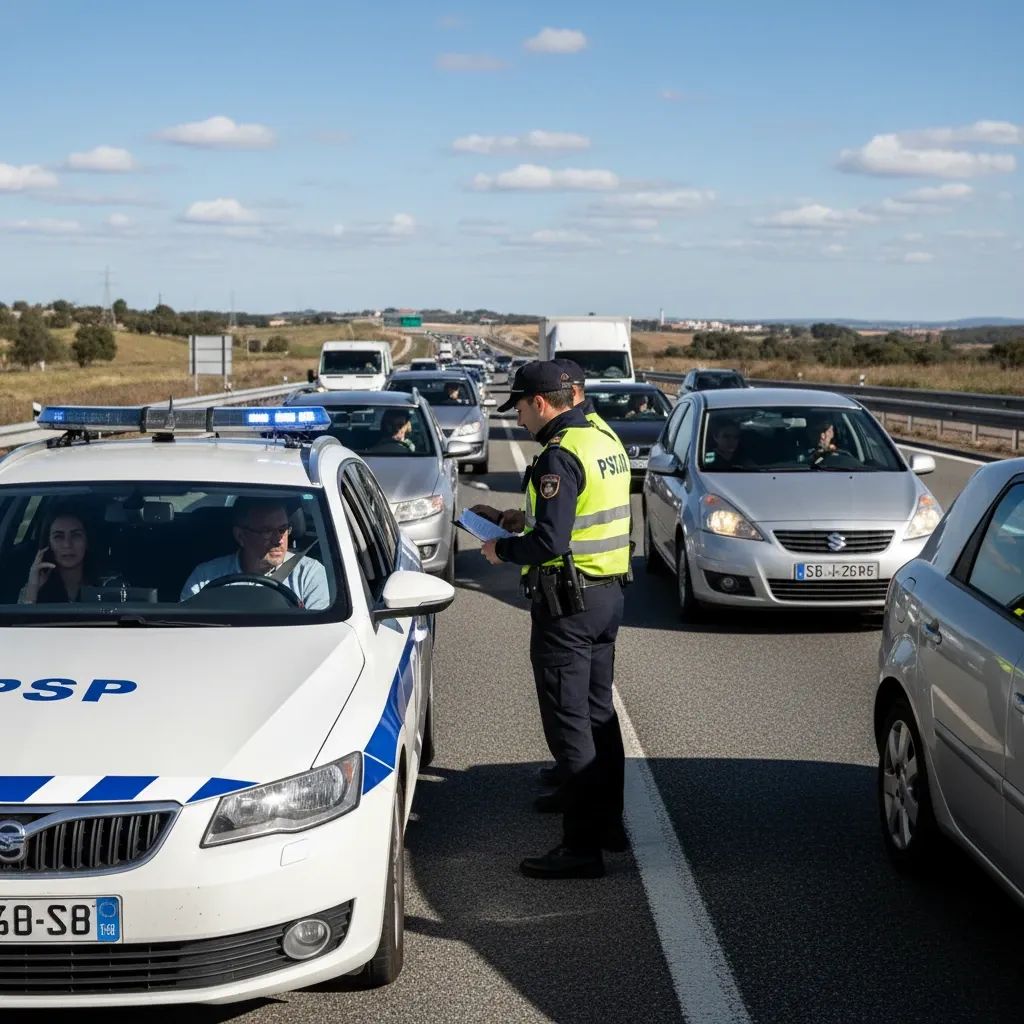
Portugal's traffic authorities caught 1,172 motorists illegally handling mobile phones during a single week of targeted enforcement in February-March 2026, a figure that more than doubles the infractions recorded in the same period in 2025 and underscores the nation's ongoing struggle with distracted driving.
Why This Matters
• Triple threat: The Portugal National Police (PSP) and Republican National Guard (GNR) inspected over 609,000 vehicles through roadside checks, flagging nearly 18,000 violations—but phone misuse jumped 147% compared to February 24-March 2, 2025.
• Fine exposure: Each offense carries €250–€1,250 in penalties, 3-point license deductions, and driving bans up to 12 months.
• Fatal pattern: Six people died during the nine-day sweep, with total accidents up 12% compared to the same period in 2025, despite fewer critical injuries.
The Enforcement Blitz: Numbers That Tell the Story
Running from February 24 to March 2, 2026, the "Connect to Life – Not Your Phone" campaign concentrated resources in the districts of Braga, Santarém, and Aveiro, extending its reach into the autonomous regions of the Azores and Madeira. Authorities deployed both mobile patrols and fixed-speed cameras, ultimately screening 3.5 million vehicles through automated radar systems operated by the Portugal Road Safety Authority (ANSR).
Of the 609,089 roadside checks, the GNR accounted for 553,597 inspections and logged 981 phone-handling violations. The PSP examined 55,492 vehicles—48,074 on the mainland and 7,418 in the island territories—finding 191 infractions: 180 on the Continent and 11 in the Azores and Madeira. Combined, the two forces detected nearly 18,890 road violations across all categories, with phone misuse comprising 6.2% of the total.
Automated speed enforcement flagged 7,814 speeding violations, a reminder that excessive velocity—blamed for roughly one-third of Portugal's road deaths—remains a significant enforcement focus. Yet the phone data signals a worrying behavioral trend: in the February 24-March 2, 2025 equivalent period, police caught only 474 distracted drivers, meaning infractions have more than doubled in 12 months.
What This Means for Residents
If you drive regularly in Portugal, the odds of being stopped during a similar operation are now measurably higher. Roadside enforcement alone screened roughly 68,000 vehicles per day, with an additional 389,000 vehicles screened daily through automated radar systems. The combined screening represents the intensity of Portugal's enforcement apparatus. The message from authorities is unambiguous: phone enforcement is scaling fast, and the legal risk is immediate.
Financial exposure escalates quickly. A single offense costs a minimum of €250—substantial enough to impact household budgets—and can surge to €1,250 if aggravating circumstances apply. Add the three-point license penalty, and two infractions in 36 months can push a motorist toward suspension. First-time offenders face a one- to 12-month driving ban, a sanction that disrupts commutes, delivery work, and family logistics alike.
For expatriates and digital nomads, the stakes are higher still. Portugal's bilateral enforcement agreements with EU member states mean a violation registered here can follow you across borders, complicating insurance renewal and triggering home-country penalties under the bloc's cross-border traffic directive.
The Science Behind the Crackdown
Campaign organizers emphasized two data points to the 601 drivers and passengers counseled during roadside awareness sessions. First, phone use significantly increases collision risk—studies show that glancing at a screen for three seconds at 50 km/h equates to driving 42 meters without full attention to the road. Second, reaction-time research indicates that phone distraction impairs driver response, delaying emergency maneuvers compared to undistracted driving.
The PSP and GNR note that phone-based activities inflate crash probability and divert critical focus from the roadway, impairing lane discipline, signal interpretation, and safe-distance maintenance. These enforcement concerns align with patterns across Europe, where authorities increasingly recognize phone use as a primary safety threat requiring targeted intervention.
Broader Sinistralidade Trends
The campaign week recorded 2,882 accidents, yielding six deaths, 38 serious injuries, and 815 minor injuries. All fatalities were male, aged 25 to 93, a demographic pattern consistent with prior road-safety research. Compared to the February 24-March 2, 2025 baseline, total crashes climbed by 316 incidents (a 12.3% increase), though critical injuries dropped by 11 and deaths fell by one. The rise in minor injuries—up 106—suggests that collision frequency is climbing even as severity declines, possibly reflecting improved vehicle safety technology and faster emergency response.
Alcohol enforcement caught 665 impaired drivers, a category that continues to draw stricter penalties than phone use despite its lower incidence. Speed violations led all offenses numerically, with the ANSR's National Speed Control System clocking the lion's share of the 7,814 infractions. Yet the growth rate in phone violations—147% year-over-year—marks it as the fastest-rising category, prompting calls in the national parliament for the introduction of mandatory hands-free technology in all new vehicles and harsher penalties for repeat offenders.
Upcoming Enforcement Operations and Regional Disparities
Mainland Portugal accounted for 99% of phone infractions, with the Azores and Madeira contributing just 1%, reflecting both the islands' smaller vehicle populations and their lower traffic density. The concentration of checks in Braga, Santarém, and Aveiro—three districts that straddle the A1 motorway corridor linking Lisbon and Porto—targeted Portugal's busiest commuter and freight routes, where distraction-related accidents impose the steepest economic and human costs.
Important for residents: The ANSR has scheduled 11 additional themed enforcement sweeps through December 2026 under the 2026 National Enforcement Plan (PNF), covering seatbelt compliance, nighttime visibility, phone use, and vulnerable road users. This means similar high-intensity operations will recur throughout the year, not as one-off events. The ANSR conducted five simultaneous awareness events during this campaign in Celeirós, Santarém, Torres Novas, and Albergaria-a-Velha, supplemented by parallel sessions in the autonomous regions.
Learning from European Neighbors
Portugal's challenge mirrors continent-wide patterns. The European Commission is advancing regulatory frameworks for newly licensed drivers, during which phone use and speeding would trigger accelerated sanctions. Other European nations have explored technology-based enforcement solutions, though outcomes vary by implementation.
The EU's forthcoming cross-border enforcement regulation will let member states pursue foreign-registered drivers for phone infractions, closing a loophole that has allowed tourists and cross-border commuters to avoid consequences. For Portugal, where seasonal tourism swells traffic volumes by 30% in coastal districts, that regulatory shift could significantly expand the reach of enforcement.
Practical Takeaways
Drivers should note three operational realities. First, Portugal's traffic police now conduct regular high-intensity operations, making detection during enforcement campaigns a real probability. Second, the €250 minimum fine represents a substantial hit to household budgets, with no payment-plan option for foreign residents lacking Portuguese bank accounts. Third, the three-point penalty accumulates across all violation types, meaning a speeding ticket plus a phone citation in the same year moves you halfway to suspension threshold.
For those who rely on navigation apps, the law permits hands-free mounts and voice commands, but any manual interaction—tapping, swiping, or holding—triggers liability. The safest protocol remains pulling off the roadway completely before handling the device, a practice authorities emphasize in every campaign cycle.
As Portugal's roads grow busier and enforcement technology becomes more sophisticated, the cost of distracted driving—financial, legal, and human—continues to climb. The latest sweep confirms that phone misuse is now a primary enforcement priority, one that will shape mobility habits and household budgets for every driver in the country. With 11 additional themed operations planned through year-end, residents should expect continued scrutiny and prepare accordingly.