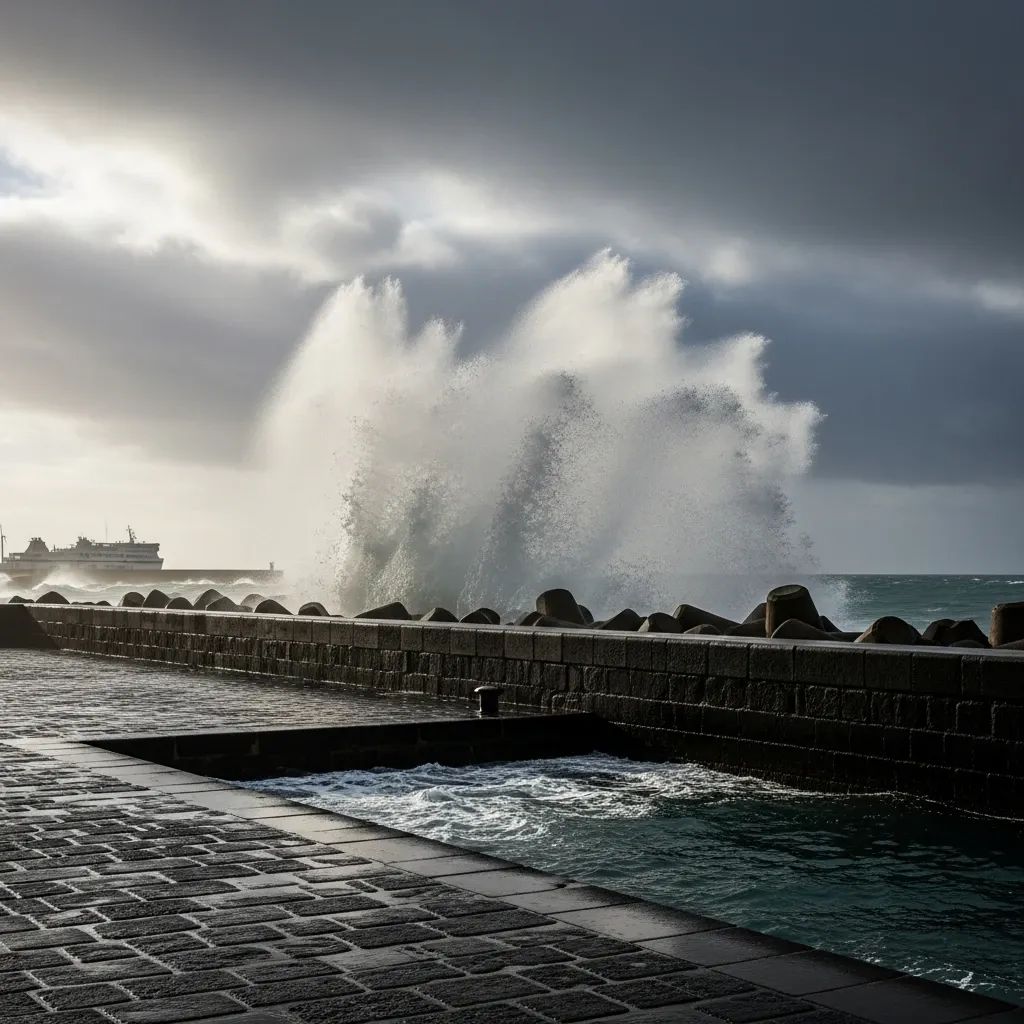
Funchal’s harbour authorities have again extended their severe-sea alert, warning residents and mariners that the Atlantic swells battering Madeira will not relent until dawn on Thursday. Expect 6m breakers along the north coast, gusts nearing 70 km/h at higher elevations and a temporary slowdown for small-craft traffic.
Quick glance before you head out
• Warning window now lasts until 06:00 Thursday, 29 January.
• Highest waves: 4.5–6.5m on the north side; up to 5m west of the south coast.
• Wind: westerly, peaking at 61 km/h, easing late Wednesday.
• Recreational fishing and cliff-top walks strongly discouraged.
• Funchal ferry and cruise operators monitoring conditions hour-by-hour.
Why the advisory packs a punch for Madeira — and for mainland travellers
Madeira lives by the sea: ferries ferrying goods from mainland Portugal, cruise liners depositing winter tourists and coastal roads hugging cliffs. When the Capitania do Porto do Funchal hoists a prolonged yellow flag, it ripples through the archipelago’s daily routine. Holidaymakers from Lisbon and Porto could find their island itineraries shuffled, while local farmers awaiting supplies watch cargo manifests nervously. The storm’s driver, Depression Joseph, has already funneled colder-than-average air across the Atlantic, and its rear flank is now steering long-period northwest swells directly toward the volcanic shoreline. Seasoned islanders recall that similar conditions in 2021 peeled away sea walls in Paul do Mar; authorities hope reinforced barriers installed since then will cope better this time.
What the water will actually look like — coast by coast
On the exposed north, the Instituto Português do Mar e da Atmosfera projects powerful 4.5–6.5m waves, subsiding marginally after midnight. South-facing beaches gain partial shelter from Porto Santo, yet the western half of that shoreline will still face western rollers nudging 5m before easing to 3m. Underneath, a north-westerly swell with an 11-second period can dump unexpectedly steep sets, catching angling enthusiasts off guard. Visibility stays “good to moderate,” but the sea surface will be studded with whitecaps, drifting debris and floating logs — a peril for open-hulled fishing vessels.
Transport, tourism and fishing: who is doing what
The Lobo Marinho ferry linking Funchal to Porto Santo has not cancelled crossings yet, but the operator has asked passengers to arrive earlier because boarding ramps may be raised or lowered between swells. Two cruise ships, the Azura and the Mein Schiff 6, opted for an overnight offshore hold rather than berthing beside Funchal’s breakwater. Freight forwarders report minor delays unloading refrigerated containers, though essential pharmaceuticals and perishables were prioritised. Meanwhile, mackerel crews from Câmara de Lobos have stayed ashore since Tuesday night; the regional fisheries office estimates that lost landings could total €250,000 if the lull stretches beyond Thursday.
Staying safe: the Capitania’s four-step checklist
Double-lash mooring lines and add chafing gear to prevent snaps.
Post round-the-clock deck watch on anchored boats; drifting gear claims more hulls than storms themselves.
Keep a minimum 20-m buffer from sea walls, cliffs and natural pools — rogue waves already drenched several selfie-seekers near Ponta do Sol.
Suspend rock-ledge fishing until the advisory is lifted; even experienced pesqueiros underestimate rebound waves in west-swell scenarios.
When will calm return?
Meteorologists expect the worst seas to taper by early Thursday, dropping to 3–4m on the north shore and below 2m on the south. A weak high-pressure ridge is forecast to nudge winds into the 20–30 km/h range, allowing normal port operations to resume. Nonetheless, the Capitania cautions that winter fronts can redevelop swiftly over the mid-Atlantic; residents are urged to watch real-time bulletins on the IPMA website and local VHF channels. For now, the safest plan — whether you’re a yacht skipper from Cascais or a coastal hiker eyeing the Levada do Rei — is to give the ocean the wide, respectful berth it demands this week.