The Portugal Infrastructure Authority (Infraestruturas de Portugal) will not begin repairs on a collapsed road segment in the Lourinhã municipality until the second half of 2026 at the earliest—a delay that has already created significant economic disruption and left 12,000 daily commuters scrambling for alternatives since late January.
Why This Matters
• Substantial economic losses recorded, with disruptions tied directly to the EN8-2 closure and coastal damage.
• 12,000 vehicles per day rerouted through narrow rural roads, adding significant travel time.
• Summer tourism season at risk: The main artery linking Lourinhã to Torres Vedras remains impassable as peak season approaches.
• Emergency vehicle access compromised, raising safety concerns across the municipality.
The Collapse and Its Aftermath
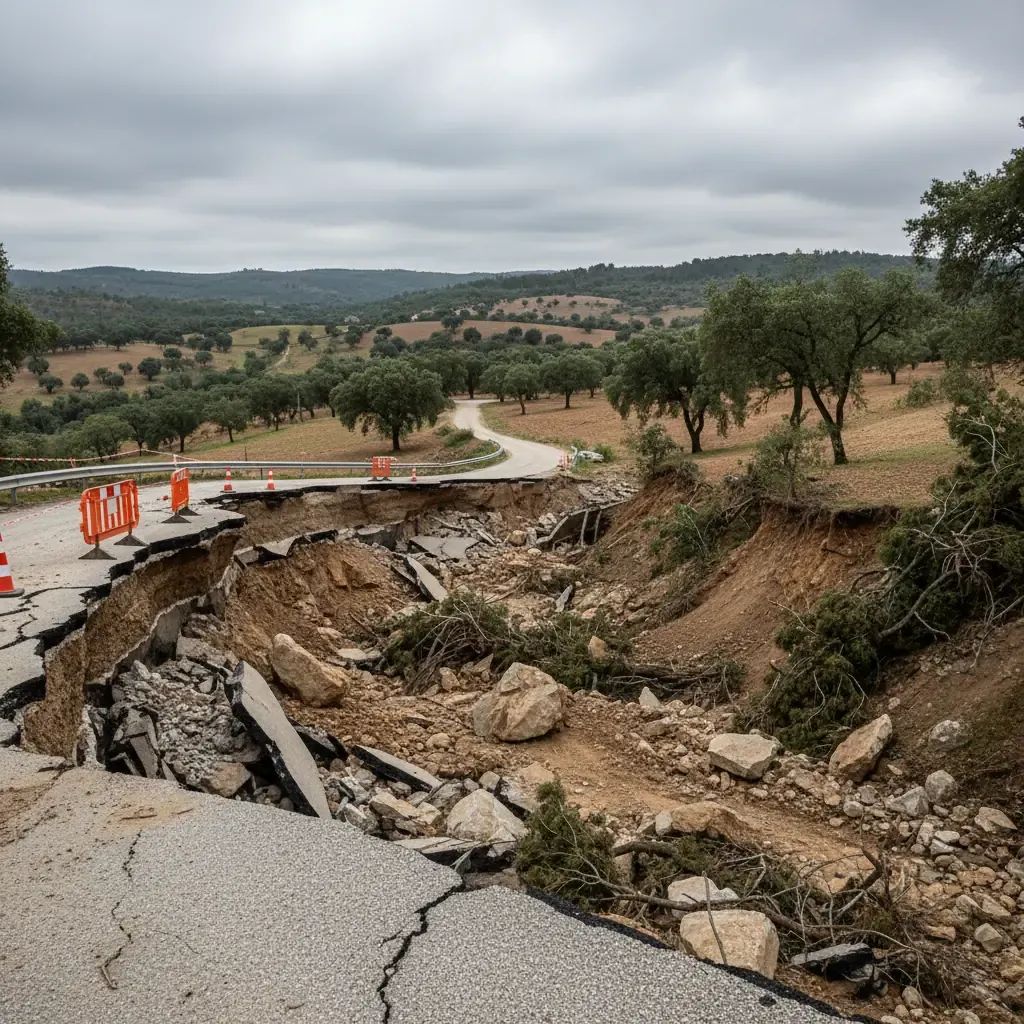
The EN8-2 national road connecting Lourinhã to Torres Vedras suffered catastrophic failure in late January and early February 2026 after relentless storms triggered severe landslides at kilometer 16.450 near Casal Lourim. The roadbed collapsed entirely, forcing Infraestruturas de Portugal to close the strategic corridor indefinitely.
What followed has been a textbook case of infrastructure bottleneck. The route served as the primary gateway for residents commuting to work, students traveling to schools in Torres Vedras, and tourists visiting the Lourinhã dinosaur sites and coastal attractions. Its sudden disappearance has upended daily routines, strained local businesses, and exposed the municipality's over-reliance on a single transport artery.
Orlando Carvalho, the Social Democratic (PSD) mayor who took office in late 2025 after the municipality flipped from Socialist control for the first time, has been blunt about the timeline: "It is completely impossible to accelerate the work," he told reporters. The technical complexity demands geotechnical surveys, detailed engineering plans, and a formal procurement process—none of which can be rushed without risking structural failure down the line.
Political Pressure and Municipal Response
On Wednesday, the Lourinhã Municipal Council unanimously approved a motion—drafted by Socialist Party councilors—urging the Portugal Government to treat the EN8-2 repair as a national priority. The resolution calls on Infraestruturas de Portugal to expedite technical and administrative procedures and to explore provisional solutions, including upgrading alternative routes with state support.
The political optics are notable: despite the PSD-Socialist divide, both camps agree the situation has reached crisis levels. The Socialists framed the motion as "urgent and non-negotiable," emphasizing the impact on economic activity, emergency services, and public safety. Mayor Carvalho, meanwhile, has pointed to decades of underinvestment, arguing that "for 30 years, the municipality did not secure alternative solutions. Today we are excessively dependent on a single structural route."
That dependence is now painfully evident. The Infraestruturas de Portugal has confirmed that the reconstruction project is "practically complete" and that a fast-track tender will be launched, with construction slated for the second half of 2026. But even optimistic projections place full reopening well into autumn—long after the summer tourism wave.
€200,000 Stopgap: Makeshift Routes for Light Vehicles
To ease the pressure, the Lourinhã Municipal Council has committed €200,000 to upgrade secondary roads and create a provisional bypass. The centerpiece is a 1.7 km reconstruction of Rua da Bica, linking Lourinhã village to the hamlet of Capelas. The rural lane will be widened to 5.5 meters, paved, and opened to light vehicles only—offering a workaround for passenger cars but doing little for trucks, agricultural machinery, or tour coaches.
Additional improvements are planned for:
• Rua D. Sancho I (Lourinhã to Matas)
• Avenida Primeiro de Janeiro (Marteleira to Perdigão)
• Estrada Nossa Senhora da Guia (Atalaia)
These routes were never designed for high-capacity traffic, and residents report long queues, damaged verges, and safety concerns as drivers navigate narrow bends at speed.
What This Means for Residents
For anyone living or working in Lourinhã, the closure translates to immediate, tangible disruption:
• Commute times to Torres Vedras—the nearest regional hub—have more than doubled for many, with detours adding 20-30 minutes each way.
• Fuel costs are climbing as drivers loop through inefficient rural corridors.
• Business deliveries face delays, and some logistics firms have reportedly begun charging surcharges for the added mileage.
• Tourism operators are bracing for cancellations or no-shows if visitors perceive access as too difficult. The Lourinhã region markets itself around paleontology (the Dino Parque and fossil heritage) and Atlantic coastline—both require reliable road links.
• Emergency response times have lengthened, a concern the municipal motion flagged explicitly.
The Portugal Infrastructure Authority has not disclosed a budget for the repair, stating that cost estimates will be finalized only after the tender process. Industry observers suggest the reconstruction could easily exceed €5M, given the need for slope stabilization, drainage upgrades, and reinforced retaining walls.
Structural Lessons and the A8 Question
The EN8-2 collapse has reignited debate over long-stalled infrastructure projects. Chief among them is a proposed direct link from Lourinhã to the A8 motorway, which would reduce dependence on the aging national road network. Planners have also floated the idea of eastern and western bypasses to distribute traffic more evenly.
In December 2025, the Portugal Government authorized preliminary studies for the IC11 – Lourinhã Bypass, assigning Infraestruturas de Portugal to lead feasibility assessments. No construction timeline has been announced, and local officials warn that any physical work is years away.
Meanwhile, the Lourinhã Municipal Budget for 2026, approved at €50.3M, includes capital allocations for emergency coastal protection and civil defense—categories swollen by the recent storm damage. That leaves little fiscal headroom for the municipality to self-finance major road projects, underscoring its dependence on national intervention.
The Clock Is Ticking
With work not starting until July 2026 at the earliest, residents and business owners are watching the calendar nervously. Peak tourism runs from June through September, and every week of restricted access represents lost revenue for hotels, restaurants, and activity providers.
The makeshift alternatives being rushed into service may suffice for local errands, but they will not restore the 12,000-vehicle-per-day throughput that characterized the EN8-2 before its collapse. Until heavy machinery arrives on-site and the roadbed is rebuilt, the Lourinhã municipality will continue operating under constrained mobility—a reality that the political motion, however unanimous, cannot by itself change.