

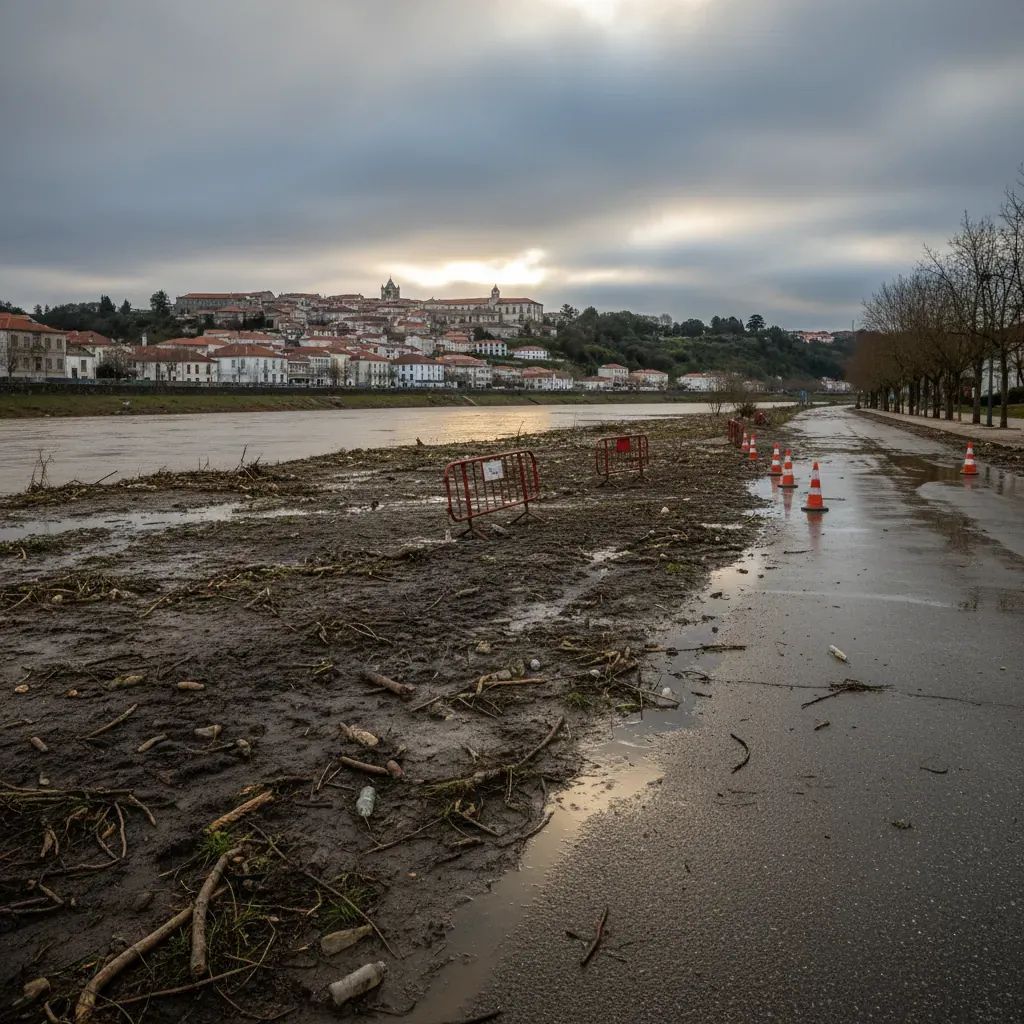
The Portugal National Authority for Civil Protection (ANEPC) has stood down its highest flood alert for Coimbra, a decision that stabilises travel and insurance costs but leaves thousands still facing cleanup bills.
Why This Matters
• State of calamity lifted: emergency rules — including simplified public-works procurement — expire today.
• Road & rail detours: a 7 km stretch of the A1 near Coimbra stays shut for at least 3 more weeks; Intercidades trains run on shortened timetables.
• €2.5 B recovery fund open: households can file damage claims from Monday via balcãounico.gov.pt.
• Higher insurance premiums likely: underwriters warn of double-digit price hikes in river-adjacent postcodes.
Storm Season in Numbers
Four back-to-back Atlantic depressions — Kristin, Leonardo, Marta and Nils — dumped the equivalent of two months of rain on mainland Portugal between 1 and 15 February. ANEPC logged 19,066 weather-related incidents; 13 fatalities were confirmed. The busiest day, 11 February, required 4,630 responders and 2,089 vehicles.
Coimbra: From Red Alert to Fragile Calm
The Mondego peaked twice above 4 m at the Santa Clara gauge, flirting with 1976 record levels. Controlled releases from the Aguieira dam — at one point 960 m³/s — prevented a levee breach but flooded low-lying parishes such as Ribeira de Frades and São Martinho do Bispo. Local authorities evacuated roughly 3,600 residents; shelters in Montemor-o-Velho filled within hours.
Today the river sits at 2.45 m. Forecasts show only light showers and a gradual temperature rise to 22 °C next week, yet the Portugal Environment Agency (APA) keeps engineers on site, citing "persistent groundwater saturation" that could still undermine embankments.
Damage to Infrastructure
• A1 motorway: a collapsed embankment at km 191 severed the Lisbon–Porto corridor; Infraestruturas de Portugal says temporary steel decking will reopen one lane northbound by early March.
• Historic wall collapse: a section of Coimbra’s medieval ramparts caved in, forcing closure of the municipal market and rerouting of bus line 38.
• Power outages: peak of 33,000 households without electricity; 1,900 remain on generator supply in rural Coimbra and Oeste.
• Agriculture: winter vegetables and irrigation equipment in the Baixo Mondego valley suffered losses estimated at €300 M.
Government Cash on the Table
The Portugal Cabinet has earmarked €1 B in treasury credit lines for councils plus a €2.5 B national recovery package covering:
Housing grants up to €35,000 for structural repairs (apply through IHRU).
Direct farm aid of €2,200/ha for flooded fields; livestock support set at €150 per head.
Emergency dredging and reinforcement of Mondego levees, budgeted at €120 M.
Finance Ministry officials say Brussels funds are "unlikely" because 2026 storms struck after the end of the EU Solidarity Fund window; Lisbon will therefore issue five-year green bonds to cover the gap.
What This Means for Residents
• Commuters: expect an extra 25–40 minutes on Lisbon–Porto journeys; Rede Expressos added six daily coaches.
• Homeowners: photograph all damage before starting repairs; receipts dated after the state-of-calamity period still qualify for reimbursement.
• Renters: decree-law 19/2026 allows tenants in red-tagged buildings to suspend leases without penalty.
• Small businesses: IVA payment deferral for February and March is automatic in the 68 municipalities that were under calamity status.
• Future premiums: insurers hint at 15–20 % rises for properties inside the 100-year floodplain; get multiple quotes and consider raising deductibles to keep costs in check.
Residents’ Voices
Eurico Sousa, a farmer in Ereira, lost every winter cabbage. "The water stayed four days, the pumps never arrived," he recounts while pointing to a rusted irrigation motor. In downtown Coimbra, café owner Filipa Mendes credits the €900 flood barrier kit she installed in 2023 for saving her espresso machine: "Worth every centavo; insurance excess alone is €1,500." Their experiences echo the mixed success of municipal preparedness — some measures worked, others lagged.
Looking Ahead
Meteorologists at Portugal Weather Institute (IPMA) predict only scattered drizzle through month-end; however, hydrologists warn that 90 % storage at Aguieira allows little buffer against another Atlantic front.
Homeowners along the Mondego should keep emergency bags ready, verify that mobile alerts are active, and sign up for APA’s new SMS water-level warnings (text MONDEGO to 3838).
Local councils plan a public debrief in March. Until then, the watchword is vigilance: the water has receded, but the bills — and the engineering challenges — are just beginning.


