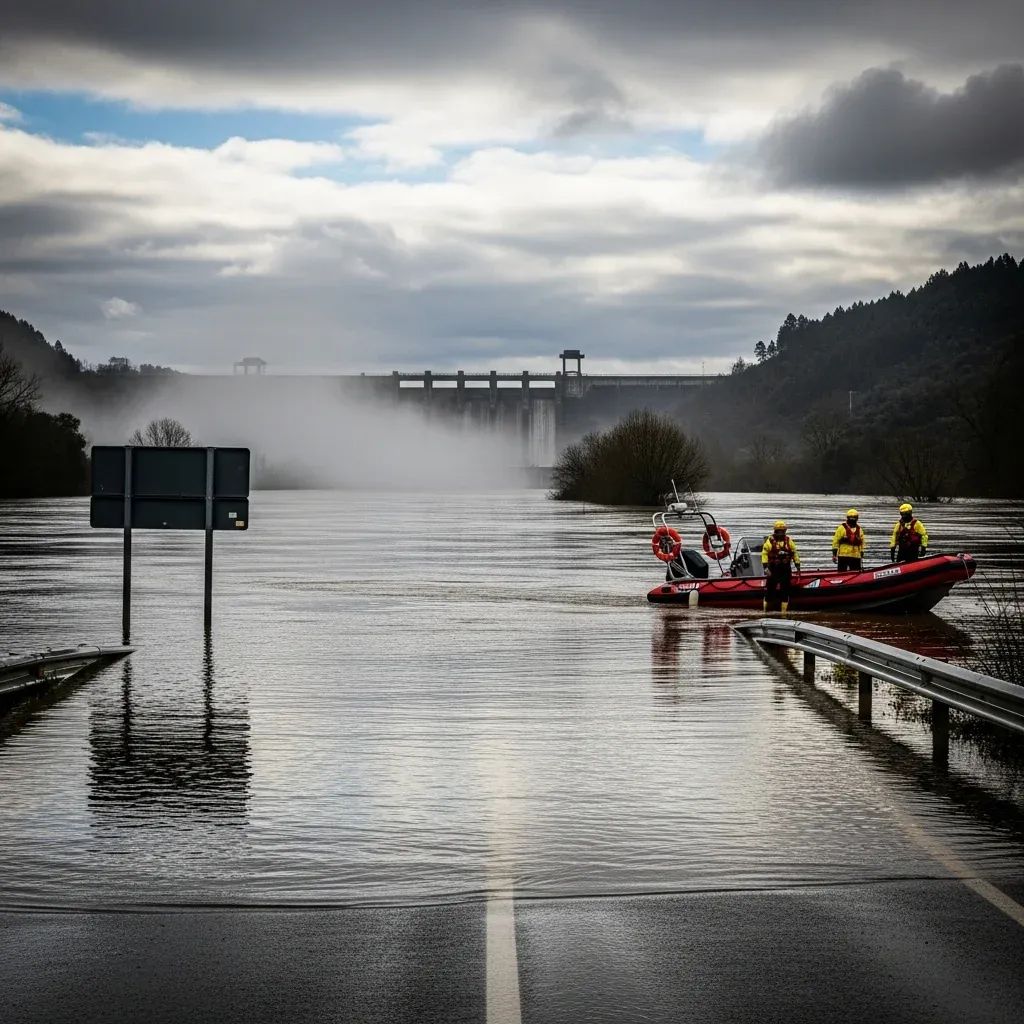
The Almada Municipal Council has warned that unstable ground continues to shift in landslide-prone areas across the Setúbal district, posing ongoing danger to residents even as skies clear. The municipality confirmed that approximately 500 people remain displaced from their homes in Porto Brandão, Costa da Caparica, and Azinhaga dos Formozinhos, with some facing the harsh reality that they may never return to their properties.
Why This Matters
• Ongoing Risk: Despite the end of rainfall, soil movement persists—Universidade Nova de Lisboa researchers have installed ground markers confirming continued shifts in affected zones.
• Financial Exposure: The initial phase of stabilization work in Porto Brandão alone is estimated at €2.6M, funded by local government with no firm completion date.
• No Quick Return: Technical teams from the National Laboratory for Civil Engineering (LNEC) have advised against immediate reoccupation until structural inspections guarantee stability of cliffs and buildings.
• Broader Context: Depressions Kristin, Leonardo, and Marta killed 18 people across Portugal and caused extensive damage in the Centro, Lisbon Metropolitan Area, and Alentejo regions.
Soil Still Moving Despite Weather Improvement
Almada Mayor Inês de Medeiros issued a public warning urging residents to continue following civil protection directives, emphasizing that the return of sunshine does not equate to safety. "The sun is out, but the danger has not disappeared," she stated in a social media message. Her statement underscores a critical gap between public perception and geological reality: saturated soils take weeks—sometimes months—to stabilize, and the arriba fóssil (fossil cliff) formations along the coast remain under immense structural pressure.
A specialized team from the Faculty of Science and Technology at Universidade Nova de Lisboa has been monitoring the affected slopes since 2023, a project originally scheduled to run for two years. Researchers have placed precision markers across the Costa da Caparica and Porto Brandão cliff faces to track millimeter-level ground displacement. This data will inform future engineering interventions and help authorities determine when—or if—residents can safely return.
Reality Check for Displaced Families
Of the 500 evacuees, 225 have been housed in temporary accommodations paid for by the municipality, including placements at the Inatel Foundation camping park (a Portuguese social tourism facility). Others have sought refuge with relatives or friends. The municipality has opened a dedicated support office to collect data on each household's circumstances and develop individualized reconstruction plans.
Mayor de Medeiros acknowledged the emotional toll on families, particularly those living in zones now deemed uninhabitable. "For many, I know the pain of leaving a home built over a lifetime, leaving behind so many memories," she wrote. "We stand with you in solidarity so that this moment passes as quickly as possible and you can heal and find hope again in this wonderful territory."
The three most affected neighborhoods—Porto Brandão, Azinhaga dos Formozinhos, and Costa da Caparica—have seen repeated landslides since the storms began in late January. In mid-February, a fresh collapse partially buried three homes in São João da Caparica and forced the evacuation of 20 additional residents from adjacent buildings. Civil protection officials confirmed this was the third major mass movement event in the area, and more are expected.
What This Means for Residents
Access and Commerce: Road clearance has begun on Rua 1.º de Maio in Porto Brandão, a key artery serving local restaurants, shops, and the ferry terminal. Reopening this route is critical for the economic survival of small businesses and for enabling the return of families evacuated as a precaution rather than due to direct structural damage.
Legal and Financial Pathways: Affected households may qualify for financial support programs announced by authorities. Applications require inspections by Regional Coordination and Development Commissions (CCDR) and municipal authorities. Specific details on assistance amounts, housing coverage, and eligibility criteria are available through the Almada municipal support office.
Property and Tenancy: Some residents face permanent displacement. The Almada Municipal Master Plan (PDM) mandates the removal of structures in high-risk cliff zones. Where removal is not feasible, the plan requires geotechnical studies and cost-benefit analyses before allowing reoccupation. Urban planning guidelines emphasize maintaining adequate safety distances between cliff edges and habitation.
Engineering Challenges and Long-Term Solutions
The LNEC report accessed by local media recommends against immediate reoccupation without comprehensive structural and geological assessments. Experts warn that similar incidents are likely to recur after future episodes of intense rainfall, particularly given the sedimentary composition of the arriba fóssil, which consists of sandstone and clay layers with embedded fossils from ancient river-marine environments.
Proposed long-term interventions include:
• Deep and surface drainage systems to reduce water infiltration and soil saturation.
• Rock block containment structures to arrest further fragmentation of the cliff face.
• Retaining walls at the base of slopes to mitigate damage from future collapses.
• Continuous monitoring programs using sensors and satellite data to provide early warning of ground movement.
Mayor de Medeiros has called for a "national project" to protect the Costa da Caparica fossil cliff, citing its status as a protected landscape of significant geological and geomorphological value. She argues that the scale and recurrence of landslides exceed municipal capacity and require coordinated national support and resources.
Broader Storm Impact Across Portugal
The depressions that battered the country left a trail of destruction. Beyond the 18 fatalities, hundreds were injured and thousands displaced. Infrastructure damage includes:
• Total or partial destruction of homes, businesses, and public facilities.
• Widespread road closures, school shutdowns, and transport service interruptions.
• Power outages, water supply failures, and communication blackouts.
• Flooding and river overflows in low-lying areas.
The Centro, Lisbon Metropolitan Area, and Alentejo regions bore the brunt of the impact. The national government has announced recovery and support measures for affected areas.
Immediate Next Steps
For residents of affected zones in Almada, the message from authorities is clear: do not attempt to return without official clearance, even if your property appears undamaged. The Civil Protection vereadora (councillor) Francisca Parreira stated bluntly that "there are no conditions of stability" for safe reoccupation in several sectors.
Families seeking assistance should contact the Almada municipal support office or their regional CCDR branch. The Portuguese Red Cross and Médicos do Mundo are also active in the area, providing humanitarian aid, temporary shelter, and psychological support.
As monitoring continues and engineering solutions are debated, the approximately 500 displaced residents face an uncertain wait—one that for some may end not with a return home, but with resettlement in safer ground.