

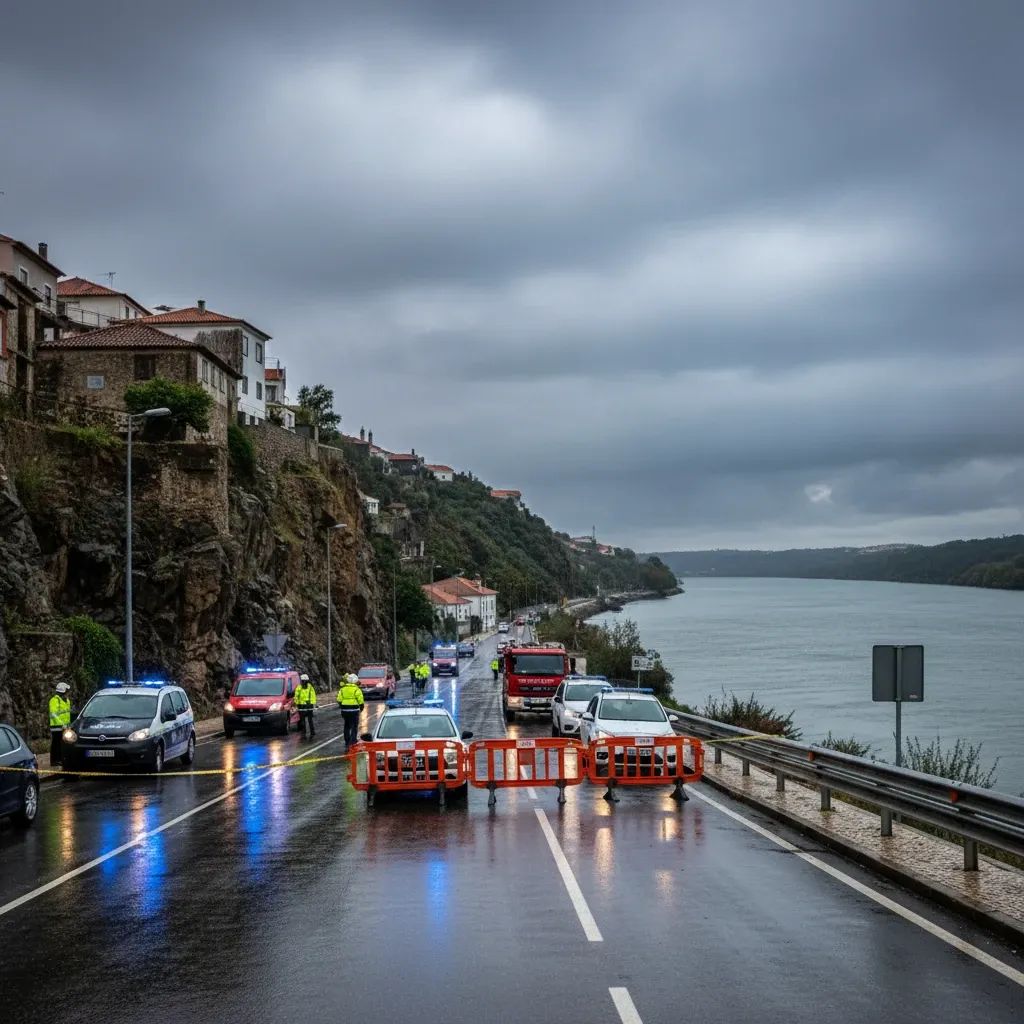
The Portugal Civil Protection Authority has ordered a full-scale evacuation of Porto Brandão, a riverside enclave in Almada, after geologists warned that a widening fissure on the cliffside could sever the only road in or out within hours.
Why This Matters
• Hundreds relocated: Around 500 residents are leaving their homes in phases that began before dawn.
• Transport reshuffled: Transtejo ferries now run only Trafaria–Belém; the Porto Brandão pier is shut until further notice.
• Financial help available: Emergency grants under the €2.5 B calamity fund cover hotel bills, rent and basic repairs.
• Property values at stake: Real-estate agents caution that homes near unstable arribas could face higher insurance premiums.
How the Hillside Became a Hazard
Weeks of relentless Atlantic squalls—Kristin, Leonardo and Marta—have drenched the south bank of the Tagus. The normally firm Miocene sandstone above Porto Brandão is now a sponge of saturated clay, according to monitoring by the Faculdade de Ciências e Tecnologia (FCT-NOVA). Drones flown late Tuesday spotted a new 30-metre crack running parallel to the access road. Engineers from the Laboratory for Civil Engineering (LNEC) estimate that even moderate rain could trigger a progressive slide capable of burying the highway and disrupting ferry docking points.
Similar failures have peppered the Costa da Caparica cliff line, a zone already classified as high risk in a 2023 geological survey. The municipality’s worry list now stretches from São João da Caparica to Cacilhas, with Porto Brandão emerging as the most acute case after this month’s rain pushed ground-water levels to a 20-year high.
The Overnight Evacuation Effort
Shortly after midnight, patrol cars from the Almada Municipal Police began knocking on doors. Social-service teams logged every resident, tagging houses so firefighters know they are clear. Transtejo diverted two catamarans to stand by as floating taxis, while a convoy of school buses ferried families to the Caparica Sun Center and Inatel hostel. By sunrise, officials counted roughly 160 people already housed in municipal facilities; most others chose to stay with relatives across the river. The operation has remained orderly, helped by pre-packed go-bags distributed last weekend when the first cracks appeared.
Government Support & Funding Path
The Portugal Cabinet last week prolonged the state of calamity to 68 councils, freeing up an initial €500 M tranche of the larger €2.5 B relief envelope. For private citizens, the headline items are:
Up-front rent vouchers covering six months (max €200 per month) under Almada’s “Casa em Almada” scheme.
100 % reimbursement of structural surveys needed to certify a dwelling’s safety.
Interest-free micro-loans via the Banco Português de Fomento for small businesses that suffer losses linked to closure or relocation.
Applications open online this Friday on the Lisboa e Vale do Tejo CCDR portal. Residents will need a photo ID, proof of address and, where relevant, a copy of their property’s energy certificate.
What This Means for Residents
• Commuting: Expect longer journeys—drivers must detour via IC20 or rely on Trafaria–Belém boats.• Utilities: Water and power remain on, but telecom firms warn of potential fibre cuts if the road collapses; keep a charged power bank.• Insurance: Policies tagged “risco geológico” typically require a claim within 8 days of evacuation; call your broker immediately.• Schooling: Children enrolled at EB1/JI Porto Brandão will attend temporary classes in Monte de Caparica from Monday.
Next Steps: Engineering Fix or Permanent Retreat?
Municipal engineers are considering two parallel tracks. The short-term option is a soil-nailing wall and surface drainage trenches to bleed water away from the lip of the cliff—estimated cost €4-6 M and four months of work. The long-term alternative, championed by several FCT-NOVA researchers, is a managed retreat, relocating housing clusters farther inland while converting the unstable slope into a green buffer. Such a plan would unlock EU Resilience Facility funds but could take three to five years.
For now, the watchword is caution. The Portugal Meteorological Institute predicts two more rain fronts this week. If the hillside holds, engineers may begin core drilling on Sunday. If not, the cliff may dictate its own timetable—and Porto Brandão’s map will have to be redrawn.


