

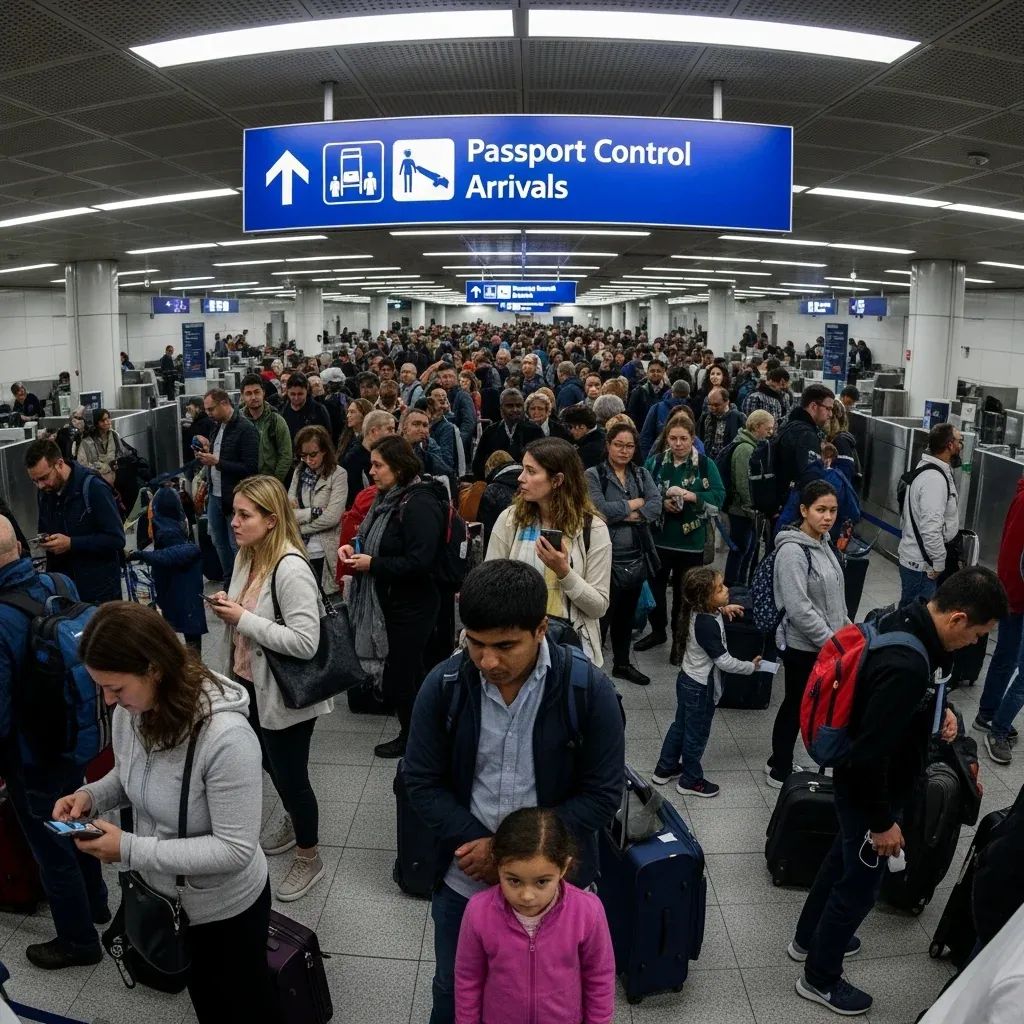
LISBON, April 3, 2026— Portugal's busiest gateway ground to a crawl on the morning of April 3, 2026, as inbound travelers faced a punishing 2-hour slog through border control at Lisbon's Humberto Delgado Airport—a bottleneck that exposed the fragility of Portugal's Easter contingency planning despite a reinforced police presence and new control lanes.
Passengers who arrived at 6:00 a.m. reported being processed by approximately 8:00-8:30 a.m., with those arriving during the 8:30 a.m. peak facing the full two-hour wait, sparking concern that the airport's infrastructure and staffing model may be buckling under seasonal surges. The Portugal Royal Police (PSP) confirmed the peak wait time hit 120 minutes around 8:30 a.m., even though every available border control booth was staffed and a newly activated 10-gate zone was operating at full capacity.
Why This Matters
• Easter travel chaos: Lisbon Airport's border control queues peaked at 2 hours on April 3, 2026, despite maximum police deployment.
• System strain: The EU Entry/Exit System (EES), temporarily suspended during Christmas and New Year 2024-2025, was gradually resumed in early 2026 and is now fully active ahead of planned EU-wide implementation in April 2026.
• Ongoing risk: Wait times dropped to 30 minutes by midday, but the morning surge suggests infrastructure gaps remain unresolved heading into peak summer travel.
Police Deploy Maximum Capacity—Still Not Enough
ANA—Aeroportos de Portugal, the airport operator, acknowledged the crisis, stating that wait times "reached two hours at a peak registered around 8:30 a.m." By late morning, queues had subsided to under 60 minutes, and by early afternoon, the PSP reported processing times of approximately 30 minutes.
Yet the morning chaos unfolded despite a pre-planned Easter contingency protocol. The PSP had deployed 30 additional officers with border guard training at Lisbon and another 15 at Faro Airport, anticipating the seasonal spike. Every manual control booth in the terminal was staffed, and a newly opened border control zone—featuring 10 additional manual posts and e-gates—was fully operational.
PSP spokesperson Sérgio Soares emphasized that the force had been "at maximum capacity throughout the morning" and that the objective was to keep average wait times "as low as possible, without compromising security and border resilience." The implication: even full deployment could not prevent a 2-hour logjam.
The EES Factor: New EU Rules Add Friction
Complicating the picture is the EU Entry/Exit System (EES), a biometric border control protocol for non-EU nationals that requires fingerprints and facial scans upon entry. The system was suspended during Christmas and New Year 2024-2025 after triggering chaotic queues, when travelers faced waits of several hours. The Portugal Ministry of Internal Affairs (MAI) confirmed that the EES "was gradually resumed since the beginning of the year and is now fully active" as of April 2026, ahead of the planned 100% EU-wide implementation in April 2026.
For travelers, the EES adds several seconds per passenger to processing times, a seemingly minor delay that compounds rapidly during peak arrivals. Non-EU passport holders—particularly from Brazil, the United States, and the United Kingdom, who make up a significant share of Lisbon's inbound traffic—are most affected.
Impact on Portugal Residents
Portuguese residents and EU citizens are not subject to EES processing and typically use separate e-gate lanes. However, during peak periods, overall terminal congestion can affect all passengers. Residents meeting arriving non-EU family members should advise them to expect 30-90 minute processing times during morning arrival waves.
What This Means for Travelers and Residents
For inbound passengers: Expect longer waits during peak travel windows, especially early mornings when overnight transatlantic and European flights converge. The PSP's Easter contingency plan has demonstrated that even maximum staffing cannot fully absorb demand surges under the EES framework.
For Portugal-based travel businesses and hospitality operators: The bottleneck risks damaging Portugal's reputation as a seamless, welcoming gateway. Missed connections, delayed ground transport, and frustrated travelers could impact customer satisfaction and rebooking rates.
For policymakers: The morning's events underscore the need for infrastructure investment beyond temporary staff reinforcements. The PSP's deployment of 45 additional officers across Lisbon and Faro represents a reactive, not systemic, solution. Without additional automated gates, expanded terminal space, or pre-clearance agreements, Portugal's airports may face recurring crises during summer, year-end holidays, and major events.
A Recurring Problem
This is not the first time Lisbon's arrivals hall has buckled. Christmas and New Year 2024-2025 saw similar or worse conditions, with multi-hour queues prompting the Portuguese government to suspend the EES temporarily—a move that drew criticism from Brussels and raised questions about Portugal's readiness for EU-wide biometric border controls.
The resumption of the EES in early 2026, combined with rising tourist volumes, has created a perfect storm. Portugal's tourism sector continues to grow, with projections suggesting sustained increases, particularly during lucrative shoulder seasons around Easter and autumn.
The PSP's statement that it aims to balance "the lowest possible wait time" with "security and resilience" reflects the inherent trade-off: faster processing risks security lapses, while rigorous checks slow throughput. The EES, designed to enhance security and track overstays, tilts that balance toward caution.
Infrastructure Gaps Persist
Despite the addition of 10 new control posts and e-gates at Lisbon, the airport's physical layout remains a constraint. The Humberto Delgado Airport, originally designed for far lower passenger volumes, has been operating near capacity for years. Plans for a new Lisbon airport have stalled amid political debate and environmental concerns, leaving the existing facility to absorb growth through incremental fixes.
The e-gates, which should expedite processing for EU and eligible non-EU travelers, are underutilized during peaks because of technical glitches, passenger unfamiliarity, and the need for manual overrides when the EES flags anomalies. The PSP's reliance on manual booths—even with full staffing—reveals the limits of a labor-intensive model.
Looking Ahead: Summer Risk
With the full EU-wide EES rollout now active in April 2026, and Portugal's peak summer tourism season approaching, the risk of repeated bottlenecks is high. The PSP's Easter contingency plan, though well-intentioned, proved insufficient. The MAI has not yet announced plans for additional reinforcements beyond the current temporary deployments.
Travelers flying into Lisbon or Faro during high-season months should brace for waits of 30 to 60 minutes as a baseline, with potential spikes to 90 minutes or more during morning arrival waves. Those with tight connections or onward travel plans should factor in extra buffer time.
For Portugal, the stakes extend beyond convenience. The country's tourism sector is a vital economic driver, and maintaining a perception of accessibility and efficiency is essential. Persistent border control chaos could erode that advantage, steering travelers toward competing Mediterranean destinations with smoother arrivals infrastructure.


