
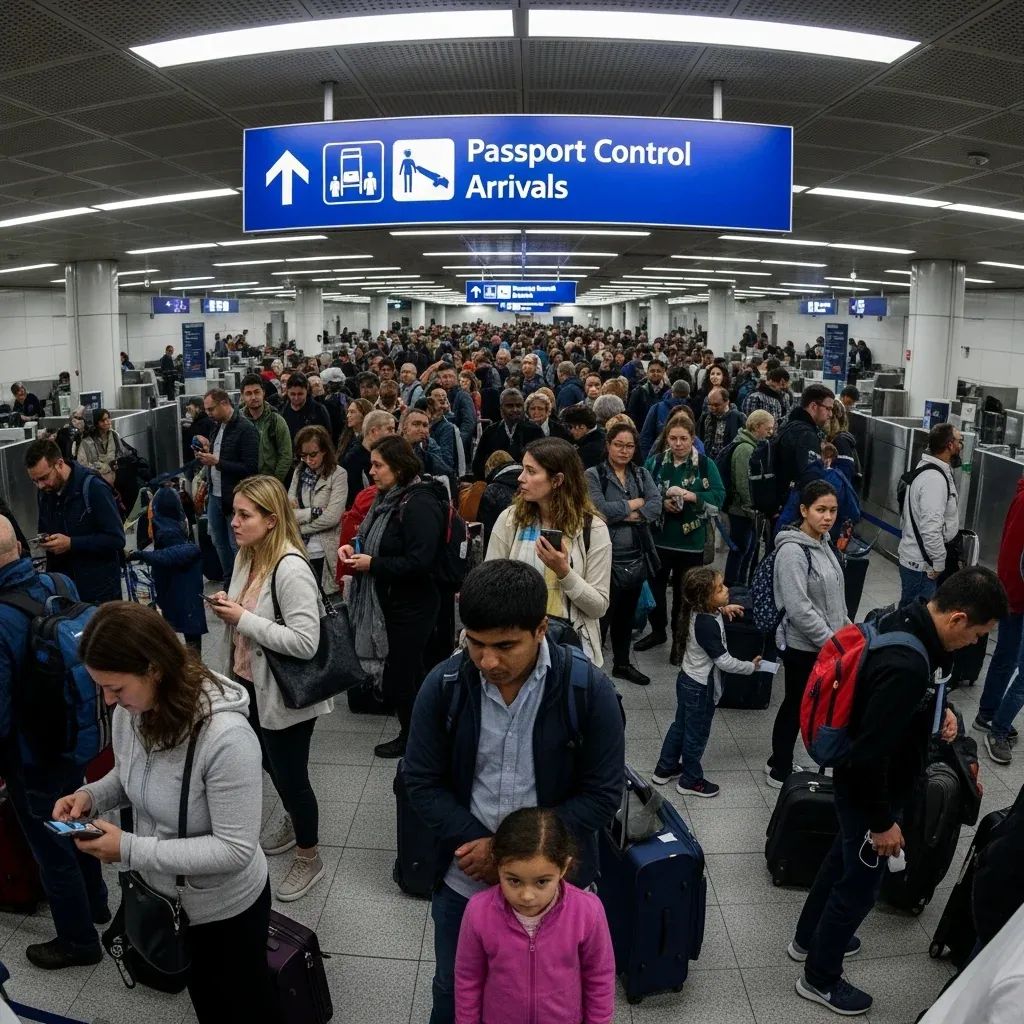
Three-hour queues and frayed tempers have turned the arrivals hall at Lisbon’s Humberto Delgado Airport into an endurance test just as the holiday rush kicks in. A persistent glitch in the new EU Entry/Exit System (EES) means travellers are waiting longer for a passport stamp than for their actual flight, and officials are now weighing whether to switch the system off altogether during Christmas.
Snapshot: why this matters to people in Portugal
• Lengthy delays at border control have spilled over into baggage reclaim and onward rail links.
• Airlines warn of missed connections that could ripple through Porto and Faro flights.
• Tourism bodies fear reputational damage during a peak spending season.
• Parliament is grilling the Interior Minister on accountability and next steps.
• A temporary suspension of the EES has already been pre-cleared by Brussels but comes with security trade-offs.
A technical snag with big consequences
Border police insist they are working at "maximum capacity" yet the digital gates keep stalling. According to airport operator ANA, the bottleneck began when one of the core servers faltered at dawn on 17 December, sending the biometric kiosks into a loop. The new EES, live since 12 October, now requires every non-EU visitor to provide fingerprints, facial scans, travel history, residence data and see it all cross-checked against Europe’s Schengen security networks. When that handshake fails, agents must revert to manual input—adding several minutes per passenger and quickly stacking up hundreds of weary travellers in the corridor.
What passengers are enduring on the ground
Holidaymakers arriving from Luanda, São Paulo and New York described scenes that oscillated between "airport camp" and "lost-luggage purgatory". Families sprawled on trolleys, airport staff handed out water, cereal bars and — once supplies ran low — leftover airline snacks. Some travellers reported queuing for six hours, missing suburban trains and paying unexpected late-night taxi fares well above the usual meter. Ride-hailing drivers see an uptick, but local unions note fatigue, overtime costs and a spike in customer complaints.
Anatomy of the glitch: six pressure points
Officials now recognise the snarl-up is more complex than a single server fault:
Infrastructure gaps: Humberto Delgado was operating above design capacity even before EES.
Biometric learning curve: The second EES phase, launched 10 December, demands full data capture.
System lag: Each kiosk consumes up to 45 seconds per passenger when functioning properly; outages triple that time.
Staffing limits: Even with 80 extra PSP officers approved for Christmas, manning every booth 24/7 is impossible.
Travellers uninformed: ANA surveys show 68% of inbound passengers had never heard of EES.
No manual workaround: EU rules forbid skipping the digital registration, removing the old paper fallback.
Government under fire and the emergency "task force"
An inter-agency crisis room now meets twice daily inside the airport. Police, migration agency AIMA, ANA and the Internal Security System (SSI) try to synchronise roster sheets, IT patches and passenger information campaigns. Parliament’s Public Administration Committee demanded answers after photos of serpentine lines went viral. Interior Minister José Luís Carneiro conceded the system “briefly failed” but argued a full rollback risks Portugal’s credibility within Schengen.
Suspend or persist? The security dilemma
Brussels has quietly authorised Portugal to hit the pause button if queues threaten public order. Security analysts, however, note several dangers: suspending EES weakens tools that detect fake identities, overstays, and forged visas; it also interrupts data sharing with systems such as SIS II. On the flip side, Christmas traffic could overwhelm hardware still in beta. Sources close to the European Commission say a "case-by-case" waiver remains the likely path, toggled in real time by queue-length thresholds reported from airport control rooms.
Can Christmas be saved? Contingency playbook in motion
Authorities have drawn up a three-tier plan:– Trigger warning at 40-minute waits; deploy extra border agents and open overflow lanes.– Critical phase at 90 minutes; redirect some wide-body arrivals to Porto and Faro, and give priority clearance to connecting passengers.– Emergency phase beyond two hours; freeze the EES, revert to manual stamps and summon the mobile AIMA support booth. ANA is also upgrading 20 additional e-gates by June 2026 and promises a 30% expansion of check-in desks next year.
Expert voices: lessons for Portugal and Europe
Veteran border-tech consultant Helena Correia calls Lisbon’s woes a “stress test the whole EU should study”. She highlights how overloaded servers, insufficient user education, fragmented procurement and airport space limits combined into the perfect storm. According to the Lisbon think tank Instituto de Políticas Digitais, failure to address these gaps could jeopardise Portugal’s future ETIAS rollout, due in 2026.
Practical advice for travellers
Before departing to Lisbon over the next two weeks, passengers should:– Pre-register arrival details on airline apps where possible.– Allocate at least four hours between landing and onward train or bus tickets.– Use the EU line if you hold dual nationality; dual citizens from Brazil, Angola and Timor-Leste often forget to present their European passport.– Keep boarding passes handy; police may shuffle those with tight connections to the front.– Pack snacks and a power bank. Airport vending machines have been emptying by midday.
The bigger picture
Lisbon is not alone. Airports in Madrid, Paris and Athens reported intermittent slowdowns after activating the same system, though none experienced Lisbon’s scale of disruption. The episode underscores an uncomfortable truth: Europe’s push for smarter borders can stall without the mundane groundwork of servers, cables and trained staff. Portugal’s challenge this Christmas is to fix those basics fast enough to keep the welcome mat—and the queues—under control.


