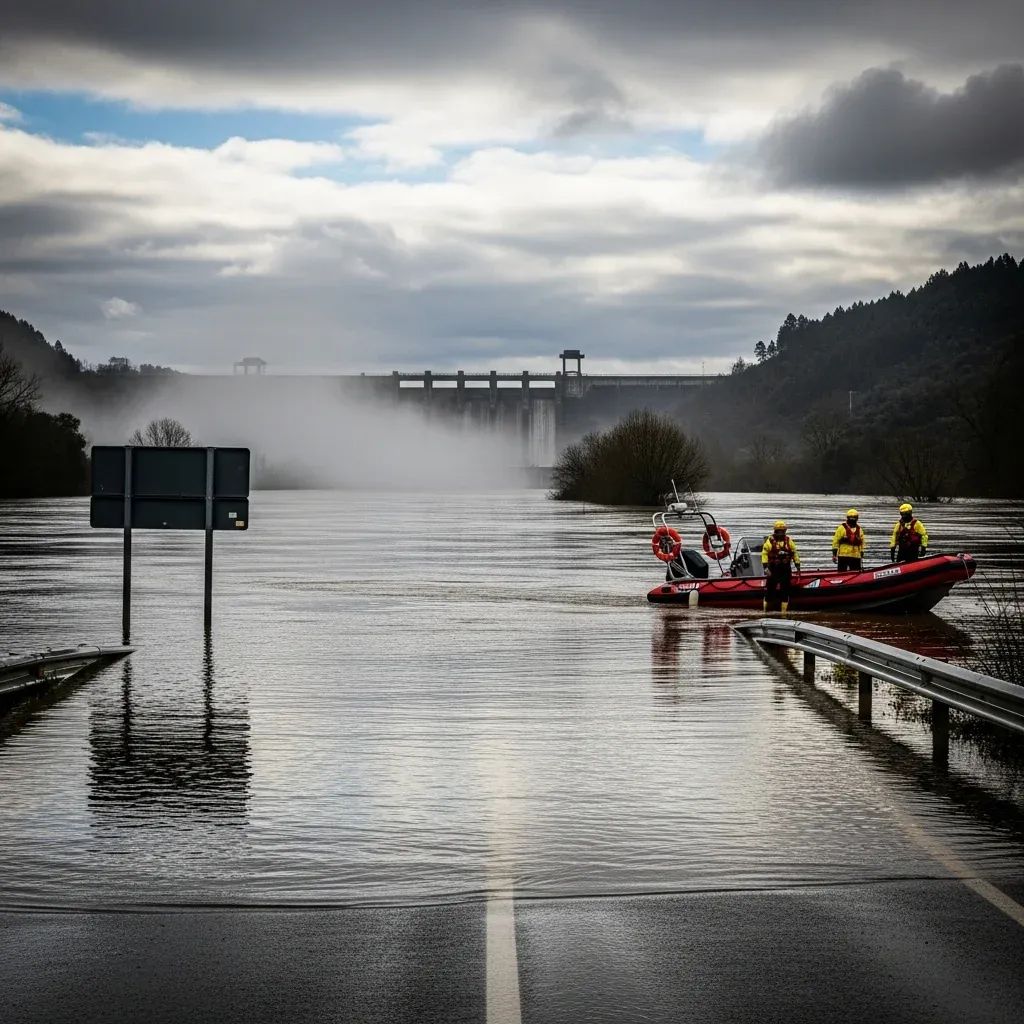
Portugal’s head of state has sounded the alarm over fresh flooding risks as storm Marta approaches and a string of major reservoirs increase emergency releases, a combination that could again test the country’s drainage systems and household budgets.
Why This Matters
• Third severe storm in 3 weeks – soils are already waterlogged, raising odds of flash floods.
• Record dam discharges – the Portugal Environment Agency confirms releases equal to a full year of national water use in just 3 days.
• €4 B in damage so far – government aid is available, but insurance claims must be filed within 8 days.
• Schools, trains, polling stations – expect more closures and detours through at least Tuesday.
Storm Marta: Another Atlantic Bulldozer
The Portuguese Institute for Sea and Atmosphere (IPMA) expects Marta to sweep across the mainland late Saturday, pushing gusts above 120 km/h, 50 mm of rain in 6-hour bursts and waves cresting at 13 m along the entire Atlantic frontage. Coming on the heels of Kristin and Leonardo, the new depression arrives when river plains from the Douro to the Sado are already saturated. Meteorologists compare the trio to the notorious 1967 sequence that rewrote Lisbon’s flood maps.
Why the Dams Are Opening
Several basins are approaching their structural limits after the wettest January in 70 years. To prevent overtopping, the Portugal Environment Agency (APA) authorised Alqueva, Pedrógão, Aguieira, Santa Clara and even traditionally thirsty Algarve reservoirs to ramp up outflows. Alqueva alone is now releasing 3 300 m³/s, three times the previous emergency rate, sending a tidal-like surge down the Guadiana. Upstream Spanish operators are doing the same on the Douro and Tejo, leaving Portuguese managers little choice but to “pass-through” the excess. The complex choreography is guided by a bilateral treaty, yet residents downstream in Mértola, Alcácer do Sal and the Lezíria do Tejo will feel the consequences first.
Flood Hotspots to Watch
Civil Protection has upgraded its map of critical points. Among the most exposed:
Lisbon’s low-lying western waterfront – Cais do Sodré to Alcântara routinely backs up when the Tejo is in spate.
Sorraia plains near Coruche – already above the red alert threshold.
Mondego valley around Montemor-o-Velho – awaiting flows from the Aguieira barrage.
Algarve’s ribeiras – small, steep catchments such as the Odelouca respond within minutes.
Local councils have pre-positioned sandbags and diverted traffic. Three inland ferries and the Douro line rail service remain suspended after landslides earlier this week.
Government and Local Response
Prime Minister Luís Montenegro extended the nationwide state of calamity until 15 February. The Cabinet unlocked an additional €2.5 B recovery fund on Friday, with fast-track grants up to €10 000 per household for structural repairs and a special 537 € hardship allowance for renters or pensioners facing displacement. Businesses can access subsidised credit lines capped at €500 000 to rebuild inventory and replace machinery. Meanwhile, 11 000 firefighters and 4 500 vehicles stand ready under Civil Protection’s Level IV posture, the highest outside wartime.
What This Means for Residents
• Stay mobile-ready: Pack essentials and prescription drugs; some villages may receive late-night evacuation orders as sluice gates modulate flows.• Check insurance today: Policies covering flood damage often impose an 8-day notification window. Digital uploads of photos are accepted.• Follow municipal channels: Many city halls are pushing street-by-street alerts through WhatsApp and local FM radio instead of relying solely on national broadcasts.• Drive defensively: Hydroplaning begins at just 60 km/h on partially flooded tarmac. Rental-car excesses still apply even under a calamity declaration.
Looking Ahead
IPMA’s 72-hour outlook shows a brief lull on Monday before another plume of Atlantic moisture arrives Tuesday, potentially dropping 25 mm over central Portugal. Hydrologists warn that even modest totals could trigger landslides on freshly soaked slopes. Longer term, Lisbon is accelerating a century-scale drainage overhaul featuring deep tunnels and floodable parks – an unmistakable sign that episodic deluges are becoming a new normal for Portugal’s temperate-Atlantic climate.
For now, the country watches river gauges and cloud radar, hoping that controlled releases and quick adaptation will keep Marta from adding its name to the roll call of historic Portuguese floods.