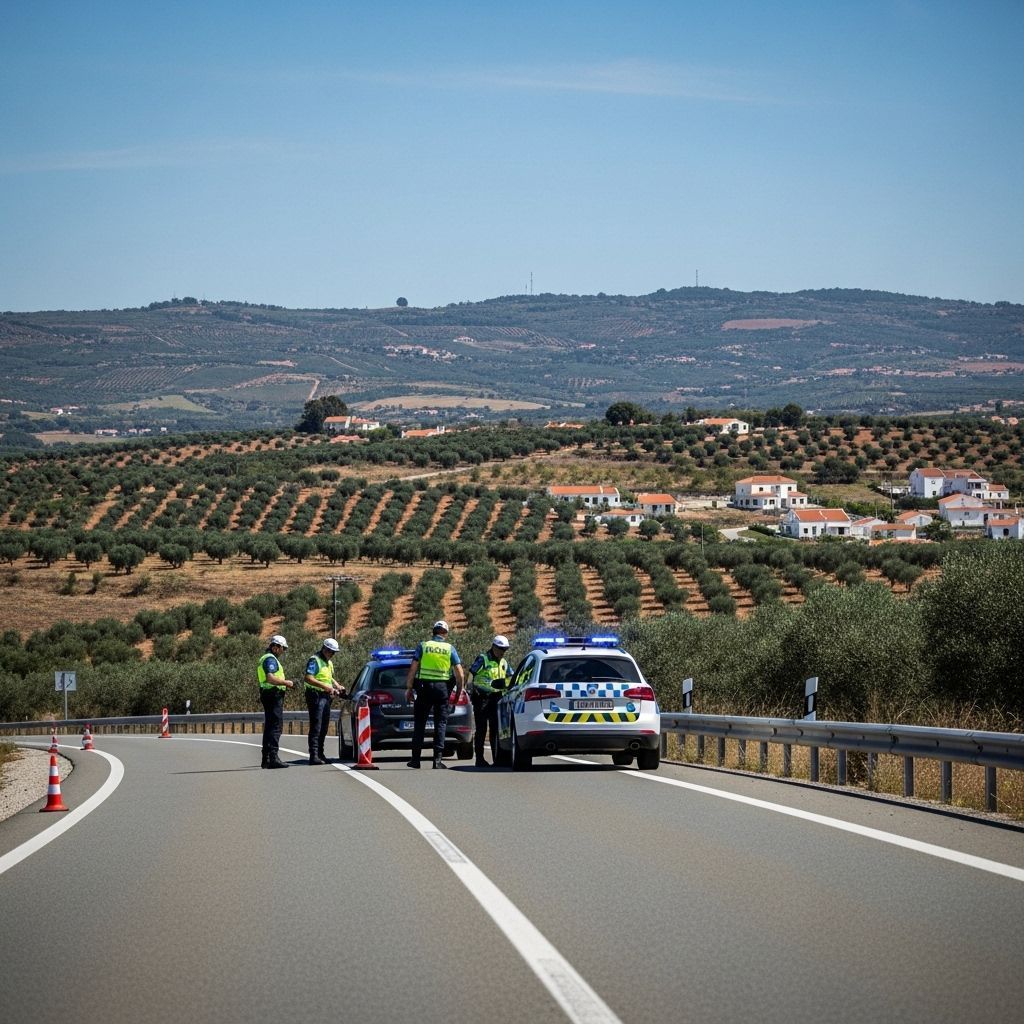
Portugal's security forces staged a national protest on April 16, 2026, in Lisbon, massing outside the Prime Minister's official residence to denounce pension reforms that could slash retirement income by more than 40% for younger officers—a move threatening the financial security of those who've spent decades protecting the public.
Why This Matters
• Pension cuts exceed 30%: New calculation rules reduce retirement income from 90% of final salary to 60%-70% of career-average earnings.
• Young officers hit hardest: Those who joined after specific cutoff dates face reductions exceeding 40%, translating to monthly losses of over €700 in some cases.
• Parliamentary rejection: The Portugal Assembly voted down proposals in February to restore the 90% pension guarantee.
• Date matters: Your enrollment date with the Caixa Geral de Aposentações (CGA), Portugal's public pension fund for civil servants, determines whether you keep the old formula or absorb the cuts.
How the Pension Cuts Work
The Portugal Security Forces pension overhaul, rooted in a 2017 decree-law, fundamentally rewrites retirement math for members of the Polícia de Segurança Pública (PSP), Guarda Nacional Republicana (GNR), prison guards, the Autoridade de Segurança Alimentar e Económica (ASAE), and the Maritime Police. Where officers once retired on 90% of their final monthly salary, the new regime averages all career contributions—a formula that punishes those with slower salary progression or extended service after 2006.
The impact is not uniform. Officers enrolled in the CGA before August 1993 retain the legacy system. Everyone else faces the convergence model, which aligns security pensions with the general social security regime. For contributions made after January 1, 2006, the General Social Security Regime applies—meaning the longer you serve past that threshold, the steeper your eventual cut.
Paulo Santos, secretary-general of the Permanent Coordinating Commission (CCP) and president of the Professional Police Union Association (ASPP/PSP), told reporters at the demonstration that the changes constitute "very painful legislation, especially for the youngest, who may see cuts above 40%." With approximately 1,000 security personnel present—exceeding organizers' expectations—the protest underscored mounting frustration within a profession already strained by demanding conditions and public scrutiny.
What This Means for Security Personnel
If you're serving in Portugal's security apparatus, your retirement timeline and enrollment date now dictate your financial future. Officers who joined before the 1993 cutoff remain insulated. Those who enlisted later confront a sliding scale of losses that accelerate with each year of post-2006 service.
Consider a hypothetical GNR officer who joined in 2000 and retires in 2026. Under the old system, a final salary of €2,000 would yield a monthly pension of €1,800. Under the new formula—averaging perhaps €1,400 across a career—the pension drops to roughly €980 to €1,120, a shortfall of €680 to €820 every month. Over a 20-year retirement, that compounds to a six-figure loss.
The CCP, which coordinates unions and associations across the PSP, GNR, prison services, ASAE, and Maritime Police, warns that the reforms penalize those who dedicated decades to public service. The February parliamentary defeat of initiatives by the Chega and Communist Party (PCP)—which sought to lock pensions at 90% of final pay—intensified the backlash, signaling that legislative relief is unlikely in the near term.
The Broader European Context
Portugal's pension turbulence mirrors a continental pattern. France faced months of mass strikes over raising the retirement age from 62 to 64. Greece imposed multiple rounds of pension cuts during its debt crisis, sparking sustained protests from retirees. Spain decoupled annual pension indexing from inflation, tying adjustments to economic performance and social security health, albeit with a floor to prevent drastic cuts.
The European Commission has urged member states to promote complementary pension schemes—employer-sponsored funds, individual retirement savings plans (PPR), and auto-enrollment models like the United Kingdom's—to reduce reliance on strained public systems. Yet across several European nations, citizens acknowledge pension systems are unsustainable but reject solutions like later retirement ages or benefit reductions.
Sweden is frequently cited for its proactive overhaul, which balanced sustainability with adequacy through indexed benefits and a multi-pillar structure. Portugal's approach, however, has been more abrupt—legislating cuts without the cushion of robust complementary schemes, leaving security forces feeling abandoned.
The Government's Calculus
The rationale for convergence is fiscal. As Portugal's population ages and the ratio of active workers to retirees shrinks, maintaining generous public-sector pensions strains the budget. Aligning security forces with the general regime aims to distribute the burden more evenly and prevent a two-tier retirement system where public servants retire on significantly higher incomes than private-sector counterparts.
But the security unions argue this logic ignores the unique hazards and early-career demands of policing, border control, and corrections work. Officers face physical danger, irregular hours, and mandatory retirement ages—often around 60 years—that curtail earning potential compared to civilian careers. The 90% pension was designed to compensate for these sacrifices, not as a perk but as a structural recognition of service conditions.
The Portugal Assembly's February rejection of the Chega and PCP proposals suggests cross-party consensus that fiscal discipline outweighs sectoral demands, at least for now. Centre-left and centre-right parties alike have prioritized deficit control and EU fiscal targets, leaving security personnel with limited parliamentary allies.
Impact on Recruitment and Morale
Beyond individual hardship, the pension cuts threaten force readiness. Security agencies already struggle with vacancies and retention. Younger recruits, aware they face 40%+ cuts, may opt for private security or emigrate to jurisdictions with better terms—France, Germany, and the Netherlands all offer more favorable police pensions and higher starting salaries.
Veteran officers, demoralized by the prospect of diminished retirement, report declining willingness to take on dangerous assignments or extended tours. Union representatives warn that the erosion of the pension compact—long a cornerstone of public-service recruitment—could hollow out Portugal's security infrastructure over the next decade.
Next Steps and Legislative Outlook
The CCP is demanding immediate reversal of the 2017 decree-law and reinstatement of the 90% formula. Organizers are planning further actions, including potential coordinated work slowdowns and a second national demonstration if the government does not engage in formal negotiations by June.
Meanwhile, the Portugal Ministry of Internal Administration has signaled openness to dialogue but stopped short of committing to structural changes. Officials point to ongoing reviews of force staffing and compensation but emphasize that any adjustments must align with broader public-sector reform and EU fiscal commitments.
Legal challenges are also in play. Several associations are exploring constitutional complaints, arguing that the retroactive application of the new formula to officers who joined under the old contract violates property rights and legitimate expectations.
What Residents Should Know
For those living in Portugal, the pension dispute carries immediate implications for public security. Reduced staffing or demoralized personnel could affect police response times, community policing initiatives, and the effectiveness of specialized units. The April 16 demonstration resulted in traffic disruptions around government buildings, and union leaders warn that larger actions may follow if negotiations stall.
More broadly, the pension battle is a litmus test for Portugal's ability to balance fiscal sustainability with social equity. If the government can impose steep cuts on a politically organized, essential workforce without significant concession, similar measures may extend to other public sectors—education, healthcare, civil administration.
The standoff also highlights the risk of brain drain. Security expertise is mobile, and Portugal competes with wealthier EU states for talent. If pension erosion accelerates emigration of experienced officers, the country may face a dual crisis: rising costs to train replacements and declining operational capacity in areas like border control and specialized investigation units.
Personal Impact for Security Personnel
Behind the statistics are officers who planned retirements around the 90% guarantee. Some took on mortgages or supported extended families on the assumption their pensions would sustain them. The new formula forces painful recalculations: delaying retirement, returning to work part-time, or downsizing living standards.
For younger personnel, the impact is prospective but significant. They entered service under terms that the state has unilaterally rewritten. Union representatives emphasize the loss of trust between government and security forces, warning that this poses risks extending beyond payroll to the legitimacy and cohesion of public institutions.
As the April 16 protest made clear, Portugal's security personnel are no longer willing to absorb cuts in silence. Whether the government responds with meaningful concessions or maintains its current position will shape not only the future of policing but the broader social contract in the years ahead.