

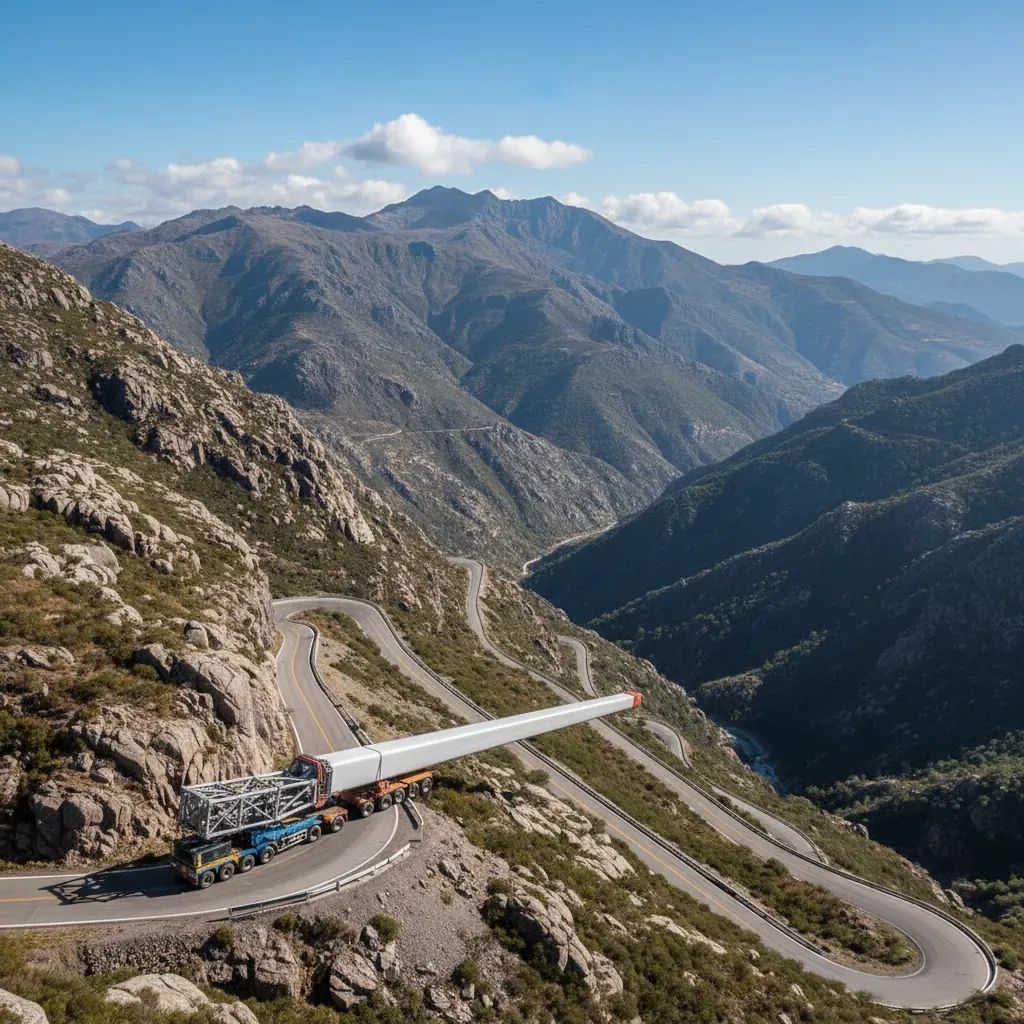
Iberdrola Renewables Portugal has begun installing the longest wind turbine blades ever deployed in the country—85 meters each—as part of the €350M Tâmega wind complex, which will become operational in phases starting this June. The operation relies on a hydraulic "blade lifter" system that tilts massive components up to 60 degrees to navigate mountain roads, a logistical feat that underscores both the scale of Portugal's renewable ambitions and the engineering challenges of building infrastructure in rugged terrain.
Why This Matters
• Energy output: The 38-turbine complex will produce 601 GWh annually, enough to power 128,000 homes—equivalent to the combined residential demand of Guimarães and Braga. The project is divided into two parks: Tâmega Norte (27 turbines) and Tâmega Sul (11 turbines).
• Hybrid first: This is Portugal's first wind-hydro hybrid project, linking turbines directly to the existing Tâmega hydroelectric system (Daivões, Gouvães, and Alto Tâmega dams) to share grid connections and cut costs.
• Carbon savings: The project will prevent 230,000 tons of CO₂ emissions per year, a key milestone for Portugal's National Energy and Climate Plan.
Transporting Giants Through Mountain Passes
The Tâmega Norte wind park, sited between Cabeceiras de Basto (Braga district) and Salto (Montalegre, Vila Real district), requires moving approximately 110 blades from the Port of Aveiro to elevations where conventional trucking fails. After a standard journey to Cabeceiras, each blade is mounted on a blade lifter truck—a hydraulic platform operated by a three-person crew—that travels at 5 km/h over a 13-kilometer climb to the installation site.
The blade lifter can rotate its load between horizontal and vertical positions, reaching inclines of up to 60 degrees. This flexibility lets the convoy navigate tight switchbacks and pass under power lines without requiring extensive road widening. In some sections, however, crews had to bury electrical and telecom cables underground and trim tree canopies to create clearance for the 85-meter blades.
Each convoy takes roughly five hours to complete the ascent. To minimize disruption, Iberdrola schedules two runs per week, moving three blades at a time under GNR (Portugal Royal Police) escort. Departure times are coordinated to avoid school bus routes and peak traffic, with alternative access routes provided for local residents.
Construction manager Giancarlo Pedro, speaking to journalists during a site visit, emphasized the precision required: "This is delicate work. We monitor wind conditions constantly. From the moment the crane lifts the blade until all 240 bolts are tightened into the hub, the operation takes over two hours."
Inside the Turbine Assembly
Each turbine stands 199 meters tall when a blade is vertical—54 meters taller than Lisbon's Vasco da Gama Tower, which reaches 145 meters. The machines arrive in modular sections: five tower segments, the nacelle (housing the generator and mechanical systems), and the hub (the three-blade rotor assembly). Every turbine delivers 7.2 MW of capacity, making them among the most advanced commercial wind units currently deployed.
Iberdrola expects all blade transports to finish by the end of March 2026, with the Tâmega Norte park entering production in June 2026. The smaller Tâmega Sul park—11 turbines located 20 kilometers away, between Ribeira de Pena and Vila Pouca de Aguiar—is still in the early stages of earthworks and platform preparation, with a target start date of September 2026.
What This Means for Residents and Investors
For homeowners and businesses: The Tâmega complex will materially boost Portugal's renewable energy supply, reducing reliance on imported fossil fuels and potentially stabilizing electricity prices over the medium term. The project's hybrid connection to the Tâmega hydro system allows operators to balance wind variability with pumped-storage hydro, smoothing out intermittency and making renewable supply more predictable.
For local communities: The construction phase has brought temporary road closures, noise, and visual impact, but also local employment and infrastructure upgrades. Environmental assessments required careful route design to protect sensitive ecosystems and wildlife corridors. Oversight programs for fauna, flora, and archaeological heritage remain active throughout construction.
For the energy sector: The Tâmega project demonstrates that large-scale wind-hydro hybridization is technically and economically viable in Portugal's mountainous interior. By sharing grid infrastructure—substations, transmission lines, and connection points—Iberdrola avoided duplicating expensive hardware, a model that could be replicated elsewhere in Europe.
Environmental Considerations and Mitigation
Iberdrola's development of the Tâmega project has incorporated environmental safeguards throughout the planning and construction phases. The broader Tâmega initiative includes reforestation efforts and habitat protection measures as part of its commitment to balancing renewable energy development with biodiversity conservation.
Blade lifter technology itself reduces environmental footprint by avoiding major road widening or bridge reinforcement. The system required tree pruning and underground cabling in stretches where overhead clearance was insufficient.
Europe's Push for Hybrid Renewable Systems
While wind-solar hybrids dominate European project pipelines—EDP alone operates several in Portugal, Spain, Romania, and Poland—the Tâmega complex highlights a less common but highly complementary pairing: wind plus pumped hydro. When wind speeds are high, excess electricity can drive the pumps, storing energy as gravitational potential. When wind drops or demand spikes, the hydro turbines release water to generate electricity, effectively acting as a giant battery.
This configuration is particularly valuable in markets like Portugal, where renewable penetration is high but storage infrastructure remains limited. The Tâmega hydro complex, combined with the new 274 MW of wind capacity, creates a powerful renewable asset that can deliver more reliable, dispatchable power—something standalone wind farms cannot guarantee.
Timeline and Costs
Iberdrola's €350M investment covers both the Tâmega Norte (27 turbines) and Tâmega Sul (11 turbines) installations. The company has not disclosed detailed budget breakdowns, but industry analysts note that blade lifter logistics and hybrid grid integration represent significant cost centers. Nevertheless, sharing transmission infrastructure with the existing hydro system is expected to deliver long-term savings and faster grid connection approval.
The 601 GWh annual output aligns with Portugal's goal to reach 80% renewable electricity by 2026 and carbon neutrality by 2050. As of early 2026, the country already derives more than 60% of its electricity from renewables, making projects like Tâmega critical to maintaining momentum.
Practical Considerations for Expats and New Residents
If you live or plan to move to the Braga or Vila Real districts, be aware that the final weeks of blade transport (through late March 2026) may cause intermittent road closures on secondary routes near Cabeceiras de Basto and Montalegre. Check local municipal websites or GNR traffic alerts before planning trips through these areas.
For those interested in Portugal's energy transition, the Tâmega project is a visible, accessible example of how the country is modernizing its electricity grid. While the turbines are tall enough to be seen from many kilometers away, Iberdrola's environmental commitments—including continuous wildlife monitoring—aim to balance renewable goals with biodiversity protection.
From a property perspective, proximity to large-scale wind installations can influence real estate values both positively (due to improved grid reliability and local economic activity) and negatively (due to visual and noise concerns). Prospective buyers in these municipalities should assess individual site lines and consult updated zoning maps published by Portugal's Environment Agency.
The Road Ahead
With Tâmega Norte scheduled to go live in June 2026 and Tâmega Sul in September 2026, Iberdrola is on track to complete what it calls Portugal's largest wind farm. The blade lifter system, though slow and labor-intensive, has proven capable of delivering oversized components to remote, elevated sites without major environmental overhaul of existing roads—a capability that may become standard as turbine sizes continue to grow.
As Portugal races to meet its 2030 and 2050 climate targets, hybrid projects like Tâmega offer a blueprint: leverage existing infrastructure, pair complementary renewables, and invest in specialized logistics to overcome geography. For residents, the payoff is cleaner air, greater energy independence, and a tangible stake in Europe's decarbonization effort.


