

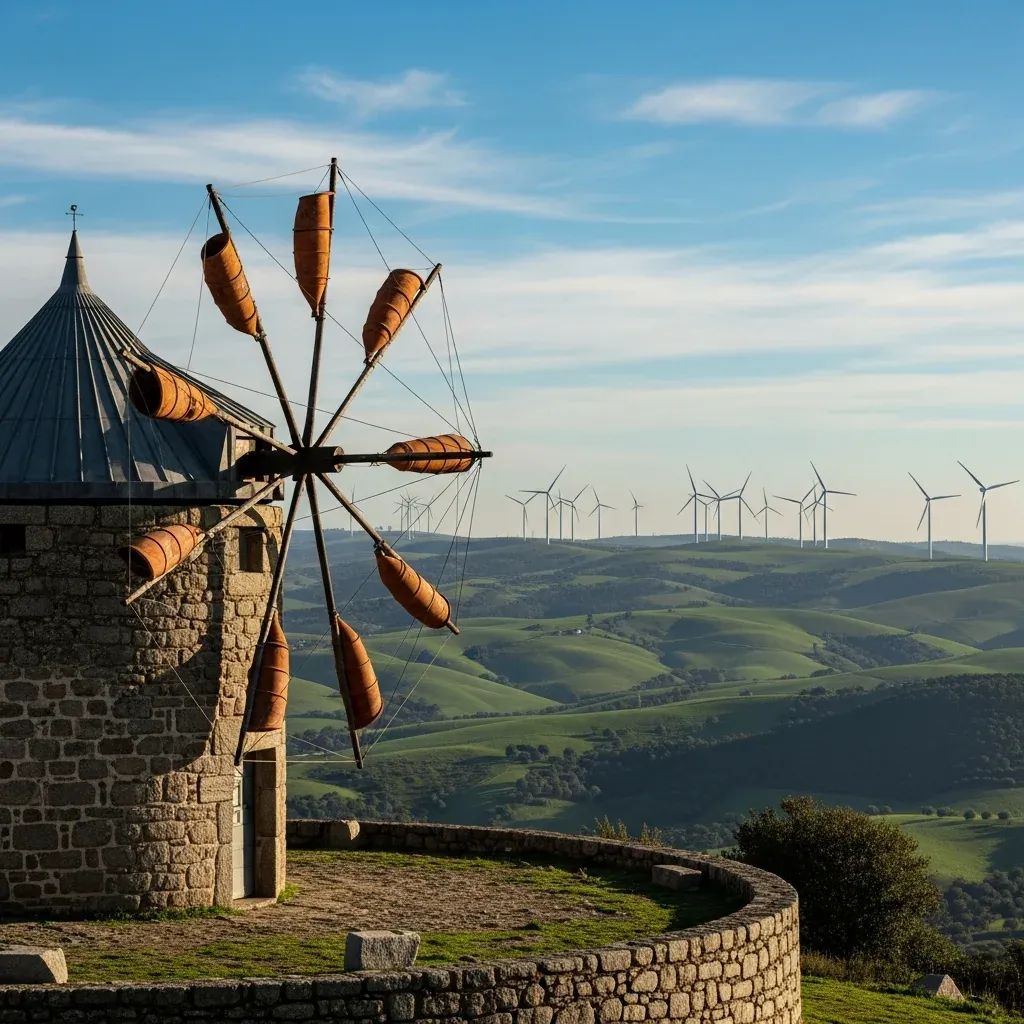
Half-hidden on hilltops and cliffs, Portugal’s windmills once kept villages alive; now they are being repurposed to spark tourism, power the green transition and attract fresh EU money. From the tiny clay-pot sails of Montejunto to the multi-megawatt turbines rising offshore, the country’s relationship with the wind is being rewritten—but always with an eye on heritage.
Key Facts at a Glance
• 10,000+ traditional mills once dotted the landscape; only a fraction survive in working order
• New EU and national programmes are channelling €3 M in grants for mill restoration in the Centro region alone
• Tourism tied to rural heritage grew 6.3 % last year, outpacing mainstream hotel growth
• A government auction will allocate 3.5 GW of offshore wind capacity by late 2025, reinforcing the country’s 80 % renewable-electricity target for 2030
From Wheat to Wi-Fi: Portugal’s Molinological DNA
Long before high-tech turbines, the moinhos de vento turned the Atlantic breeze into bread. By the early 1960s, 3,000 windmills and 7,000 watermills ground wheat, corn and even rare local grains such as Barbela. Their massive wooden gears and hand-sewn canvas sails were cutting-edge engineering for communities with little else. Today, university researchers argue these structures hold as much immaterial value—craft, folklore, communal know-how—as brick and mortar.
Where the Sails Still Turn
Several mills continue to operate, often thanks to municipal caretakers or family cooperatives:
Moinho Municipal da Quintinha (Santiago do Cacém) – an 1813 tower that still grinds flour on windy days and doubles as a hands-on museum.
Moinhos Juntos (Odemira) – two neighbouring mills; one ruins, one fully functional with a tiny shop selling fresh meal.
Tri-mill Cluster (Grândola) – three distinct towers that share a fixed masonry core and offer weekend demos.
Moinho de Avis (Serra de Montejunto) – the country’s largest traditional mill; its flour feeds a nearby restaurant famed for wood-oven bread.
Porto Santo Trio – rebuilt under an EU-backed project that earmarked €340,000 for heritage and a small training centre.
Money in the Breeze
Restoration is no longer a romantic hobby; it is becoming a line item in regional development plans:
• The Centro2030-2025-19 notice sets aside €3 M (FEDER) for listed buildings, explicitly naming mills as eligible.
• Local bylaws, such as Penacova’s 2016 regulation, offer €1,000 tax breaks to owners who keep original grinding systems intact.
• National schemes like IFRRU 2020 extend low-interest loans if the mill lies inside an urban-rehab zone.Heritage scholars warn that rushed conversions may strip character; best practice is to pair craft training with modern safety and accessibility standards.
Sleep Inside a Piece of History
With rural tourism booming, restored mills have become Instagram-proof hideaways. Listings on Airbnb and independent portals report near-full occupancy on summer weekends. Industry data show:
• Rural and heritage stays welcomed 1.5 M guests last year (+6.3 %).
• 42 % of all overnight stays already happen in non-hotel lodgings, a share authorities once underestimated.
• Despite tighter rules (condominium consent, local caps), analysts expect an 8–10 % revenue rise for distinctive units such as mills through 2025.Municipalities hope these quirky accommodations will spread visitors beyond saturated coastal hubs, bringing cash to inland cafés, bakeries and artisans.
The New Giants Offshore
While tourists photograph century-old towers, energy planners chase gigawatts at sea. Lisbon will auction 3.5 GW of offshore wind licences by end-2025, riding on last year’s record-breaking onshore output. Success hinges on upgraded grid lines and faster permitting, yet officials insist the plan stays on track for 80 % renewable electricity within four years. For many coastal towns, that means the silhouette of a modern turbine could soon join the traditional white-washed mill on the horizon.
Why It Matters for Communities
Preserving mills is no nostalgia trip; it stitches together culture, climate goals and local income:
• Keeps ancestral skills alive while opening new jobs in heritage management.
• Anchors tourism in regions like Alentejo and Viana do Castelo that need off-season demand.
• Supports the wider narrative that Portugal can honour the past and lead Europe’s low-carbon future—all under the same Atlantic wind.
As grants, tourists and kilowatts converge, the old question—who will keep the sails turning?—may find an unexpected answer: everyone, from miller-turned-B&B host to offshore engineer, pulling in the same direction whenever the wind blows.


