

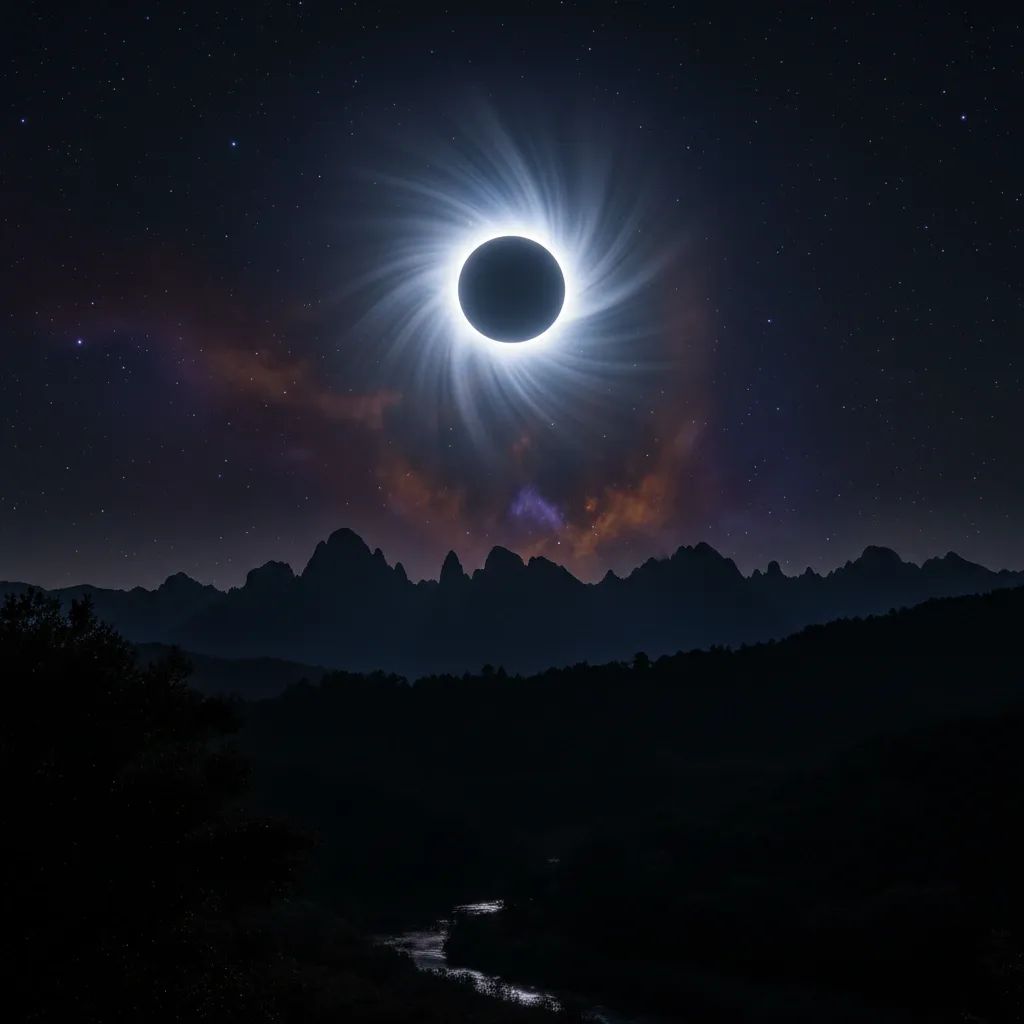
Portuguese authorities and the Ciência Viva national science agency are preparing for a significant surge of visitors to the country's remote northeast frontier as a total solar eclipse sweeps across a narrow band of Trás-os-Montes on August 12, 2026. For exactly 26 seconds, the sun will vanish entirely over the Montesinho Natural Park near the Spanish border, marking the first total eclipse visible from mainland Portugal since 1912 and the last until 2144.
Why This Matters:
• Rarity: This is a once-in-a-lifetime event—Portugal won't see another total eclipse for 118 years.
• Limited viewing zone: Only border villages like Rio de Onor and Guadramil will experience totality; the rest of the country sees a deep partial eclipse (92-98% obscuration).
• Safety imperative: Direct viewing without ISO 12312-2 certified eclipse glasses can cause permanent, painless retinal burns.
• Regional preparation: Local councils are coordinating infrastructure upgrades in Bragança district, and officials expect accommodation demand to surge during the event.
What This Means for Residents Across Portugal
If you live in Bragança district, expect road congestion and sold-out accommodations on eclipse day. Local councils are improving access to Montesinho Natural Park and coordinating with mobile-network providers, but planners advise arriving at least a day early and bringing offline maps, food, and water.
For residents elsewhere in Portugal, the deep partial eclipse still warrants attention. Schools and workplaces should consider flexible schedules around 19:00–20:00 to allow employees and students to witness the event safely. Community centers, observatories, and science museums are expected to host public viewing parties with certified equipment and expert commentary.
Hospitality sector response: Tour operators are beginning to market multi-day eclipse packages that combine the eclipse viewing with local attractions in Trás-os-Montes. The influx mirrors patterns seen during the 2017 total eclipse in the United States, where rural counties experienced significant temporary population spikes and corresponding boosts in local business.
A 70-Kilometer Corridor of Darkness
The path of totality—a roughly 70-kilometer-wide ribbon where the moon's shadow will completely block the sun—will slice across the Iberian Peninsula from the Atlantic Ocean to the Balearic Islands, clipping only the far northeastern corner of Portugal. Inside this corridor, observers in the Montesinho Natural Park will witness a fleeting twilight at approximately 19:30 local time (7:30 p.m.), with the complete blackout lasting just over half a minute before the sun reemerges near the western horizon.
Outside that sliver, the rest of Portugal still gets a remarkable show. Porto will see 98.2% of the solar disk covered, Lisbon 94.5%, and Faro 92.7%. Because the eclipse occurs late in the day—the partial phase begins around 18:33 and concludes near 20:24—a clear view toward the west-northwest horizon will be essential. Urban observers should scout vantage points with unobstructed sightlines: rooftops, coastal bluffs, or open fields away from buildings.
National Preparations and Safety Information
Ciência Viva has announced plans for the National Eclipse 2026 Program, launching in February 2026 with intensified activities through the summer. The initiative is expected to feature:
• Safety education in schools and community centers on proper viewing techniques.
• Distribution of certified eclipse kits, including ISO-compliant filters.
• Live streams from multiple locations, coordinated by the Pavilhão do Conhecimento science museum in Lisbon.
Portuguese health authorities and ophthalmology associations have issued guidance emphasizing that standard sunglasses, smoked glass, photographic negatives, CDs, or welding filters below shade #14 offer zero protection and have caused preventable blindness in past eclipses. Only eyewear stamped with ISO 12312-2:2015 certification is safe for direct solar viewing.
Before each use, inspect filters for scratches, pinholes, or delamination. Discard any damaged unit immediately. Even with certified glasses, observers should limit continuous viewing to short intervals with frequent breaks. Children must be supervised at all times, and anyone with recent eye surgery or preexisting retinal conditions should rely solely on indirect projection methods—such as the pinhole-box technique—rather than direct observation.
Critical exception: During the 26 seconds of totality within the path, and only during those seconds, it is safe to remove filters and view the corona with the naked eye. The moment the sun's edge reappears, filters must go back on instantly. Observers in partial-eclipse zones, which includes most of Portugal, must keep filters on the entire time; there is no safe totality phase outside the narrow corridor.
Practical Information for International Residents and Expats
For expatriates and digital nomads in Portugal, several practical considerations apply:
• Eclipse glasses availability: Ensure ISO 12312-2 certified glasses are secured well in advance, either domestically or through international suppliers, as demand will be high closer to August.
• Montesinho Natural Park access: Check with local authorities about any reservation requirements or restrictions for park access during the eclipse. Contact the Montesinho Natural Park management offices in Bragança for current guidelines.
• Transport logistics: The nearest major airport to Bragança is Porto International Airport (approximately 160 kilometers south). Public transportation to the eclipse zone is limited; renting a vehicle is advisable. Expect significant road traffic if traveling within a few days of the eclipse.
• Accommodation: Book lodging as early as possible, as availability in Bragança district will be limited. Options farther west (Vila Real, Guarda) offer alternatives within 1-2 hours' drive.
• Weather contingency: Cloud cover in mountainous Trás-os-Montes is possible in August. Have a backup location slightly west or south of the path of totality, and monitor forecasts from the Portugal Meteorological Institute starting in early August.
Historical Context and the 118-Year Gap
The last total solar eclipse visible from mainland Portugal occurred on April 17, 1912, when the path of totality crossed the southern Alentejo region. Photographs from that era show crowds gathered in open plazas, many using improvised smoked-glass viewers. The next opportunity after 2026 will not arrive until 2144, placing this event firmly in the "once in multiple lifetimes" category.
Astronomers note that Portugal's geography means total eclipses are exceptionally rare here compared to equatorial or mid-latitude continental interiors, where the statistical frequency is roughly once per 375 years for any given point. The 2026 event is thus a statistical anomaly—and a significant test for regional infrastructure and emergency coordination.
Broader Regional and Tourism Implications
For Portugal's broader tourism and regional development strategy, the eclipse represents an opportunity to test whether interior regions can attract visitors through natural phenomena and scientific heritage. Success in August 2026 could position Trás-os-Montes as a hub for specialized tourism, complementing existing attractions and creating year-round economic benefits beyond the eclipse event itself.


