
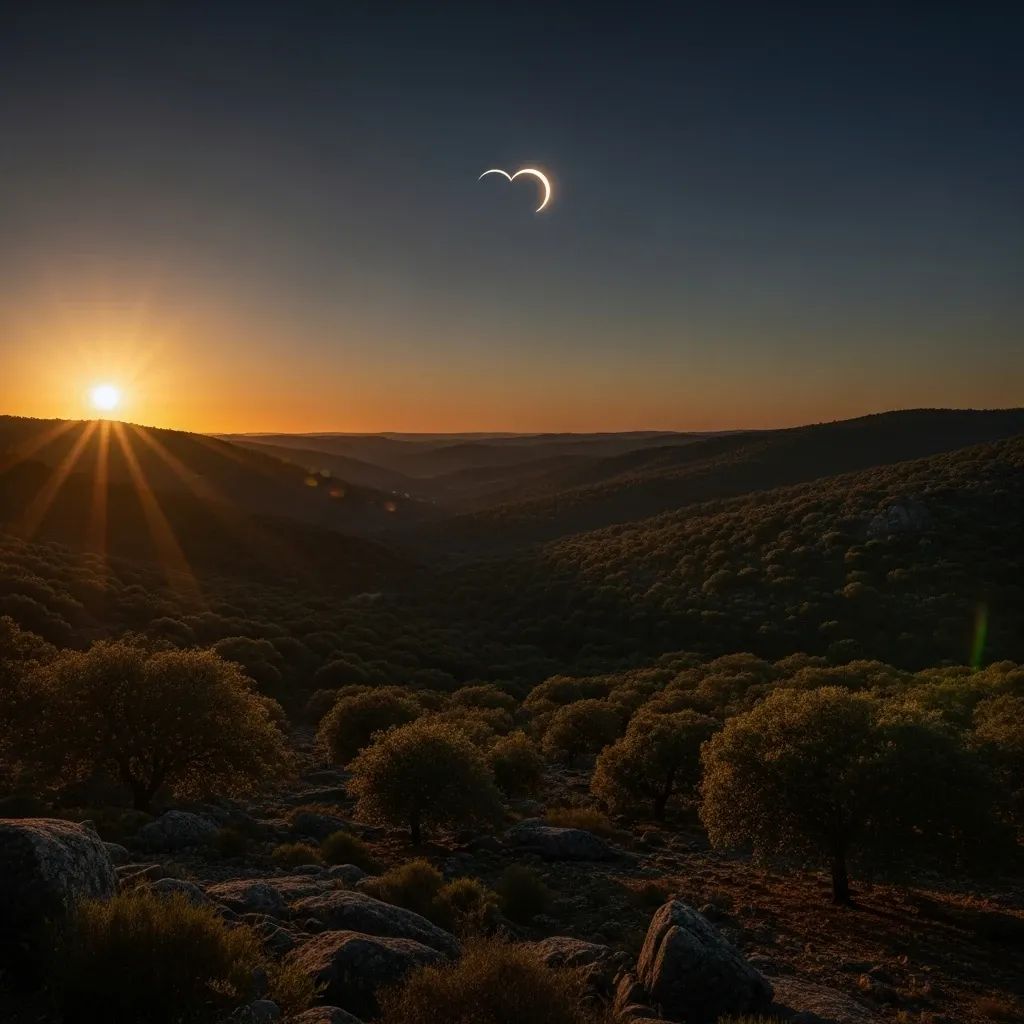
On 12 August 2026, Portugal will witness an astronomical rarity that will briefly turn daylight into dusk. For a fleeting 26 seconds, those gathered inside the rugged valleys of Montesinho Natural Park will watch the Sun vanish behind the Moon—an experience the rest of the country will only sample in partial form.
Snapshot for the busy reader
• Totality limited to a narrow corridor in Bragança’s Montesinho region; everywhere else sees a deep partial eclipse.
• Highest partial cover: Porto 98.2 %, Lisbon 94.5 %, Faro 92.7 %.
• Event unfolds late in the afternoon, so an uncluttered western horizon is critical.
• Special programmes from Ciência Viva kick off in February and scale up through summer 2026.
Countdown to a 26-second nightfall
Portugal has not witnessed a complete solar blackout since 1912, and astronomers say the next chance after 2026 will only arise in 2144. During the brief moment of totality, daylight will drop, temperatures can fall a couple of degrees, and birds may fall silent—all classic signatures of a total eclipse. Although the darkness is short, experts highlight that even a half-minute is ample time to study the solar corona, the elusive halo of plasma normally hidden by the Sun’s glare.
Why Montesinho steals the show
The geometry that lines up the Sun, Moon and Earth creates a pencil-thin path of totality that slips into Portugal solely over Trás-os-Montes. Inside Montesinho’s oak forests—particularly between the villages of Rio de Onor and Guadramil—the Moon’s umbra will first touch Portuguese soil, gift observers the full spectacle, then dart across the border into Spain. Local councils are already upgrading roads and mobile coverage, expecting an influx of sky-chasers and scientists.
Partial but powerful elsewhere
While 99 % coverage might sound like consolation, astronomer Rui Jorge Agostinho reminds the public that a sliver of uncovered Sun can still dazzle—and damage—eyes. Cities such as Porto, Coimbra, and Évora will see daylight fade to a deep twilight hue, offering a dramatic show if clouds cooperate. Coastal residents from Peniche down to Sagres should favour clifftops where the Sun sits low over the Atlantic, adding cinema-worthy reflections.
Science window: corona, climate and creatures
Total eclipses give researchers a natural laboratory. Instruments deployed in Montesinho will probe the solar wind, study rapid temperature shifts near ground level and record animal behaviour inside the park’s biodiversity hotspot. Europe-wide collaborations, including teams from ESA and Spain’s Instituto de Astrofísica de Canarias, plan to share data in real time, treating the 2026 alignment as a rehearsal for longer eclipses in 2027 and 2028.
Tourism windfall and rural revival
August is peak holiday season, and Bragança’s hoteliers report that rooms for eclipse week are already more than 80 % booked. Outdoor operators are marketing dawn-to-dusk packages that combine hiking, wolf-tracking and a dusk eclipse finale. Local officials eye the event as a catalyst for long-term nature-based tourism, arguing that once visitors discover Montesinho’s granite hamlets and chestnut groves, they will return.
Plan your viewing—safely
Certified solar glasses are mandatory the entire time except during totality itself, which lasts only in Montesinho.
Seek open vistas—rooftops, beaches or plains free of tall buildings.
Check the meteorological forecast; a 10 km relocation could mean the difference between cloud and clear sky.
If totality is your goal and you miss Portugal’s corridor, consider the north of Spain, where darkness stretches for up to 2 minutes.
Beyond 2026: an Iberian eclipse trilogy
The 12 August spectacle is merely the opener of a southern European run: a record-setting 6-minute eclipse in 2027 will graze the Andalusian coast, and another total event returns to Spain in 2028. Portuguese educators hope that momentum from 2026 will boost STEM enrolment and keep public attention fixed on the skies long after the Moon’s shadow races east.
Key take-aways for Portugal
• The nation gets a once-in-a-lifetime totality—but only inside Montesinho.
• Nearly all residents will witness a dramatic partial eclipse if skies are clear.
• Ciência Viva’s national programme launches in early 2026, offering workshops, safe-viewing kits and live streams.
• Book accommodation or travel early; demand in Bragança province is surging.
Everything now hinges on the weather gods. If they grant a window of clear sky, Portugal will enjoy an unforgettable astronomical matinee—one that grandparents will recount for decades and children may never see again in their homeland.


