

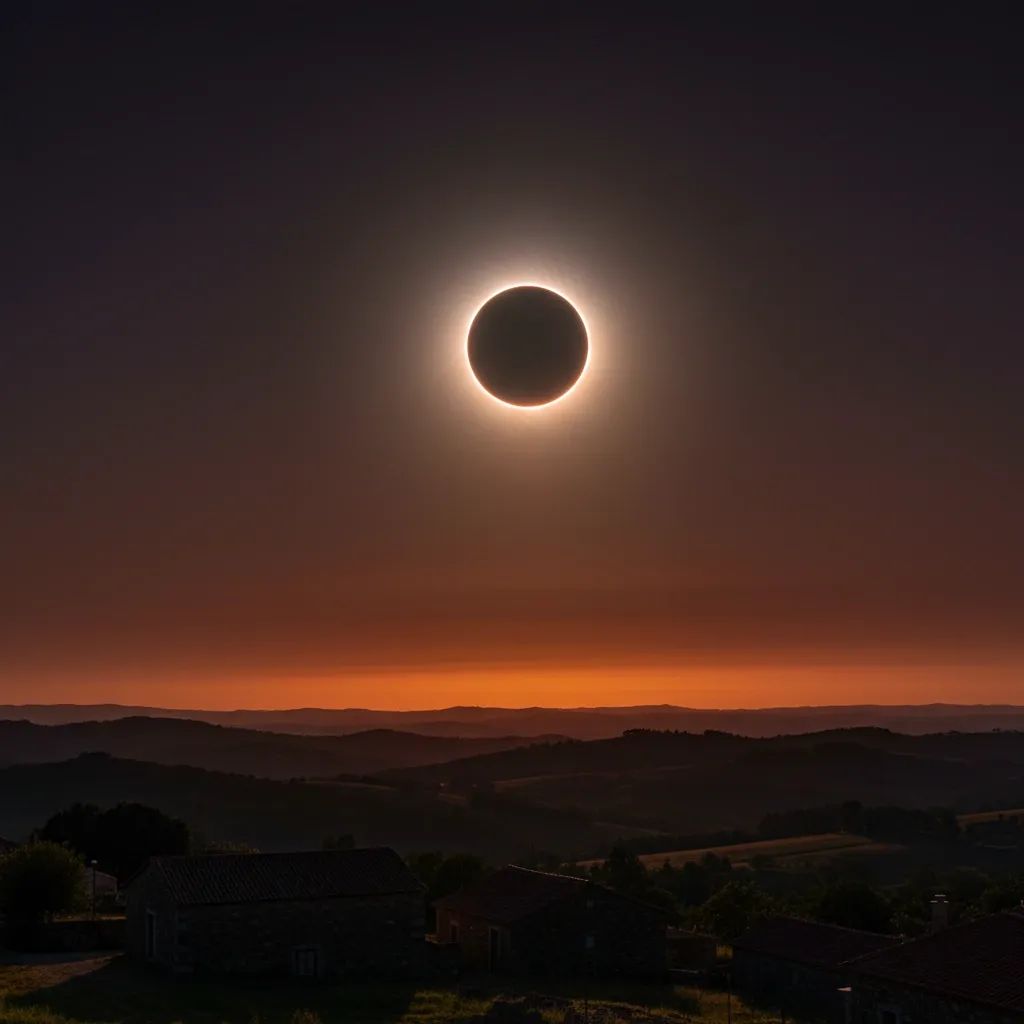
The Portugal Space Agency has confirmed that a total solar eclipse will brush the country’s northeastern corner on 12 August 2026, a fleeting spectacle that could rearrange summer holiday routes, spike rural bookings and briefly turn late-afternoon daylight into twilight.
Why This Matters
• Next chance in Portugal only in 2144 – meaning most living residents will never see this again.
• 26 seconds of full darkness in villages near Bragança; elsewhere the Sun will be 90-98 % covered.
• Accommodation prices in the north already up 40 %, according to data from booking platforms.
• ISO-rated eclipse glasses are now selling out at major pharmacies; stock up early.
The Science Behind the Shadow
Veteran astronomers at Porto’s Institute of Astrophysics and Space Sciences explain that the Moon’s umbra – the darkest part of its shadow – will carve a corridor roughly 70 km wide across Iberia. Inside that ribbon, daylight collapses: temperatures drop a few degrees, birds fall silent, and the solar corona becomes visible to the naked eye. Just outside the ribbon, Portugal will experience a deep partial eclipse, with the Sun appearing as a glowing crescent. The event coincides with the annual Perseid meteor shower, adding another reason to keep eyes on the sky that week.
Where the Shadow Falls
Spain hosts most of the totality corridor, stretching from Galicia through Castilla y León and out toward the Balearic Islands at sunset. On the Portuguese side, only the border hamlets of Rio de Onor, Guadramil and a slice of the Montesinho Natural Park fall inside full darkness – for a breath-taking 26 seconds around 20:27 local time. Porto will see the Sun 98.2 % obscured, Lisbon 94.5 %, and Faro 92.7 %. Because the eclipse happens near sunset, coast-watchers from Foz do Douro to Cabo de São Vicente could catch the partially covered Sun sinking into the Atlantic, weather permitting.
Getting There From Portugal
Road access to Montesinho is straightforward via the A4 motorway to Bragança, but authorities warn of single-lane rural roads for the final stretch. The Portugal National Republican Guard (GNR) plans temporary one-way systems and portable cell towers to manage the crowd surge. Public-transport lovers can book the CP Intercidades train from Lisbon to Porto, then switch to a regional service or coach. Car-sharing apps report a 60 % jump in pre-bookings for 11-13 August.
What This Means for Residents
• Holiday budgets – expect hotel rates in northern districts to jump; locking in now could save €100+ per night.• Traffic detours – drivers on the A4/A52 should plan for rolling closures between 17:00-22:00.• Power grid stability – the Portugal Energy Directorate says the brief dip in solar generation is "manageable" but advises rooftop-solar owners that inverters may auto-disconnect during totality.• School calendars – several municipalities are shifting summer-school field trips to leverage the event for science education.
Business & Tourism Windfall
Researchers at the University of Minho estimate that eclipse travellers could inject €25 M into Trás-os-Montes over one weekend through lodging, food and fuel. Local wineries plan ‘Darkness Tastings’ pairing eclipse viewing with late-harvest reds, while adventure outfitters are marketing guided hikes to the Spanish side for a longer dose of totality. Lisbon-based tour operator LuaCheia reports that its two-day coach package to León, Spain – where darkness lasts 1 min 40 s – sold out in 48 hours. Rural mayors hope the spotlight converts into long-term visitors once the shadow has passed.
How to Observe Safely
The Portugal Directorate-General of Health reiterates: only ISO 12312-2 certified glasses shield eyes from permanent damage. Sunglasses, smoked glass or camera negatives are useless. Photographers should fit solar filters before pointing lenses skyward; sensors can burn in milliseconds. For children, consider the pinhole-projection method – cardboard with a small hole cast onto white paper – to watch the crescent safely until the brief moment of full cover.
Weather Odds & Ends
August is statistically dry in the north. IPMA climate records show León averages just 1 rainy day during the first half of the month; Palencia records an average daytime high of 32 °C with near-zero precipitation. Burgos, slightly cooler, still posts only 2-3 wet days all month. Cloud-cover risk therefore tilts low but not negligible – coastal fog can roll inland unexpectedly, so veteran chasers always keep a backup viewing site.
Looking Beyond 2026
The 12 August event launches an Iberian ‘Eclipse Trilogy’: another total eclipse sweeps southern Spain and Gibraltar in 2027, followed by an annular eclipse across Portugal’s Alentejo in 2028. After that, Portugal must wait until 2144 for the next totality. In other words, if you miss this one, you may be counting in centuries, not years, for a do-over.
Bottom line: grab the glasses, mark the calendar, and maybe book that farmhouse in Montesinho before someone else does. The shadow will not wait.


