

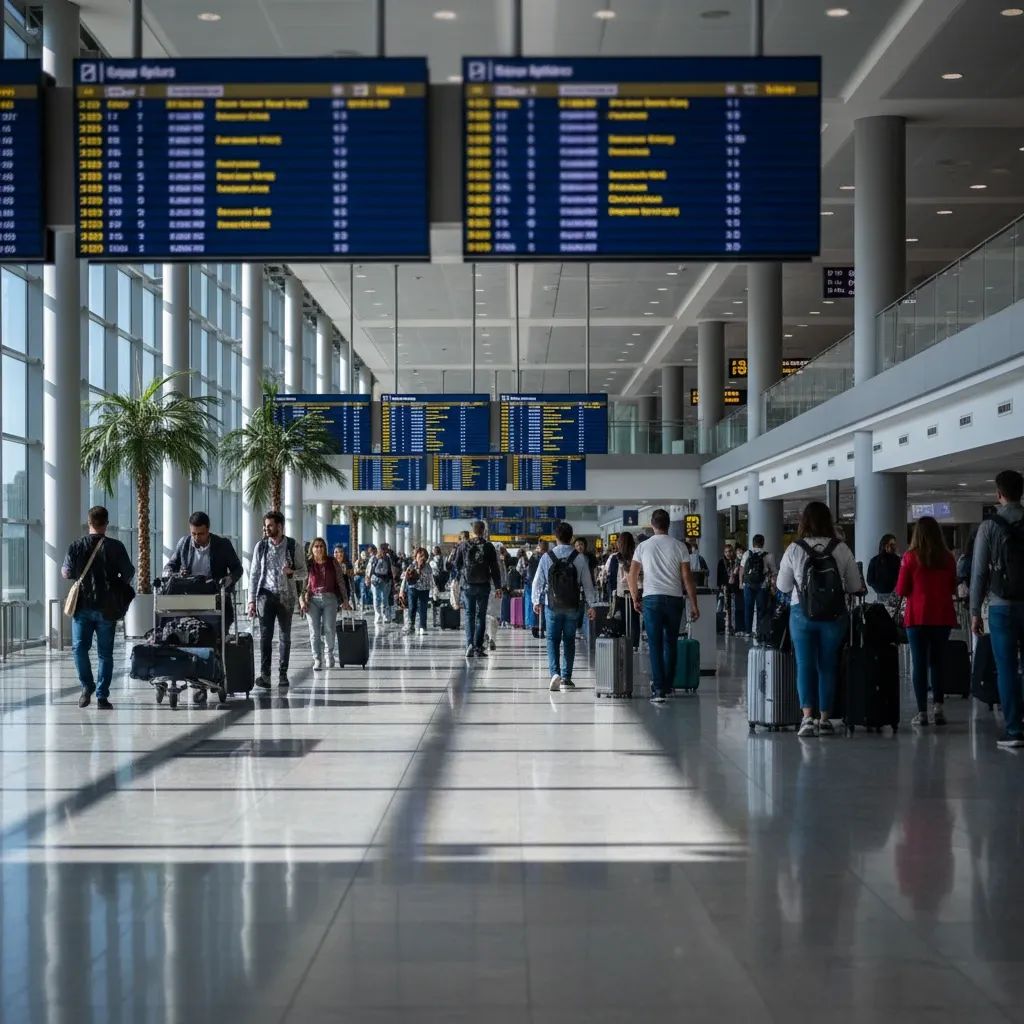
The Portugal National Institute of Statistics has confirmed that domestic airports handled 4.4 million passengers in January 2026, setting a fresh high-water mark for the first month of any year and underscoring the mounting strain on infrastructure that was already groaning under capacity constraints. The 4% year-on-year uptick—compared to January 2025—translates to an average of 68,200 passengers disembarking daily, up from 65,600 the previous January, while commercial aircraft landings rose 2.9% to 16,500.
Why This Matters
• Lisbon's bottleneck persists: The capital's Humberto Delgado airport handled 56.6% of all traffic (2.5 million passengers) but posted the slowest growth at 3.4%, constrained by a single-runway setup already past saturation point.
• Porto surges: The Francisco Sá Carneiro hub registered 9.6% growth to 1 million passengers—triple Lisbon's rate—fueled by new long-haul routes and a €65 million runway upgrade scheduled to complete by end of March 2026.
• American traffic spikes: Passengers from the Americas jumped 11.6%, the sharpest regional gain, while France and the U.K. remained the top European origins despite France's 3.8% decline in arrivals.
• Cargo slips: Freight and postal tonnage fell 1.6% to 17,992 tonnes, with Lisbon accounting for 76.3% of the total and posting a 2.4% decline.
Capital Creaks, North Booms
Lisbon's Humberto Delgado airport remains the nation's dominant gateway, absorbing more than half of all passenger movements. Yet its 3.4% growth—the lowest among major hubs—reflects what the ANA–Airports of Portugal concession operator and airline executives have long warned: the facility operates at the edge of its declared capacity, hamstrung by slot limits and delays that ranked among Europe's worst in late 2025. The Portugal Home Ministry has pledged to deploy additional border-police officers through 2028 to ease congestion at immigration checkpoints, where long queues became a flashpoint for passenger complaints at year-end.
Meanwhile, Porto's Francisco Sá Carneiro posted a 9.6% surge that vaulted it past 1 million passengers for the month, claiming 23.6% of the national total. The acceleration stems from a confluence of factors: runway-reinforcement works worth more than €50 million are scheduled to complete by end of March 2026, raising the airfield's capacity to accommodate 20 million annual passengers; Delta Air Lines launches daily non-stop service to New York-JFK on May 21; and United Airlines has moved its Newark-Porto service start date forward to late February 2026, extending the season through November with a second daily frequency at peak. Budget carriers Ryanair and easyJet are both layering on routes—Gothenburg, Rabat, Warsaw, Milan Linate, and Cape Verde—cementing Porto's role as a secondary intercontinental hub for northwest Iberia.
The Portugal Cabinet and ANA are working on a masterplan to expand Porto further, aiming to replicate some of the connectivity that Lisbon can no longer absorb. Tourism bed-stock in the northern region grew 30% between 2018 and 2022, more than double Lisbon's 13%, and the hotel pipeline shows no sign of slowing.
Islands and Algarve Paint a Mixed Picture
The Madeira Cristiano Ronaldo airport in Funchal climbed into third place nationally, handling 345,900 passengers—a 4.8% increase that edged it ahead of Faro for the first time in modern records. The Atlantic archipelago has benefited from year-round connectivity and a growing cruise-passenger base that often dovetails with air arrivals.
By contrast, the Algarve's Gago Coutinho hub in Faro recorded 302,100 passengers, a 2.5% decline that left it accounting for only 6.8% of the national total. The dip contrasts sharply with the wider tourism narrative: Faro surpassed 10 million passengers across the full 2025 calendar year for the first time, propelled by summer holiday demand. January's softness likely reflects a shift in Easter timing and fewer off-season charter flights, though the airport remains the country's fourth-busiest on an annual basis.
European Neighbors Dominate, Americas Surge
Spain held its crown as the single largest origin and destination country, with inbound passengers rising 5.6% and outbound traffic up 5.4%. France slipped into a rare second place for origins despite a 3.8% drop in arrivals, reversing positions with Spain when measured by embarkations, where French-bound passengers fell 4.1%. The United Kingdom—long Portugal's mainstay tourism source—occupied third position in both directions, posting modest gains of 1.5% for arrivals and 3.2% for departures. Brazil and Germany traded fourth and fifth spots depending on whether passengers were arriving or departing, the statistics agency noted.
Yet the stand-out story lies across the Atlantic: passengers from the Americas grew 11.6%, the fastest clip of any continental bloc, and now represent 11.9% of total traffic. That acceleration dovetails with fresh air-service agreements and expanded frequencies to New York, Newark, and São Paulo, as carriers respond to Portugal's pull as a gateway for North Americans seeking both leisure and ancestry travel. Overall, 81.8% of January's passengers flew international routes, with Europe supplying 62.6% of the total—up 2.9% year-on-year.
What This Means for Residents
For anyone living in or traveling through Portugal, the headline number—4.4 million passengers in a single month—translates into longer queues, tighter gate areas, and an ever-higher premium on advance booking. Lisbon's capacity crunch means more travelers are trickling north or arriving via Porto, which in turn drives up property prices and hotel rates in the northern city and strains local transport links.
Practical guidance for residents: To minimize travel disruption, book flights during off-peak hours (early morning or late evening) and avoid Wednesday through Friday when business travel concentrates demand. If based in central or northern Portugal, consider flying from Porto instead of Lisbon—you'll often save 1-2 hours on ground time and may find cheaper fares as carriers divert capacity northward. For ground transportation, expect 15-20 minute delays during mid-morning (8am-10am) and early evening (4pm-6pm) peak periods; ride-share apps and taxi queues will be congested during these windows, so plan accordingly or arrange transport in advance. Parking availability at Lisbon airport has tightened significantly, with some lots filling by mid-morning on weekdays—budget an extra €5-10 per day or use off-airport options.
The metropolitan Porto light-rail extension and additional bus frequencies are now urgent priorities for municipal planners, who expect the airport's catchment area to widen as new international routes come on stream. On the plus side, the proliferation of direct flights from Porto—particularly transatlantic services launching in May and beyond—reduces the need to backtrack through Lisbon and can shave hours off journey times for passengers based in the north or Galicia. Meanwhile, residents in the Algarve may notice quieter terminals in January, though the summer crush is unlikely to abate; charter operators are simply concentrating their capacity into the high season.
The cargo and postal decline—down 1.6% to just under 18,000 tonnes—carries real implications for e-commerce and business operations. Residents ordering packages internationally may experience slightly longer delivery times, as express-parcel carriers and integrators are routing some freight through Madrid or Paris instead of Lisbon, a symptom of slot scarcity and congestion surcharges at Humberto Delgado. Small businesses relying on time-sensitive exports should consider consolidating shipments through Porto when feasible.
Infrastructure Race Against the Clock
ANA has wrapped a €12 million makeover of the Terminal 2 Schengen departure zone at Lisbon, adding seats, charging points, and biometric boarding gates. A far larger €300 million program at Terminal 1 is under way, aiming to deliver 12 new gates—10 with jet bridges—and an extra 33,000 square meters of floor space. Yet executing construction inside an airport that never sleeps has proved slow and disruptive; passengers can expect scaffolding, detours, and compressed gate lounges for much of 2026.
The ultimate fix remains the Alcochete greenfield airport, christened Luís de Camões and slated to open in 2037 at an estimated cost of €8.5 billion. The Portugal Environment Ministry is due to receive the first phase of the environmental-impact assessment in February, while planning authorities have already frozen development across 71,000 hectares in seven municipalities to safeguard flight paths and prevent land speculation. Until that mega-project delivers its first runway, travelers and residents alike will have to navigate a patchwork of interim solutions, incremental expansions, and the occasional chaotic holiday weekend.
The January figures confirm what most industry watchers anticipated: Portugal's airports are riding a structural growth wave driven by the tourism boom, new long-haul connectivity, and the country's appeal as a digital-nomad and retiree destination. Yet the mismatch between demand and built capacity—especially in Lisbon—means that friction, delays, and higher ancillary costs are likely to persist well into the next decade. For passengers based in Portugal, the message is clear: book early, allow extra buffer time at the terminal, consider Porto as a viable alternative whenever the routing permits, and adjust your ground-transport timing to avoid peak congestion periods.


