

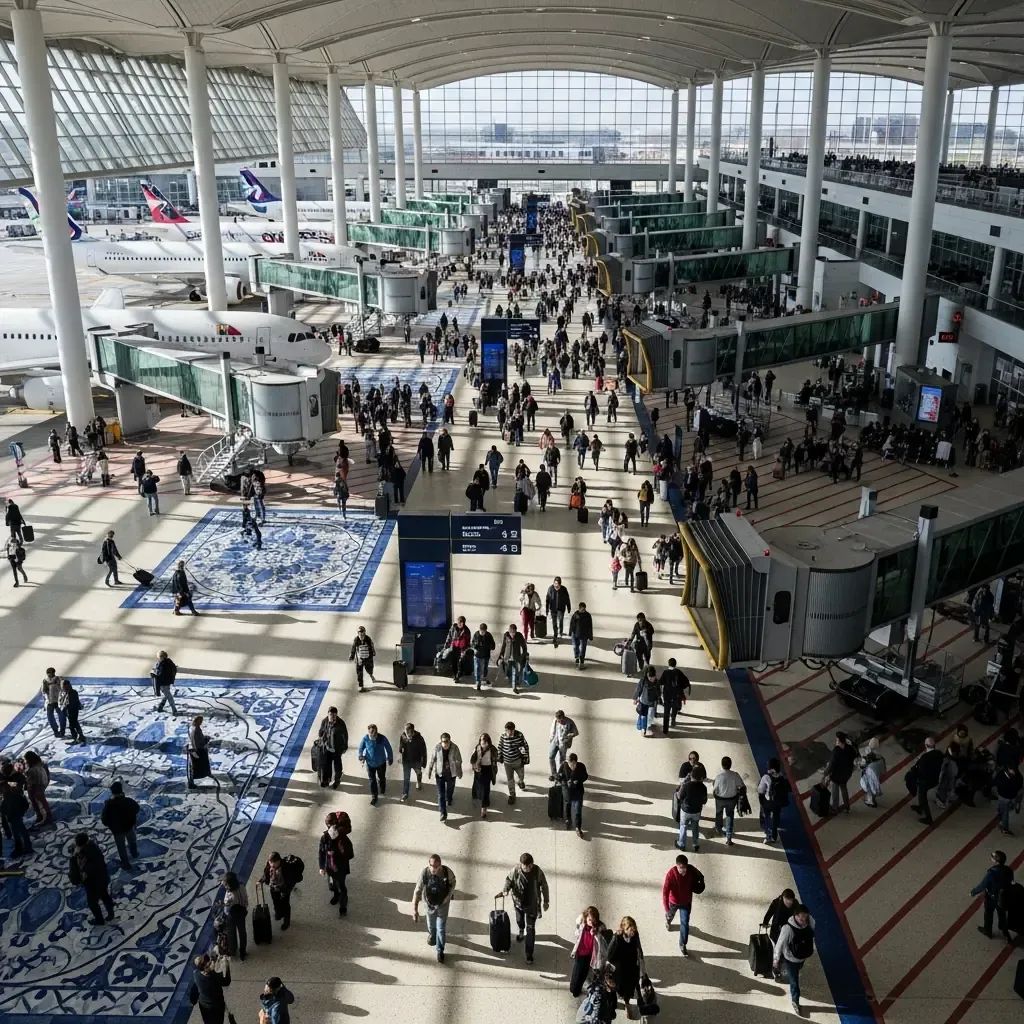
Air travel through Portugal’s gateways ended 2025 on a high note, outpacing last year’s totals, stretching terminal capacity and feeding fresh debates about where the next runway should go. From Lisbon’s perennial squeeze to Madeira’s record-setting leap, the latest figures from the National Statistics Institute (INE) point to a country that—despite economic clouds elsewhere in Europe—remains on the move.
At a glance
• 68.9 M passengers used Portuguese airports from January-November 2025, a 4.7% jump on the same stretch of 2024.
• November alone handled 5 M travellers, the busiest eleventh month ever recorded.
• Two hubs—Porto and Faro—grew 6.1%, while Madeira surged 13%.
• International traffic made up over 82% of arrivals and 83% of departures.
• Cargo cooled, slipping 2.3% in November.
Why the uptick matters to residents
For people living in Portugal, these numbers are more than abstract data points. Busier airports translate into jobs, tourism income and—less pleasantly—longer queues. Aviation already underpins roughly 7% of national GDP and supports hundreds of thousands of positions. Each extra million passengers can ignite up to 10 000 direct and indirect jobs, according to aviation economists. The 4.7% rise therefore carries real-world weight, especially in regions that rely heavily on visitor spending.
November’s sprint: decoding the data
The penultimate month of 2025 brought a 5% year-on-year increase in traveller volumes. Daily, an average of 79 100 people disembarked, up from 75 800 a year earlier. Commercial landings hit 17 500, expanding 4.8%. International routes dominated: 1.9 M inbound and 2.2 M outbound passengers, mostly on European legs. Yet the Americas provided the fastest lift, clocking double-digit growth above 13% on both sides of the Atlantic.
Regional winners—and the capacity pinch points
Lisbon still towers over the field, funnelling 48.6% of all traffic, but its growth slowed to 2.9%, a reminder that scarce slots and ground-handling bottlenecks have become routine. By contrast, Porto’s Francisco Sá Carneiro Airport turned in another lively year, buoyed by low-cost carriers and an emerging tech-tourism scene. Down south, Faro thrived on early summer bookings and off-season golf breaks, while the Madeira archipelago broke its own passenger record, thanks to cruise-to-air itineraries and remote-work visas.
What’s fuelling the surge?
Several overlapping forces explain the resilience:
Strong British and German demand—the United Kingdom remains Portugal’s top origin and destination market, followed closely by Germany and France.
Expanded short-haul capacity—airlines such as Ryanair, easyJet and Vueling have added rotations to second-tier cities, keeping fares competitive.
Long-haul revival—non-stop links to the United States, Brazil and, increasingly, Canada, gave Lisbon in particular a higher-yield mix of passengers.
Holiday-home effect—Northern Europeans continue to snap up property along the Algarve and in the interior, generating repeat travel.
Euro-denominated bargains—with Portugal still cheaper than many Mediterranean peers, visitors find their money stretches further.
Economic ripples beyond the terminals
The impact spreads well outside the perimeter fences. Hotels in Porto logged occupancy above 75% even in shoulder months, while Algarve restaurateurs reported turnover gains exceeding 9% year-on-year. Real-estate agents in Madeira noted a spike in winter lettings, a by-product of its 13% passenger leap. Meanwhile cargo softness—a 2.3% drop in November—has sparked concern among exporters relying on quick airfreight, especially pharmaceutical and high-value agro-food firms.
Growing pains and the next runway debate
The renewed momentum resurrects an old headache: Lisbon’s Humberto Delgado is operating beyond design limits, with peak-hour delays that ripple across European airspace. Successive governments have weighed expansion versus a green-field site across the Tagus. The latest INE bulletin gives that discussion fresh urgency. Without additional capacity, analysts warn the country could forfeit up to €7 B in foregone tourism receipts by 2030.
Looking ahead
Barring an external shock, airlines plan to lift seat supply by another 4-5% for summer 2026, betting on sustained leisure demand and corporate travel’s slow return. Yet the sustainability question looms large. Brussels is tightening emissions caps, and Portugal has pledged to align with the EU’s Fit for 55 agenda. How quickly the industry can pivot to SAF (sustainable aviation fuel) or electric short-haul ventures will shape the next chapter of the country’s aviation story.
For now, passengers keep coming, the economy keeps cashing in, and the runways—at least the existing ones—are busier than ever. Those eyeing Easter getaways might want to lock in tickets early; the numbers suggest 2026 could be another record-breaking year.
Data source: Instituto Nacional de Estatística bulletin on air transport, published December 2025.


