

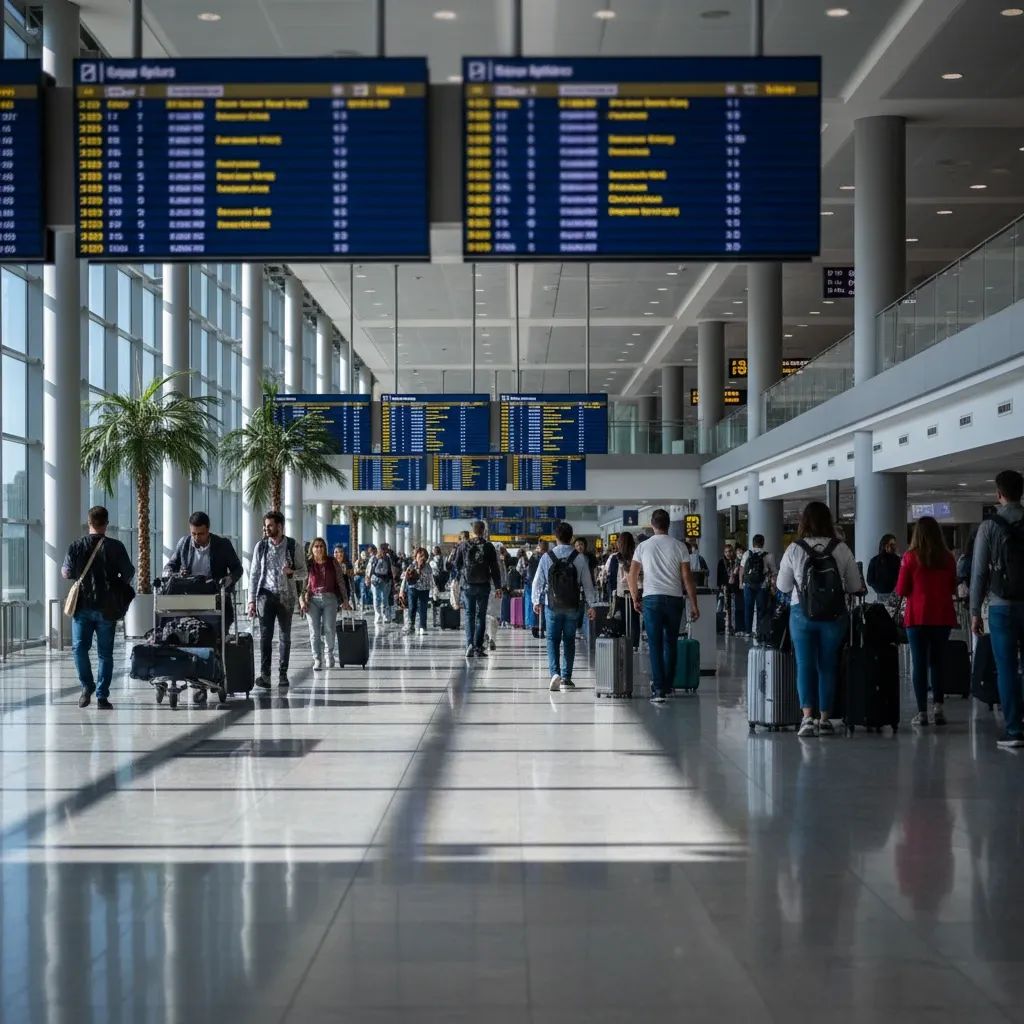
The Portugal airport operator ANA, owned by France’s Vinci Group, has moved a record 72.5 million travelers through the country’s terminals in 2025, a performance that cements Portugal as the company’s second-busiest market worldwide and sets the stage for higher fees and major construction work in the next decade.
Why This Matters
• More flights, fewer seats left – demand outpaced capacity in Lisbon and Porto, pushing average load factors above 85 %.
• Airport charges likely to climb – ANA’s plan to finance a new Lisbon hub relies on progressive fee hikes between 2026-2030.
• Construction everywhere – expansions are under way in Lisbon, Porto, Faro, Madeira and the Azores; expect temporary detours and longer security lines.
• Regional tourism windfall – Madeira’s double-digit passenger surge hints at fresh openings for hotels, rental hosts and local suppliers.
How 72.5 Million Passengers Were Distributed
Portugal accounted for 21.7 % of Vinci Airports’ global footfall in 2025. Lisbon’s Humberto Delgado remained the workhorse with 36.1 M users (+2.9 %), while Porto handled 16.9 M (+6.3 %). Faro crossed the psychological 10 M line for the first time, and the two island regions diverged sharply: Madeira jumped 12 % to 5.6 M, whereas the Azores inched up 2.7 % to 3.3 M.
The Movers: A Tale of Four Airports
Lisbon’s growth leaned on new long-haul links to Asia and Latin America that relieved TAP of some transfer pressure, but capacity at the ageing terminal is now saturated at peak hours.
In Porto, a relentless blitz by Ryanair – 72 routes and 12 based aircraft – plus fresh transatlantic services from TAP (Boston) and a forthcoming Delta JFK link drove the north’s 6 % jump. Low-cost carriers supplied roughly 4 in every 10 extra seats added nationwide.
Faro profited from a longer tourism season and rising digital-nomad stays along the Algarve. Yet the biggest headline belongs to Madeira, where United Airlines’ New York route, 12 summer inaugurations and muito bom occupancy rates pushed international traffic up 17.4 %.
What Is Fueling the Growth
Several forces converged:
Rebound in global travel demand, flagged by IATA as an all-time high in 2025.
Aggressive capacity additions from low-cost and legacy airlines, often backed by tourism boards’ co-marketing funds.
Diversification of source markets – more Asian itineraries out of Lisbon and more North-American seats into Madeira and Porto.
A government push for year-round tourism, extending airline schedules beyond traditional summer peaks.
Upgrades Coming to a Terminal Near You
The Portugal Infrastructure Ministry has green-lit a suite of projects worth over €9 billion:
• New Lisbon Airport in Alcochete – two runways, scalable to four, €8.5 B price tag, target opening 2037, funded by higher airport charges and a 30-year concessão extension.• Lisbon interim expansion – 10 new jet bridges, 33 000 m² added to T1, extra stands and solar panels; completion 2027.• Porto runway reinforcement plus biometric checkpoints and a new CIP lounge, budgeted at €50 M.• Faro roof overhaul and fleet electrification, €17 M.• Porto Santo’s new terminal and wind-farm investment, >€50 M.• Azores terminal refurbishments in Ponta Delgada and Horta, €17 M.
Expect periodic lane closures, early-morning works and occasional noise-curfew waivers during these builds.
What This Means for Residents
For those living in Portugal – locals, expats, digital nomads:
• Ticket prices may tighten as high load factors leave fewer last-minute bargains.• Airport taxes will edge up gradually; budget €3-€5 extra per departure from 2026.• More nonstop options to North America and Asia cut connection times and can make regional airports (Porto, Madeira) attractive alternatives to Lisbon.• Travel-day logistics could be messier: arrive earlier, use online security-slot booking where available, and consider public transport to dodge construction-related parking squeezes.• Property owners in Madeira and the Algarve might see occupancy lift if airlines keep additional winter flights.
Looking Ahead
ANA’s projections assume the national network could surpass 90 M passengers by 2030 if the Alcochete project stays on schedule. That target, however, hinges on three variables: the pace of fee approvals by Portugal’s Civil Aviation Authority (ANAC), airline appetite for new slots, and the global economic outlook. For now, the surge is translating into fuller restaurants, busier metro carriages and a brisker tourism economy – but also into the growing pains of a country whose main gateway was designed for barely half the traffic it now wrestles each year.


