

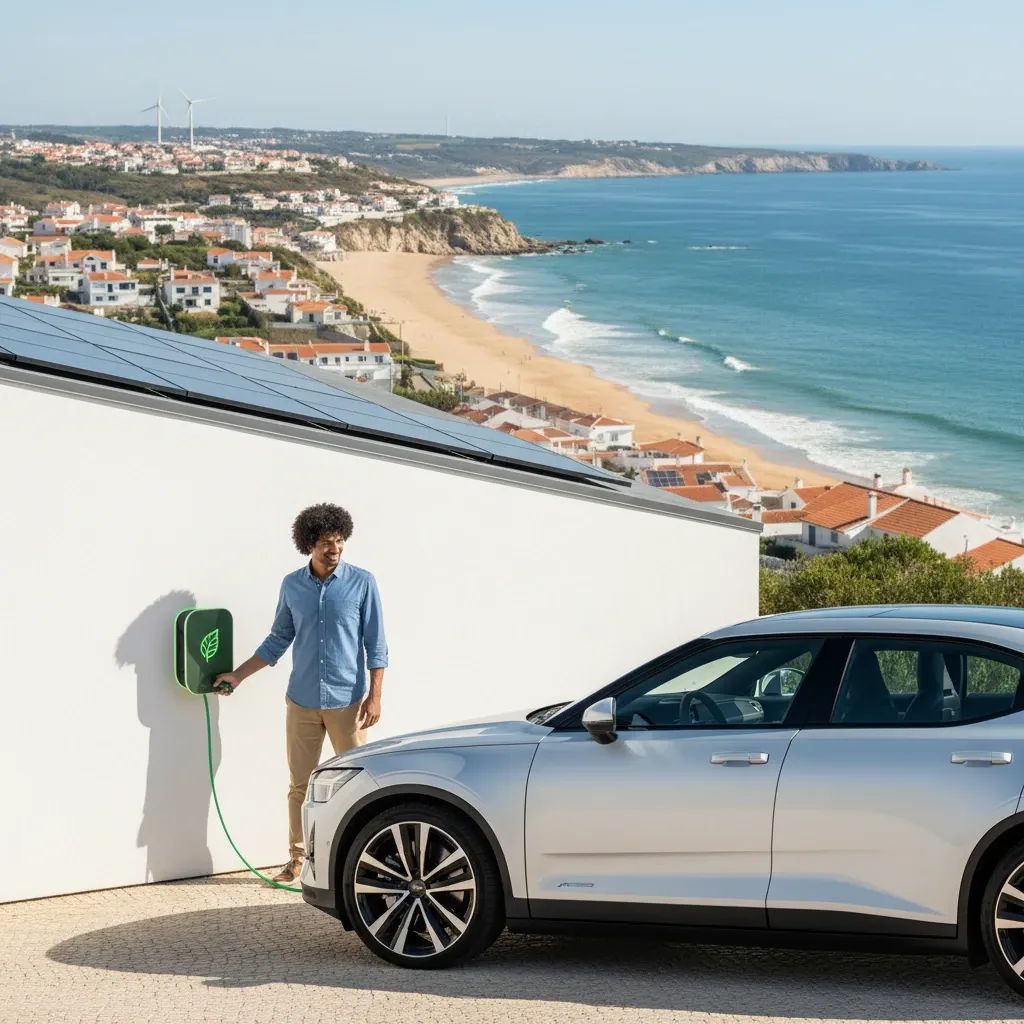
The Portugal Ministry of Environment has confirmed a €20M fund for electric vehicle subsidies opening between May and June, marking a substantial increase over previous rounds and positioning the country among Europe's more aggressive EV adopters despite persistent infrastructure gaps.
Why This Matters
• €4,000 direct subsidy for individual buyers purchasing new electric passenger cars under €38,500 (€55,000 for 5+ seaters), contingent on scrapping a fossil-fuel vehicle older than 10 years.
• Application window opens May-June 2026, with funds distributed first-come, first-served—previous rounds sold out within hours.
• Tax exemptions remain intact: ISV (vehicle tax) and IUC (circulation tax) waivers continue for 100% electric vehicles, with companies deducting full VAT up to €62,500.
• Bikes, scooters, and cargo bicycles eligible for €500–€1,500 subsidies; home chargers covered at 80% cost up to €800.
The Competitive Rush for Funding
Environment Minister Maria da Graça Carvalho told Parliament the new allocation represents an "emblematic measure" in Portugal's decarbonization strategy, with transport accounting for the largest share of national carbon emissions. The €20M budget reflects a 14% uptick from the €17.6M deployed in the last cycle, which launched on December 29, 2025, and exhausted individual allocations within hours.
That December scramble awarded 2,200 vouchers to private buyers, a pattern that underscores both surging demand and the program's structural bottleneck: finite funds released in sprint-style windows rather than year-round availability. The Portugal Environmental Fund, which administers the scheme, processes applications on a rolling basis until the money runs dry, rewarding speed over need or carbon-reduction potential.
Who Gets What
Private individuals receive €4,000 per qualifying electric passenger car. The car must be brand-new, cost no more than €38,500 including VAT and fees—or €55,000 for vehicles seating six or more—and the buyer must permanently deregister a combustion-engine car registered before 2016. Non-profit social institutions (IPSS), transport authorities, and municipalities qualify for €5,000 per vehicle under the same price caps. Private companies are excluded from direct subsidies but retain full ISV and IUC exemptions plus 0% autonomous taxation on electric fleets valued below €62,500.
The program extends beyond cars. Electric cargo bicycles with pedal assist draw up to €1,500; cargo bikes without electric motors qualify for €1,000. Standard e-bikes fetch €750, conventional bicycles €500. Electric motorcycles, mopeds, three-wheelers, and quadricycles cap at €1,500. Personal mobility devices—e-scooters, electric unicycles—receive 50% of purchase price up to €500. A separate notice for light commercial vehicles (N1 category) promises subsidies reaching €6,000, though launch details remain unconfirmed.
Home charging stations enjoy 80% cost coverage up to €800 per unit, with installation expenses in condominium parking spaces subsidized up to €1,000 per slot, capped at 10 units per building. Recipients must retain ownership for 24 months and cannot export the vehicle or equipment during that period.
Market Momentum Versus Infrastructure Friction
Portugal matriculated 52,256 electric vehicles in 2025, a 25.1% jump from 2024, lifting BEVs to 23.2% of the total passenger-car market—two percentage points above the EU average of 22%. Tesla led sales with 7,585 units, followed by BYD (4,938), BMW (4,604), Peugeot (4,197), and Mercedes-Benz (3,039). The first half of 2025 saw 6,883 all-electric registrations across all categories, up 41% year-on-year.
Yet adoption faces structural headwinds. 101 municipalities lack fast-charging stations; 231 have no ultra-fast infrastructure. The national average stands at 77 users per fast-charging point, more than double the EU benchmark. The Portugal Competition Authority flagged geographic asymmetry and barriers to new charging-network operators, while 42% of households lack access to private parking, forcing reliance on public charging that can cost twice the price of home electricity—sometimes rivaling diesel fuel expenses.
The MOBI.E network, operational since 2010, remains one of Europe's earliest interoperable charging systems, but the country had roughly 8,000 public chargers by mid-2025, short of the EU's AFIR regulation target of 15,000 by year-end 2025. Average purchase prices compound the challenge: the ten cheapest EVs in Portugal average €30,000, versus €25,000 in the Netherlands and €24,000 in Germany, reflecting lower economies of scale and higher logistics costs.
What This Means for Residents
If you're weighing a switch to electric, the subsidy math favors early movers. A €4,000 voucher covers roughly 10% to 13% of a qualifying vehicle's price, stacking with permanent ISV and IUC waivers that together save €3,000–€5,000 over five years, depending on engine size and CO₂ rating of the displaced car. For households with off-street parking, the €800 charger subsidy plus €1,000 installation grant can cover most or all setup costs, reducing per-kilometer energy expenses to roughly one-third the cost of gasoline at current Lisbon pump prices of €1.75/liter.
Timing is critical. The Environmental Fund portal opens applications exclusively online, evaluated sequentially until exhaustion. Set calendar alerts for late May, ensure your combustion vehicle's registration certificate confirms a pre-2016 date, and prepare proof of residence, tax identification, and dealership invoices in advance. Prior rounds closed within six to eight hours; expect similar velocity.
For buyers without access to home charging, public infrastructure remains patchy outside Lisbon, Porto, and the Algarve corridor. Fast-charging sessions in rural municipalities often require detours of 20 km or more, and pricing opacity—operators use proprietary apps with opaque tariffs—can inflate costs unpredictably. If your daily commute exceeds 60 km round-trip and you rely on street parking, consider whether a plug-in hybrid under the €38,500 cap better suits operational reality, even though ISV exemptions apply only to battery-electrics.
Companies benefit from deeper fiscal relief: 100% VAT deduction on vehicles under €62,500, 0% autonomous tax versus 10%–35% for combustion fleets, and elimination of benefit-in-kind taxation on EV company cars for employees. For fleets turning over more than five units annually, these incentives can shift total cost of ownership below diesel equivalents within three years, particularly if charging infrastructure is installed on-site using solar panels—another subsidy stream Environment Minister Carvalho confirmed for 2026, details pending.
Regional and European Context
Portugal's 33.3% plug-in market share in 2024 outpaced France (25.7%), Germany (20.2%), Spain (11.5%), and Italy (7.6%), reflecting sustained policy consistency since the first incentive round in 2018. Spain's MOVES III program offered up to €7,000 with scrappage until December 2025, €2,500 more than Portugal's ceiling, but required regional co-funding that often delayed disbursements by months. Germany's subsidy scheme collapsed in December 2023 after budget reallocations, creating market volatility that saw EV sales plunge 27% in early 2024.
Portugal's model—centralized funding, transparent eligibility, and stable tax exemptions—has delivered steadier growth, but the sprint-window allocation format introduces artificial urgency and excludes buyers whose purchase timelines fall outside the two-month application window. Shifting to a year-round rolling fund with monthly caps, as Norway operates, could smooth demand and reduce the server crashes that plagued the December 2025 launch.
Heavy-vehicle electrification lags at 5% of 2023 sales, underscoring the N1 light commercial program's importance for tradespeople and small logistics operators. The promised €6,000 subsidy could accelerate fleet replacement among plumbers, electricians, and delivery services, sectors where combustion vans dominate due to payload anxiety and charging-time constraints.
Impact on Expats and Investors
Non-resident taxpayers with Portuguese tax identification qualify for the subsidy provided the vehicle is registered to a Portuguese address and the scrappage requirement is met. Expats importing used EVs from Germany or France cannot claim the incentive; only factory-new purchases from authorized dealers count. The 24-month ownership clause complicates plans for digital nomads or temporary residents; violating it triggers full subsidy clawback plus penalties.
For property investors, installing EV charging infrastructure in rental units or condominium developments adds tangible value—units with dedicated chargers command 8%–12% rental premiums in Lisbon and Porto, according to 2025 data from Confidencial Imobiliário. The condominium subsidy allows buildings to install up to 10 chargers at minimal net cost, preempting future tenant demand and differentiating listings in competitive markets.
The government's parallel solar-panel support program, details of which remain forthcoming, could further tilt lifetime economics. Pairing rooftop solar with home EV charging drops per-kilometer energy costs below €0.02, less than one-tenth the equivalent diesel expense. For households installing 4 kW systems, payback periods in southern regions fall to six to seven years even without subsidies; with grants, breakeven could arrive within four years.
The Clock Starts Now
Preparation separates successful applicants from disappointed ones. Verify your old car's registration date at IMT (Instituto da Mobilidade e dos Transportes). If borderline, request a formal certificate; discrepancies between electronic records and physical documents have disqualified applicants. Scout dealerships now for stock availability—Tesla, BYD, and Peugeot typically hold inventory, but lesser-known Chinese brands like MG and Nio operate on order-only models with 8-to-12-week delivery lags.
Confirm your bank's willingness to finance the pre-subsidy price; the €4,000 arrives as reimbursement 60–90 days post-purchase, not as a point-of-sale discount. Budget accordingly. Monitor the Fundo Ambiental website for the exact launch date, expected in the third week of May based on prior patterns.
Portugal's EV transition hinges less on technology than on execution: matching subsidy windows to buyer behavior, expanding charging networks beyond coastal corridors, and maintaining fiscal clarity as Brussels pressures member states to harmonize green incentives. The €20M fund won't satisfy all demand—at €4,000 per voucher, it covers roughly 5,000 cars, 9.6% of 2025's electric sales—but for the segment that wins the allocation race, the shift to zero-emission mobility just became materially cheaper.


