

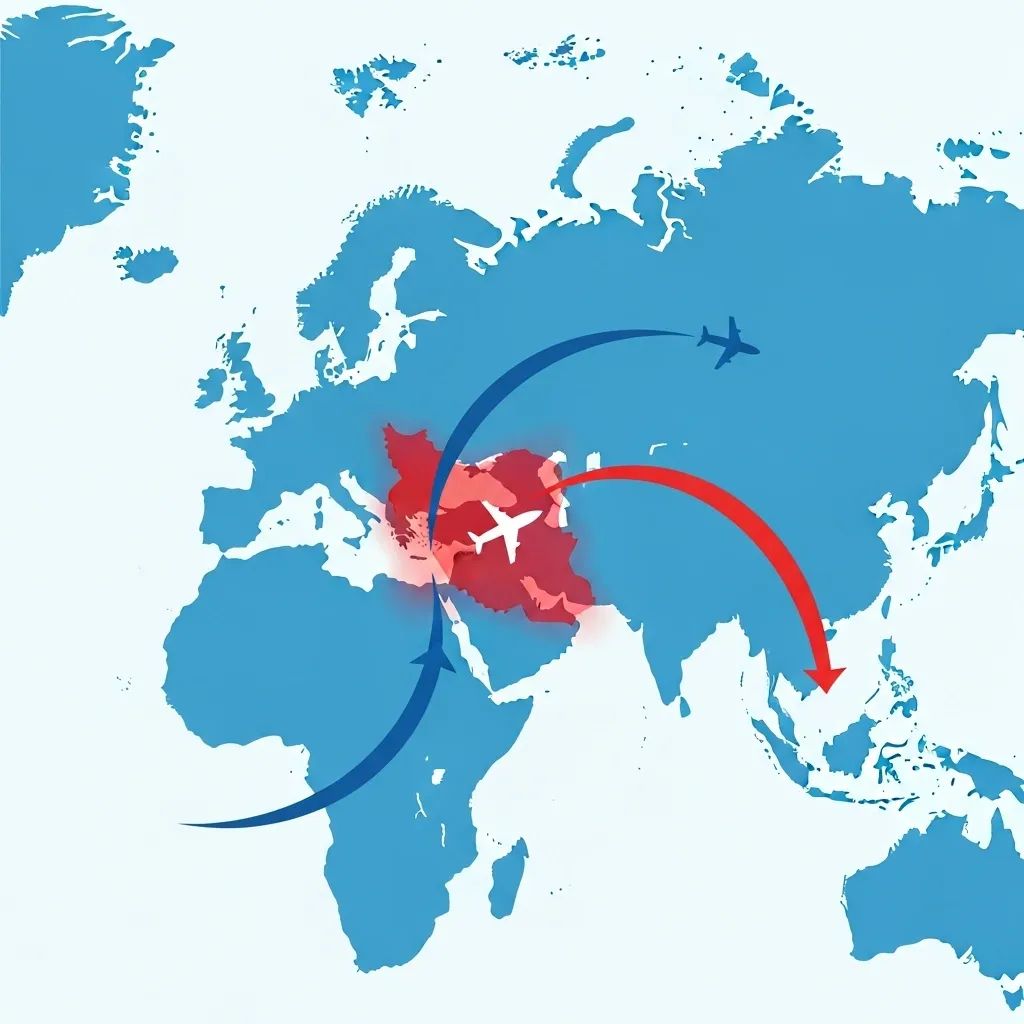
Flights between Europe and Asia may soon feel longer on the wallet and the clock for travellers departing Portugal. A fresh safety bulletin from the EU’s aviation watchdog urges carriers to steer clear of Iranian skies, warning that jittery air-defence systems and the prospect of a US strike create an unusually dangerous mix for civil aircraft. The guidance is already reshaping routes, insurance costs and ultimately ticket prices across the continent.
Quick Lens: what just changed?
• EASA Conflict Zone Information Bulletin (CZIB) designates the Tehran flight-information region “high risk” at all altitudes
• Mis-identification of civil jets by Iranian surface-to-air batteries cited as the primary threat
• Lufthansa Group, KLM, British Airways, Wizz Air, Finnair, Ryanair and TUI have either suspended Tehran services or plotted detours around Iran and Iraq
• War-risk insurance premiums in London shot up, adding thousands of euros to a single wide-body rotation
• Extra fuel burns and crew hours could push long-haul fares up, including those paid by passengers connecting out of Lisbon and Porto
Why it matters for Portuguese flyers
While TAP Air Portugal does not currently cross Iranian airspace, many Lisbon-based travellers connect in Frankfurt, Amsterdam or London for onward journeys to Bangkok, Tokyo or Sydney. Detours around Iran mean:
Longer flight times—up to 3 extra hours on some Europe-to-Gulf legs
Higher fares—carriers have begun applying Asia-surcharges of €40-€95 according to two ticket consolidators in Porto
Tighter seat availability—airlines are trimming winter schedules to stay within crew-duty limits
The trigger: red alarms from Brussels
EASA’s alert, released in mid-January as a Conflict Zone Information Bulletin, speaks of “a wide array of ground-to-air weapons” and “unpredictable state response”. The agency draws a direct line between the United States’ public hints of possible military action and Iran’s habit of placing its surface-to-air missile (SAM) units on hair-trigger. The memory of Ukraine International Flight 752, downed near Tehran in 2020 after an erroneous SAM launch, still weighs heavily on regulators.
Airlines re-draw the map overnight
The first to act was Lufthansa, extending its Tehran suspension until late March and routing Asia services over the Black Sea and Central Asia. Its Austrian offshoot followed suit. KLM and British Airways quietly redirected flights to the Gulf via Saudi Arabia and the Red Sea corridor. Ultra-low-cost Wizz Air is now planning fuel stops in Larnaca or Thessaloniki for westbound runs from Dubai, while Finnair relies on a southern arc that keeps jets above the Arabian Desert. Even budget champion Ryanair has banned dispatchers from filing flight plans through either Iran or Iraq.
Insurance underwriters tighten the screws
London-based war-risk insurers classified the Persian Gulf as a “Hull War Risk Area”, triggering instant surcharges. Brokers say a typical A350 now attracts an extra $6,000-$8,000 per crossing, a cost few carriers can absorb. Israel, keen to keep foreign airlines coming, has already rolled out an $8 B state-backed coverage scheme; no parallel mechanism exists for flights near Iran, leaving European operators to swallow the bill—or pass it along to passengers.
Cargo, tourism and the Iberian supply chain
Portuguese exporters of fresh fish, wine and pharma products rely heavily on belly-hold capacity via Middle-East hubs. Forwarders report that longer routings are eroding the shelf-life margin on perishables and boosting freight rates by 12-15 %. Leisure agencies in the Algarve, meanwhile, fear that costlier fares to Asian destinations could cool the Chinese outbound market just as it was recovering.
How long could the detour last?
Diplomats in Brussels point to two milestones: Washington’s final decision on a possible strike package and Tehran’s readiness to de-escalate. Until one of those dominoes falls, regulators are expected to keep the CZIB in force. A senior EASA official, speaking under the usual anonymity, hinted that quarterly reviews are the bare minimum.
Tips before you book
Check your itinerary: If a multi-stop ticket uses a carrier on the detour list, expect schedule changes.
Build in slack: Allow extra connection time—inbound flights from Asia may arrive late into European hubs.
Watch fare classes: Some airlines temporarily cap lower economy buckets to offset higher operating costs; early booking helps.
Monitor travel alerts: Both EASA and Portugal’s Ministério dos Negócios Estrangeiros publish updated guidance that can affect insurance coverage.
Portuguese travellers have little control over geopolitics, but staying informed can soften the impact on their time, budget and peace of mind as the Gulf flashpoint reverberates across global aviation.


