

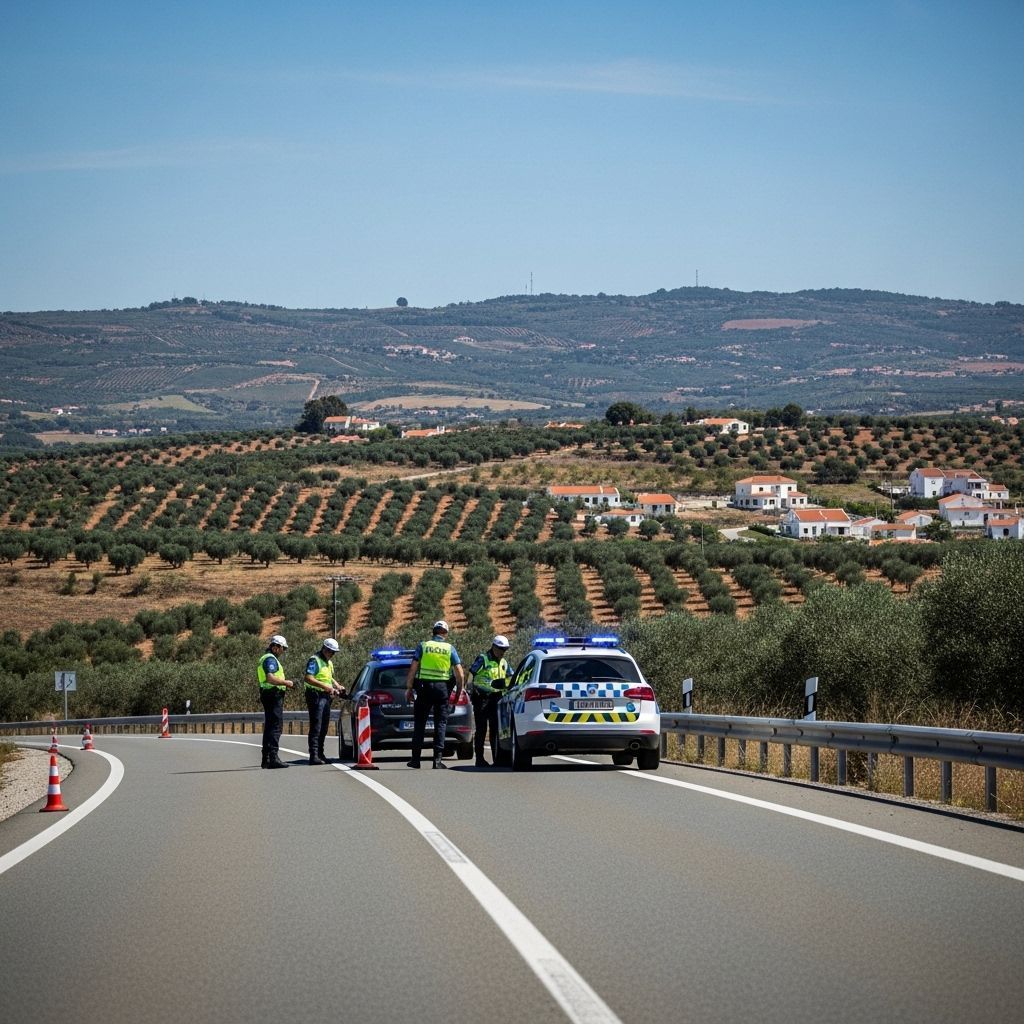
The Portugal Public Security Police (PSP) has pulled nearly 2,000 drivers off the road for criminal-level alcohol impairment in the first four months of 2026, highlighting an ongoing road safety challenge that continues to claim lives despite enforcement efforts.
Why This Matters
• Criminal threshold breached daily: An average of 29 drivers per day were caught exceeding legal alcohol limits in urban areas through late April, with 1,909 arrests for blood alcohol levels at or above the criminal threshold of 1.2 g/l.
• Urban death toll rises: PSP jurisdiction recorded 18,445 accidents, 30 fatalities, 229 serious injuries, and over 5,000 minor injuries in the first four months of 2026.
• Risk doubles at legal limit: Even at the legal limit of 0.5 g/l, crash risk doubles; most offenders far exceed this baseline.
• Enforcement intensifies: Authorities conducted 6,551 roadside operations, screening 223,908 drivers and administering 66,020 breathalyzer tests since the start of the year.
Scope of the Problem in Portugal's Cities
The PSP's enforcement sweep through Portugal's urban centers reveals an alarming pattern: of the 66,020 breathalyzer tests administered between January 1 and late April, 3,229 drivers tested positive for excess alcohol. Of those, nearly 60% crossed into criminal territory, meaning their blood alcohol concentration reached at least 1.2 g/l—a level that severely impairs judgment, reaction time, and motor coordination.
The remaining 1,320 offenders received administrative fines for levels between 0.5 g/l and 1.19 g/l, still dangerous but below the criminal threshold. This means that on any given day in Portugal's cities, roughly three dozen drivers are behind the wheel while legally impaired or committing a crime.
The enforcement numbers tell only part of the story. The Portugal National Republican Guard (GNR), which patrols rural roads and highways, reported an additional 4,752 criminal alcohol arrests between January and April 2026, after screening over 751,000 drivers. Combined, the two forces paint a picture of a nationwide enforcement challenge that stretches from Lisbon's Avenida da Liberdade to the back roads of the Alentejo.
The Human Cost: Accidents and Fatalities
Behind the statistics lie tangible consequences. In PSP jurisdiction alone—Portugal's major urban areas—18,445 road accidents occurred in the first 16 weeks of 2026. While not all were alcohol-related, the agency emphasized that impaired driving remains one of the three leading causes of road fatalities, alongside speeding and mobile phone distraction.
Nationally, provisional data from the Portugal National Road Safety Authority (ANSR) show a troubling year-on-year increase: road accidents climbed 12.89% compared to the same period in 2025, while fatalities surged 42.72%. The GNR recorded 127 deaths and 492 serious injuries in its jurisdiction through late April, reinforcing the scale of the crisis.
Alcohol's role in this carnage is well-documented. In 2024, 36.5% of road fatalities involved victims with blood alcohol levels at or above 0.5 g/l. Of those, 73% had criminal-level intoxication exceeding 1.2 g/l. The data suggests that when alcohol is involved, crashes are not only more likely—they are "particularly severe," as PSP officials noted in their public warning.
How Alcohol Impairs Driving
The PSP issued a detailed caution about alcohol's physiological effects. At 0.5 g/l—the legal limit for most drivers—the risk of a fatal or serious crash doubles. Beyond that threshold, the dangers escalate rapidly.
Alcohol consumption narrows the visual field, creating what experts call "tunnel vision." It delays decision-making and reaction time, often by critical fractions of a second. It also disrupts motor coordination, making it harder to steer, brake, or execute evasive maneuvers. These impairments compound each other, exponentially increasing the likelihood of a collision.
Portugal's legal framework recognizes these hazards through a tiered penalty system. Drivers caught between 0.5 g/l and 0.79 g/l face fines ranging from €250 to €1,250 (roughly 15 days to one month's minimum wage), lose three points from their license, and may be banned from driving for up to 12 months. At 0.8 g/l to 1.19 g/l, penalties escalate to €500–€2,500 fines, five-point deductions, and bans lasting up to 24 months. Once the threshold hits 1.2 g/l, the offense becomes a crime punishable by up to one year in prison, a six-point license penalty, and driving bans stretching up to three years.
Impact on Residents and Daily Commuters
For those living in Portugal, the enforcement blitz translates into more frequent roadside checkpoints, particularly during holiday periods and weekends. The PSP's 6,551 operations since January represent an intensification of visible policing, with breathalyzer stations appearing on major arterial roads, near nightlife districts, and along commuter corridors.
Where checkpoints are set up: In Lisbon, expect stops on the 2nd Circular Road, near the Príncipe Real nightlife district, and heading out toward the IC19. In Porto, the Ribeira waterfront area and the A1 motorway are enforcement hotspots. Coastal towns like Cascais and Estoril see increased checkpoints during weekends and holiday periods. The ACP reports that PSP operations intensify near restaurants, bars, and areas known for evening entertainment.
What happens if you're stopped: Police will signal you to pull over safely. You'll be asked for your documents—license, vehicle registration, and insurance. Officers will conduct a roadside breath test (preliminary screening). If you test positive or refuse, you'll be transported to the police station for a more accurate breath or blood test. Refusal is treated as an admission of guilt and carries the same penalties as testing positive.
License points and foreign drivers: Portugal operates a 12-point penalty system. Each infraction deducts points, and reaching zero means automatic suspension. If you hold an EU license, your points transfer; if you're a non-EU resident, you can request a Portuguese license, and any violations will be recorded. Some countries have reciprocal agreements with Portugal, so violations may also be reported to your home country's licensing authority.
Professional drivers and probationary license holders: In Portugal, new drivers receive a probationary license for their first three years, during which stricter limits apply. Professional drivers—including taxi operators, delivery couriers, and heavy vehicle operators—must stay below 0.2 g/l, a threshold easily crossed after a single glass of wine. Probationary license holders face the same 0.2 g/l limit and harsher penalties for violations.
Cost comparison: A €1,250 fine represents roughly one month's minimum wage in Portugal. A €2,500 fine equals two months' wages. For comparison, a ride-sharing service (Uber or similar) across Lisbon costs €8–15; a taxi might run €15–25. Lost time from a one-year driving ban could cost an employed resident thousands in transportation expenses or job implications. The math strongly favors alternative transport if you've consumed any alcohol.
Residents should expect this trend to continue. The government announced plans to eliminate advance warnings for STOP operations, making it harder for intoxicated drivers to avoid detection. The Automóvel Club de Portugal (ACP) has also proposed "zero tolerance" policies for professional drivers, emergency services, and those in the three-year probationary period following license issuance.
For expats and newcomers, understanding Portugal's stricter limits for certain categories is essential. Refusing a breathalyzer test carries its own penalties, treating the refusal as an admission of guilt. The practical advice is straightforward: if you plan to drink, arrange alternative transport. Ride-hailing apps, public transit, and designated driver arrangements are far cheaper than penalties or a year without a license.
National Context: A Structural Problem
Portugal's alcohol-related road safety issue is not new, but it has proven resistant to intervention. Despite the "Taxa Zero ao Volante" (Zero Rate at the Wheel) campaign launched in February 2025 by the ANSR, GNR, and PSP, infraction rates have climbed. Between 2019 and 2024, the number of drivers caught at criminal alcohol levels rose 72.3%, and by 2024, 58.1% of all alcohol offenders detected were already in the criminal category.
During the Easter 2026 enforcement operation, authorities detained over 630 drivers for drunk driving in a single week. Holiday periods consistently reveal the problem's depth: during the Christmas and New Year operation spanning late December 2025, an average of 76 drivers per day were arrested for excess alcohol.
Experts increasingly question whether enforcement alone can solve the problem. The Portuguese Road Safety Association (PRP) advocates for a multi-pronged strategy: public health measures to reduce excessive alcohol consumption, further reductions in legal limits, consistent and visible policing, social norm campaigns, and better access to alternative transport options.
European Comparison: Where Portugal Stands
Understanding how Portugal compares to other European countries provides important context for residents from abroad. Portugal's 0.5 g/l limit aligns with most of the European Union, including France, Germany, Spain, and Italy. However, several countries have adopted stricter standards. Sweden, Poland, and Estonia enforce a 0.2 g/l limit for all drivers, while Bulgaria, Hungary, Slovakia, the Czech Republic, and Romania mandate zero tolerance (0.0 g/l).
Some nations deploy innovative enforcement technologies. Sweden uses mobile "alcohol barriers"—electronic gates that require drivers to pass a breathalyzer before opening. If the test fails, the gate remains closed and police are alerted. France and Italy have introduced mandatory alcohol interlock devices for repeat offenders, physically preventing a vehicle from starting if the driver's breath exceeds the limit.
Portugal has yet to adopt such technologies at scale, relying instead on traditional roadside enforcement and post-conviction penalties. The ACP's 2026 proposals signal a potential shift, with calls for harsher fines starting at 0.2 g/l for general drivers and absolute prohibition for high-risk categories.
What Comes Next
The PSP's enforcement data through April suggests that 2026 could become one of the deadliest years on Portugal's roads in recent memory. With fatalities already up 42% year-on-year by mid-spring, authorities face mounting pressure to act decisively.
The government has signaled intentions to revise the Highway Code, potentially tightening limits and penalties. Advocacy groups continue to push for structural interventions—better public transit, safer urban design, and alcohol-serving venues required to promote safe transport options.
For now, the message from the PSP is unambiguous: impaired driving will face aggressive enforcement. Whether that enforcement translates into behavioral change remains an open question, but the statistics leave little room for complacency. Every day, nearly 30 drivers in Portugal's cities are caught driving drunk—and those are only the ones who are stopped.


