
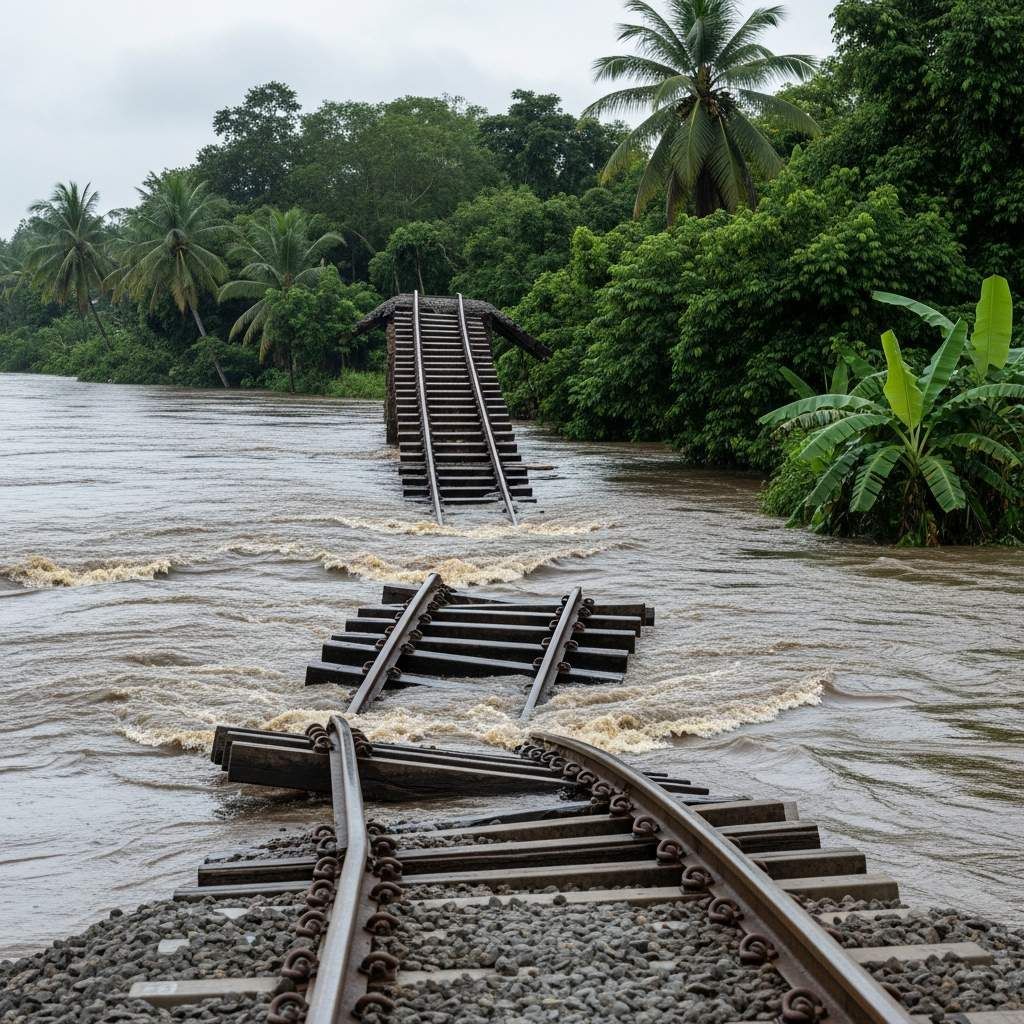
Heavy rain that swept across Thailand’s lower South during the past week has snapped the country’s main rail lifeline to Hat Yai, leaving passengers, freight operators and hotel owners scrambling for alternate routes while engineers race against the clock.
Rail artery cut by sudden surge
Eyewitness video shared online shows a section of track near Ban Khok Mao in Tha Chang Municipality hanging in mid-air, the ballast washed away by a torrent that struck shortly before dawn on Tuesday. The State Railway of Thailand confirmed that water flowing off the Titiwangsa foothills undercut more than 150 m of the southern line, forcing an immediate shutdown. Eight services have been truncated to the closest intact stations and another 22, including all overnight sleepers to the Deep South, are now cancelled until further notice.
What the break means for the South
The paralysis comes at the worst possible moment for Songkhla. Year-end holidaymakers heading to the province’s beaches and to the Malaysian border had been expected to lift occupancy rates after a sluggish low season. Instead, tour vans are now fighting for space on Highway 41, adding to congestion just as residents in Nakhon Si Thammarat and Phatthalung shift belongings to higher ground. SRT data from last year show that roughly 9,000 passengers ride the Bangkok–Hat Yai corridor on a normal December day, highlighting how extensive the knock-on effects could become.
Cargo delays ripple through local industries
Beyond tourism, fresh produce exporters are bracing for higher logistics costs. Rubber, fruit and processed seafood usually move north on refrigerated rail wagons that arrive in Lat Krabang within 24 hours; trucking the same cargo can take up to 36 hours and cost 40 % more. Crucially, small factories in Chumphon and Surat Thani depend on south-bound trains to receive fuel oil from the central plains, raising fears of production cuts if the closure drags on.
Engineers weigh repair options
SRT’s civil-works team told reporters they have two choices: rebuild the washed-out embankment in its original form or install a concrete viaduct that lets floodwater pass freely. The first is quicker—ten days in ideal conditions—but risks a repeat if the monsoon intensifies. The viaduct could last decades yet may take a month, given the need to drive piles in saturated soil. Officials must also wait for the Royal Irrigation Department to divert part of the run-off before heavy machinery can safely enter the site.
Climate-driven extremes becoming the new norm
Meteorologists have linked this week’s cloudbursts to a strong Northeast Monsoon interacting with a low-pressure cell over the South China Sea, a pattern that has grown more erratic as ocean temperatures climb. The Department of Disaster Prevention notes that the South now experiences at least four significant flooding episodes each year—double the average of the early 2000s—putting critical infrastructure under constant stress.
Practical advice for would-be passengers
Travellers who already hold tickets for suspended trains can claim full refunds at any station, while those still determined to reach the Deep South are being guided toward the Transport Company’s express buses. SRT warns that seats on buses departing Bangkok’s Southern Terminal are expected to sell out quickly and advises buying online rather than showing up in person. Airline carriers, for their part, have introduced limited rescue fares between Don Mueang and Hat Yai, but availability fluctuates as storms disrupt flight schedules.
Looking ahead
Weather forecasters see another tropical disturbance forming east of Borneo, raising the spectre of fresh downpours next week. For many residents, the question is not just when the trains will run again, but whether Thailand is prepared to climate-proof the vital corridor that binds its northern capital to the southernmost tip of the Malay Peninsula.


