

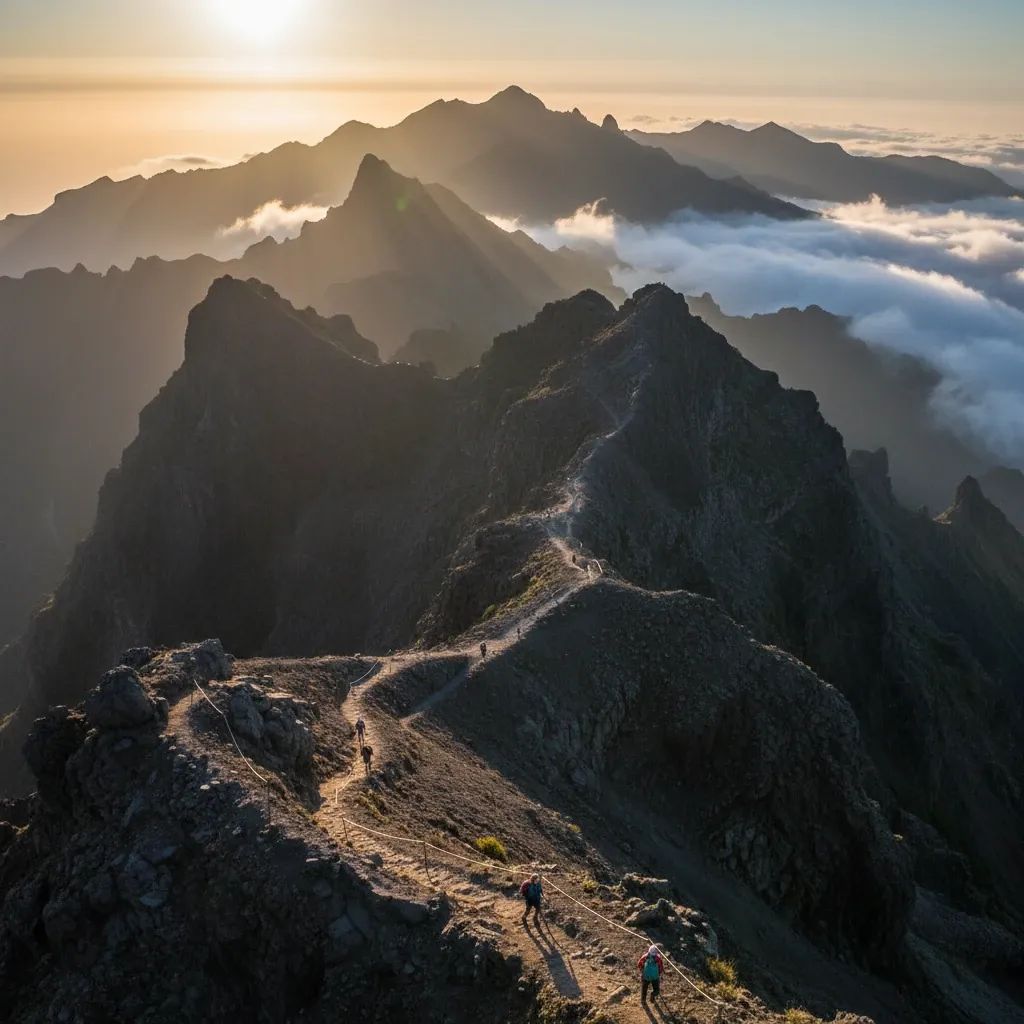
A Mountain Path Reopens: What Madeira's Iconic Ridge Walk Means for Visitors and the Local Economy
When geologists scan the basalt cliffs above 1,800 meters on Madeira, they're looking for cracks. Two years ago, they found plenty. The August 2024 wildfire that blackened over 5,000 hectares across central Madeira didn't just incinerate vegetation—it compromised the very stone that millions of tourists have trusted beneath their boots for decades. Now, after €444,070 in reconstruction, the Vereda do Areeiro (PR1) finally welcomes hikers again, but this isn't a simple return to the past. The 7-kilometer ridge walk between Pico do Areeiro and Pico Ruivo has re-emerged under stricter rules, new fees, and engineering constraints shaped by climate volatility and overcrowding concerns.
Why This Matters
• Phased access through May: The trail operates Friday–Sunday only until late May while crews finalize stabilization work on weekdays; expect weekend congestion and possible delays.
• One-way traffic mandatory: Hikers must now descend from Pico do Areeiro to Pico Ruivo; only the short Areeiro–Pedra Rija segment remains bidirectional, reshaping logistics for tour operators and independent travelers.
• €10.50 entry fee plus online booking: Access requires advance registration via the Simplifica platform; non-residents must pay this fee starting in January 2026, with Madeira residents exempt but still required to book.
The Scale of Recovery After Fire
The August 14, 2024, fire erupted near Serra de Água and swept through four municipalities—Ribeira Brava, Câmara de Lobos, Ponta do Sol, and Santana—before stabilizing crews contained the flames. What firefighters couldn't restore was the geological integrity of Madeira's famous basalt formations. Intense heat can destabilize columnar rock by 20–40%, depending on depth and mineral composition. The island's signature ridge, which had operated uninterrupted for over 30 years, suddenly became a rockfall hazard.
The European Union's FEADER rural development fund supplied €377,460 of the reconstruction budget, with the Madeira Autonomous Region contributing €66,611. The Institute for Forests and Nature Conservation (IFCN) oversaw a methodical reconstruction: clearing charred debris, removing unstable rock masses, resurfacing volcanic-basalt steps, installing drainage systems to prevent erosion from Madeira's intense winter rains, anchoring security cables, reinforcing support walls, and restoring the Miradouro do Ninho da Manta viewpoint. The project, formally coded PRODERAM20-8.5.0-FEADER-002623, reflects both the financial weight of Madeira's natural infrastructure and the rising costs of climate adaptation across European rural zones.
A Cascading Trail Network Still in Limbo
Beyond PR1, the August fire effectively closed a constellation of beloved routes. Most severely affected were the Levada das 25 Fontes (PR6) network, the Levada do Caldeirão Verde (PR9), sections of the Rabaçal circuit, and vertical spurs like the Vereda da Ilha (PR1.1) and Vereda da Encumeada (PR1.3). The fire also triggered secondary damage: between September 2024 and March 2026, December storms and landslides shuttered the Levada Nova, Levada dos Moinhos, and Levada do Rei (PR18) in São Jorge. In December 2025, Storm Laurence forced temporary closures of high-altitude routes and the strategic Areeiro–Eira do Serrado road corridor.
Only partial segments have reopened. On September 4, 2024, IFCN cleared 1.2 kilometers from Pico do Areeiro to Pedra Rija and 2.4 kilometers from Achada do Teixeira to the Pico Ruivo mountain shelter. Access to Pico Ruivo's actual 1,862-meter summit—Portugal's third-highest peak—remained prohibited until now. More than 20 classified trails remain closed or under assessment. The Levada do Furado (PR10), a popular mid-altitude walk, reopened only after €51,000 in rockfall netting and cliff stabilization work by specialized rope-access teams.
This fragmented recovery underscores a structural vulnerability. Madeira's trail network threads through young volcanic terrain where erosion, rockfalls, and rapid vegetation overgrowth are recurring problems, not anomalies. Adding climate volatility—longer droughts punctuated by extreme rainfall and wind events—and you have a maintenance nightmare that outpaces traditional funding models.
How the New Rules Reshape the Experience
The one-way mandate reverses 30 years of practice. Previously, hikers could start from either end, creating negotiating delays on narrow ledges and erosion hotspots. Under the new regime, all traffic flows downhill from Areeiro to Ruivo, theoretically reducing congestion and wear. Tour operators, however, have flagged a logistics problem: shuttle drivers must now position vehicles at opposite trailheads, complicating schedules and increasing fuel costs. Local guides estimate an extra €8–€12 per tour for repositioning.
The phased Friday–Sunday opening during the initial month serves dual purposes: safety oversight and workforce scheduling. Paving crews can work Monday–Thursday without closing the route entirely, but weekend demand will likely exceed capacity. Online booking systems in similar Alpine regions show that peak time slots fill 2–3 weeks in advance, suggesting hikers should reserve spots before late April if planning a May ascent.
The €10.50 fee applies universally to non-residents aged 12 and older. For comparison, most other Madeira trails charge €3; this premium reflects PR1's iconic status and higher maintenance costs. Residents of the Autonomous Region are exempt from fees but must still book online. This two-tier system is designed to generate approximately €180,000–€220,000 annually for trail maintenance (based on estimated visitor flows), though local opposition groups argue the fee structure disadvantages budget travelers and disproportionately favors wealthy tourists.
Tourism's Fragile Rebound
Land-based tour operators reported 90% booking cancellations during the active fire week in August 2024. Accommodations outside Funchal saw visitors defect or postpone trips. Even after flames were extinguished, the damage persisted: hikers ignored interdiction signs on blackened trails, prompting safety warnings and enforcement action by regional authorities. The cascading closures throughout 2024–2025 created a perception problem—Madeira as unreliable—that damaged the island's brand during peak Northern European hiking season.
The timing of PR1's full reopening coincides strategically with the Madeira Island Ultra Trail (MIUT) ultramarathon on April 25–26. This marquee event typically attracts 500–800 elite and amateur trail runners from across Europe, along with support crews, families, and media. Hotels and rental properties that saw 70% occupancy during fire-closure months should see sharper bookings through May. The event functions as a confidence signal: "Madeira is back."
Reinforcing this comeback narrative, the Portugal regional government introduced the UPGRADE program in February 2026. This cross-sector strategy weaves tourism, mobility, environment, housing, and cultural preservation into a unified framework. Specifically, UPGRADE establishes individualized management plans for six protected natural areas, reorganizes parking and access points to reduce bottlenecks, and introduces enforcement fines for hikers who ignore closure signs or venture off-trail. The system caps daily visitor numbers per trail through the online booking portal, ensuring that the island's fragile volcanic ecosystems get seasonal breathing room for maintenance and ecological recovery.
Practical Logistics and Costs for April–May Hikers
If you plan to hike PR1 this month, book immediately via the official Simplifica government portal (Simplifica.gov.pt). Weekend slots are filling rapidly ahead of the MIUT surge.
Note for Madeira residents: You are exempt from the €10.50 fee but must still register online via Simplifica before your visit.
Non-residents should budget:
• Trail fee: €10.50 (paid during online registration)
• Transport: €25–€35 per person for shuttle between Areeiro and Achada do Teixeira trailheads (a 30-minute drive), assuming two-person minimum; solo hikers should plan for taxi alternatives or join organized tours
• Time allocation: 5–6.5 hours for the full descent, depending on fitness and photo stops
Pack layers—mountain-top temperatures hover near freezing at dawn despite coastal Funchal sitting at 20°C. Wear sturdy hiking boots; recent reconstruction used reclaimed basalt steps that can be slippery when damp. Respect uphill-yielding protocol on the bidirectional Areeiro–Pedra Rija section, and heed crew-closure notices if weekday work extends.
Avoid lateral routes. The PR1.1 Vereda da Ilha, PR1.3 Encumeada, and PR3 Vereda do Burro remain shut pending geological assessment. Off-trail hiking now incurs fines under UPGRADE enforcement protocols.
What This Means for the Broader Trail Network
Madeira faces a paradox. Its trail network—42 officially classified routes totaling 320 kilometers—generates tourism revenue essential to the regional economy. Yet maintenance costs are soaring due to climate volatility, visitor pressure, and geologic complexity. The €444,070 spent on a single 7-kilometer path illustrates this tension. Budget agencies cannot sustain individual trail repairs indefinitely through emergency funding cycles.
The new registration and fee system is partly a revenue mechanism and partly a demand-management tool. By capping daily visitors and requiring advance booking, authorities reduce overcrowding damage and generate data on usage patterns. Over five years, this information should clarify which trails require enhanced drainage, which are overstressed, and which can absorb more foot traffic safely. Early signs suggest the system will work—September 2024 trial data from closed trails showed that 30–35% of would-be hikers simply skipped the visit rather than book, reducing pressure on alternative routes.
Yet skepticism persists among independent hikers, budget tour operators, and environmental purists. Some argue that the fee structure favors wealthy Western European tourists over young Portuguese adventurers and backpackers. Others worry that rigid time-slot booking removes spontaneity and responsiveness to weather changes. These debates will likely intensify if the system proves unpopular or if fees rise in future seasons.
A Scarred Landscape Adapting
Madeira's most famous footpath has returned, marked by fresh basalt steps, stabilized cliffs, and modern safety cables. It is not, however, the trail of 2023. The fire left visible scars—blackened tree skeletons on flanking slopes, rerouted segments around unstable terrain, and psychological echoes in hikers' minds of recent closure years. Yet it is also evidence of adaptation. The new one-way regime, phased opening, and online management system represent Madeira's attempt to balance visitation demand with ecological fragility and climate risk.
Whether this model proves sustainable—or sparks sufficient visitor frustration to spur policy changes—will unfold over the next 12–18 months. For now, the gates are open. Those willing to pay the fee, book ahead, and follow the new rules will find what they came for: a ridge walk through some of Europe's most dramatic volcanic terrain, proven resilient enough to survive fire, adapted enough to endure the next storm season, and perhaps just restrictive enough to preserve itself for hikers a decade hence.


