

Madeira's Banana Gamble: How a Heritage Crop Became a Tourism Draw
Madeira's banana farmers face an economic contradiction. The fruit they cultivate commands premium prices, protected by European Geographic Indication status, yet production costs frequently exceed what supermarkets will pay. As coastal development swallowed productive terraces over the past three decades, the sector contracted from 50,000 tonnes in 1990 to roughly 20,900 tonnes today. Yet rather than fading into nostalgia, the banana has evolved into something more valuable: a cultural asset anchoring agritourism circuits and commanding tourist euros alongside legitimate agricultural operations.
Why This Matters
• Production decline halted through value-chain repositioning: The Banana Centre of Madeira (BAM) has transformed the fruit from a commodity competing on price into an experiential product competing on story. The facility cultivates disease-free planting stock for 3,000 island farmers while simultaneously running as a self-sustaining tourism operation, generating €9 entrance fees rather than relying on subsidy cheques.
• Visitor traffic validates new economic model: After recording 65,000 visits in 2025, the centre projects 85,000 entries for 2026, with on-site banana product sales and merchandise purchases extending visitor spending beyond entry fees—money that trickles to local cafeterias, transport services, and surrounding accommodation.
• Practical benefit for growers and residents: Farmers access disease-tested planting material and observe modernised cultivation systems firsthand. Island residents (non-farmers) enjoy free admission on the final Saturday of monthly cycles. Banana producers and their families enter gratis year-round, embedding the centre into community infrastructure rather than treating it as a tourist ghetto.
Why the Banana Mattered, Then Stopped Mattering, Then Mattered Again
Historians believe Portuguese navigators transported banana plants to Madeira sometime after the 15th century, likely sourcing material from Southeast Asian ports during early trading voyages. Over four centuries, the fruit integrated so thoroughly into island agriculture and diet that locals couldn't easily imagine Madeira without it. The plant thrived in subtropical climates, volcanic soils, and terraced mountain slopes where labour-intensive cultivation ruled out most alternatives.
The economic peak came suddenly. In the early 1990s, annual production hit 50,000 tonnes, supplying Portugal's mainland markets and generating reliable income for multi-generational farming families. Then the structure collapsed.
Regulatory intervention arrived first. In 1993, the European Union Common Organisation of Markets (CMO) for Bananas established production quotas and pricing frameworks. While designed to protect regional producers like Madeira, the system simultaneously invited competition from rival EU outermost regions—the Canary Islands, Guadeloupe, Martinica—which received favourable allocation formulas. Within a decade, cheaper bananas flooded mainland supermarkets, depressing farm-gate prices across the region.
Simultaneously, real estate developers recognized that banana-terraced hillsides near Funchal could command vastly higher revenues as residential or commercial real estate. Agricultural land surrendered to apartment blocks and shopping centres. By 2012, production had contracted to 16,500 tonnes, a 67% decline from the 1990 baseline. Younger islanders migrated to tourism sector jobs; aging farmers abandoned marginal plots.
A 2026 audit by the European Court of Auditors examining the POSEI programme (Programme of Options Specifically Relating to Remote and Insular Regions) revealed a structural inequity: while Madeira's banana output stabilised between 2015 and 2023, EU subsidy-per-kilogram declined. Competing regions received proportionally larger support, leaving Madeira growers financially exposed against more heavily subsidised competitors operating from larger landholdings.
The economic narrative shifted from oversupply to undersupply. Fewer producers meant fewer economies of scale. Rising labour costs on steep terrain made harvest increasingly expensive. Smaller yields meant higher per-unit costs. Supermarkets, faced with cheaper alternatives from Central America or Ecuador, offered lower prices. Farmers faced a choice: abandon cultivation or find a different market positioning entirely.
When a Museum Becomes Agricultural Infrastructure
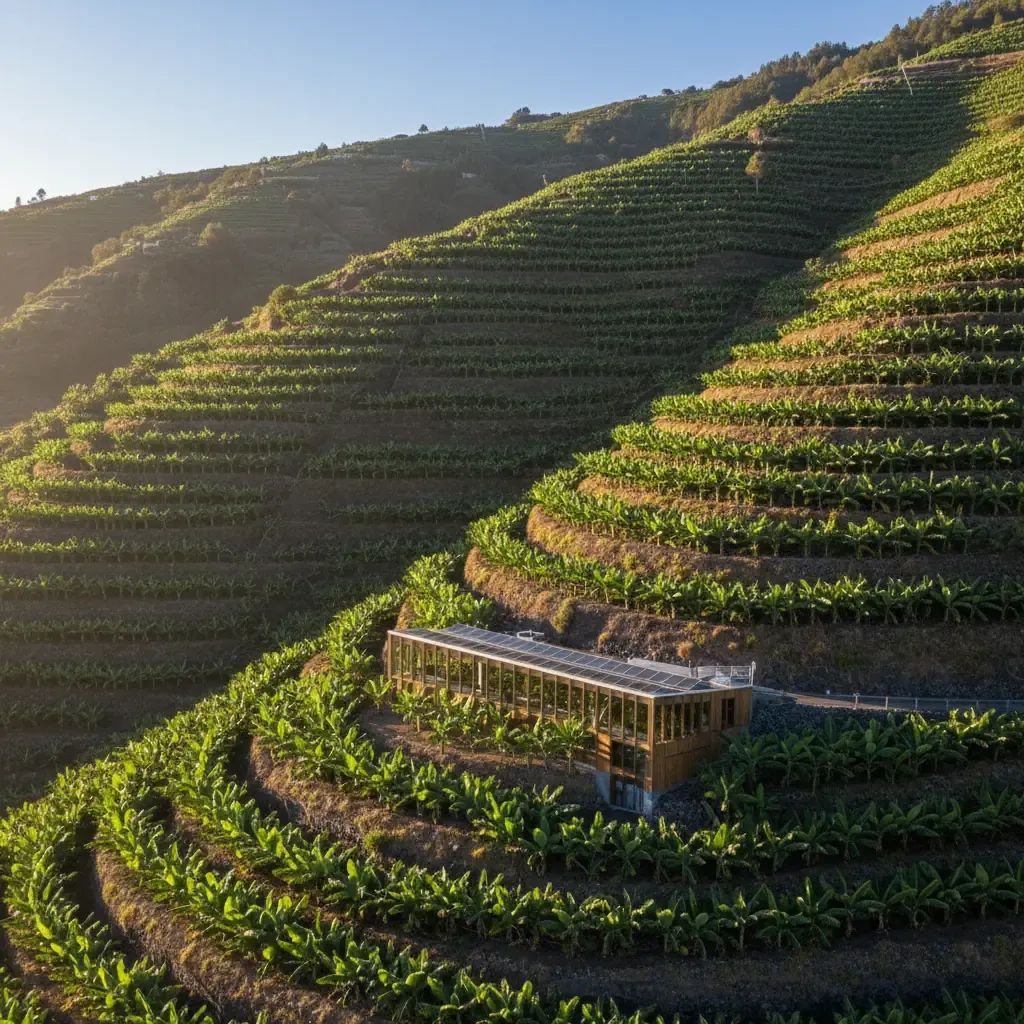
The Centro da Banana da Madeira, inaugurated approximately four years ago (2022), embodies that repositioning. Located in Lugar de Baixo, a sun-exposed valley within the Ponta do Sol municipality some 20 kilometres southwest of Funchal, the facility operates as simultaneously a museum, working farm, research nursery, and commercial tourism venue.
Gesba, the public enterprise managing Madeira's banana sector, designed the space deliberately not as a heritage display frozen in time but as functioning agricultural operation where visitors can observe production occurring in real time. Terraced fields with active banana plants occupy the most prominent visual real estate. Visitors walk through climate-controlled galleries while literally gazing out at working slopes. The museum explains the crop; the fields demonstrate it.
The site maintains 18 distinct banana varieties, though only a handful get commercially harvested. The others exist for genetic conservation, disease-resistance testing, and experimental cultivation trials examining climate adaptation under increasingly erratic rainfall and temperature patterns across the Atlantic.
Nuno Barros, administrator of Gesba, describes the philosophy bluntly: "This is a tribute to farming, culture, and the soil." More strategically, it is infrastructure for agricultural resilience, where 50 to 55 tonnes of bananas harvested annually from the BAM's own terraces generate revenue that covers operational costs—salaries for the seven full-time staff members, facility maintenance, technological upgrades—without requiring constant infusions of government money.
The Technology Layer
The Portuguese Museum Association (APOM) awarded the BAM its 2023 Prize for Digital Innovation in Portuguese Museums, recognising the integration of immersive technology with authentic agricultural content.
Upon entry, visitors encounter a holographic projection depicting the complete botanical lifecycle of a banana plant—from sucker emergence through bunch maturation and plant death. The imagery loops continuously, condensing 12 to 14 months of growth into a few minutes of visual narrative.
Inside the galleries, Pedro, a multilingual virtual guide embedded in interactive tablets, responds to five visitor-selected questions. "How many bunches per plant?" is standard; Pedro's answer: "Just one. Each bananeira produces a single bunch averaging 35 to 45 kilograms, then the plant expires. New growth emerges only from underground rhizomes." Another frequent query addresses botanical classification. "Is the banana plant a tree?" Pedro clarifies the technical distinction: it's a giant herb, not a tree, because its visible trunk is actually a pseudostem—overlapping leaf sheaths wrapped concentrically like rolled paper.
4D projection galleries immerse visitors in climatic storytelling: tropical humidity sensors activate spray effects; seasonal rainfall patterns synchronise with projection changes; mountain-ridge visuals explain how Madeira's topography shelters fruit from Atlantic winds. The experience aims not for entertainment alone but for cognitive map-building—visitors leave understanding not just what a Madeira banana is but why it grows specifically here.
Crucially, these technological layers don't overshadow agricultural authenticity. The technology serves the story; the story remains rooted in soil, sunlight, and seasonal labour.
The Nursery Operation: Disease-Free Stock as Competitive Advantage
Beyond visitor galleries lies the operational nucleus: climate-controlled greenhouses where laboratory-certified young banana plants mature prior to sale to local growers.
Island agriculture faces unique vulnerability. Banana pathogens—Panama disease (Fusarium wilt), Black Leaf Streak fungus, root-knot nematodes—spread rapidly across geographically confined territories. A single severe outbreak could render entire valleys unproductive for years. Replanting requires new stock; if that stock carries dormant infections, the contamination simply reestablishes itself.
The BAM's tissue-culture laboratory employs propagation techniques eliminating fungal and viral loads. Plants leaving the greenhouses carry documented health certification. For smallholder farmers operating margins of mere centimetres, the assurance of disease-free planting material represents genuine risk mitigation—money in the pocket through averted crop loss.
Barros emphasises this function: "Producers acquiring our plants have guarantee of healthy culture and quality yield." This positions Gesba not as a tourism operator but as agricultural service provider, reinforcing legitimacy among the farming community while generating revenue that justifies facility investment.
Commercial Reality: Market Concentration and Razor-Thin Margins
Nearly all Madeira bananas destined for commercial markets flow to continental Portugal. Distribution data reveals 85.7% of banana exports route to mainland Portuguese supermarkets and greengrocers, with only 14.3% consumed locally or sold at farmers' markets and agritourism venues.
This geographic concentration creates structural vulnerability. A supply disruption, shifting consumer preference, or aggressive discounting by competitor regions can rapidly depress prices across the entire system. Moreover, wholesale banana prices—even those carrying premium regional certification—frequently hover near or below production costs when accounting for fertiliser, pest management, labour, terracing upkeep, and transport.
Supermarket chains exploit this dynamic ruthlessly. They offer producers marginally above break-even prices while maintaining retail markups of 200% or higher. Family farms averaging smaller than a football pitch cannot negotiate independently; they accept offered prices or watch fruit rot on the vine.
This cost structure explains generational attrition. Madeirans under 40 have largely abandoned banana farming for tourism sector employment or emigration. Aging parents remain, tending shrinking plots from economic obligation rather than prospect.
What Tourism Revenue Actually Changes
The BAM disrupts this equation by creating alternative revenue streams for banana cultivation itself.
Premium-paying tourists—visiting explicitly because they've read about Madeira's heritage agriculture or follow agritourism travel blogs—willingly spend €9 on museum admission. Many purchase banana-derived consumables at the on-site cafeteria: banana beer, banana chips, banana cakes, beverages served with views overlooking production terraces. They acquire branded merchandise—jams, recipe cards, wooden spoons bearing the BAM logo—serving as durable mementos that reinforce purchase decisions and encourage repeat recommendation to peers.
For island residents, the BAM functions as an informal agricultural extension service. Farmers visit to study advanced drip-irrigation systems, windbreak configurations, bunch-anchoring techniques, mechanised harvest transport protocols they might adapt to their own terraces. School groups attend to understand how a distant ancestor's navigational choice shaped their island's economic trajectory. University researchers access the germplasm collection and experimental cultivation data.
Madeira's tourism economy employed 12.9% of the working population in 2019 and contributed 22.7% of regional gross value added. Cultural institutions—the Ethnographic Museum exploring sugar-milling and linen production, the Wine and Vineyard Museum in Funchal, and now the BAM—anchor integrated agritourism circuits combining education, tastings, terraced-field walking tours, and artisan workshops. Visitors spending multiple days on such circuits generate significantly higher expenditure per person than beach-resort tourism alone.
The BAM's 2025 visitor projection of 85,000 people represents meaningful tourist traffic. If even 20% spend €20 additionally on local services beyond museum entry, that translates to €340,000 in secondary economic activity annually—money supporting local restaurants, transport operators, accommodation providers.
Practical Access and Operational Reality
The BAM operates year-round: 09:00 to 18:00 during winter months (roughly November to March) and until 19:00 during summer. Standard entry costs €9.
However, access structures embed equity principles:
Madeira residents who are not banana producers enjoy complimentary admission on the final Saturday of each calendar month—approximately 12 days annually. This policy positions the centre explicitly as regional infrastructure, not exclusively tourist exploitation.
Banana farmers and their immediate family members enter free year-round, at all times. This recognises both the centre's dependence on agricultural legitimacy and the community's historical relationship to the crop.
Facilities accommodate diverse visitor needs: climate-controlled galleries with seating areas, a merchandise shop, a cafeteria with banana-derived menu items, and viewing terraces overlooking active terraces. Visitors with mobility constraints should contact the facility beforehand to assess accessibility of steeply sloped terrain.
Strategic Ambitions and Sustainability Questions
Gesba has publicly stated intentions to expand exhibition galleries and diversify programming. Planned developments include workshops on agroecology and climate adaptation, seminars on Protected Geographical Indication (PGI) certification processes, and collaborative research projects examining banana genetics under warming conditions, soil biology specific to volcanic Madeirani terrain, and integrated pest management strategies relevant to the archipelago's shifting climate patterns.
The business model—where on-site production revenue covers fixed costs while visitor admissions fund staffing and expansion—has demonstrated durability over its operational period. However, sustainability at scale depends on several factors remaining stable: visitor traffic sustaining through tourism cycles, labour productivity on steep terrain as wage costs rise, and European Union subsidy frameworks not shifting priority away from banana support or redistributing funds to competing regions.
None of these conditions is assured. Tourism patterns shift; labour scarcity in rural Europe deepens; EU agricultural policy evolves according to continental political currents, not island economic needs.
Yet the BAM proves one critical principle: heritage agriculture need not become economically moribund. By merging authentic production with narrative depth, interactive technology, and experiential tourism, Madeira's banana sector has escaped the commodity commodity treadmill. It now competes in the cultural capital market, where storytelling and experiential authenticity command premiums that yield margins commodity production cannot achieve.
For 3,000 banana growers whose ancestors planted this crop centuries ago, that market repositioning may ultimately prove more durable than any subsidy guarantee.


