

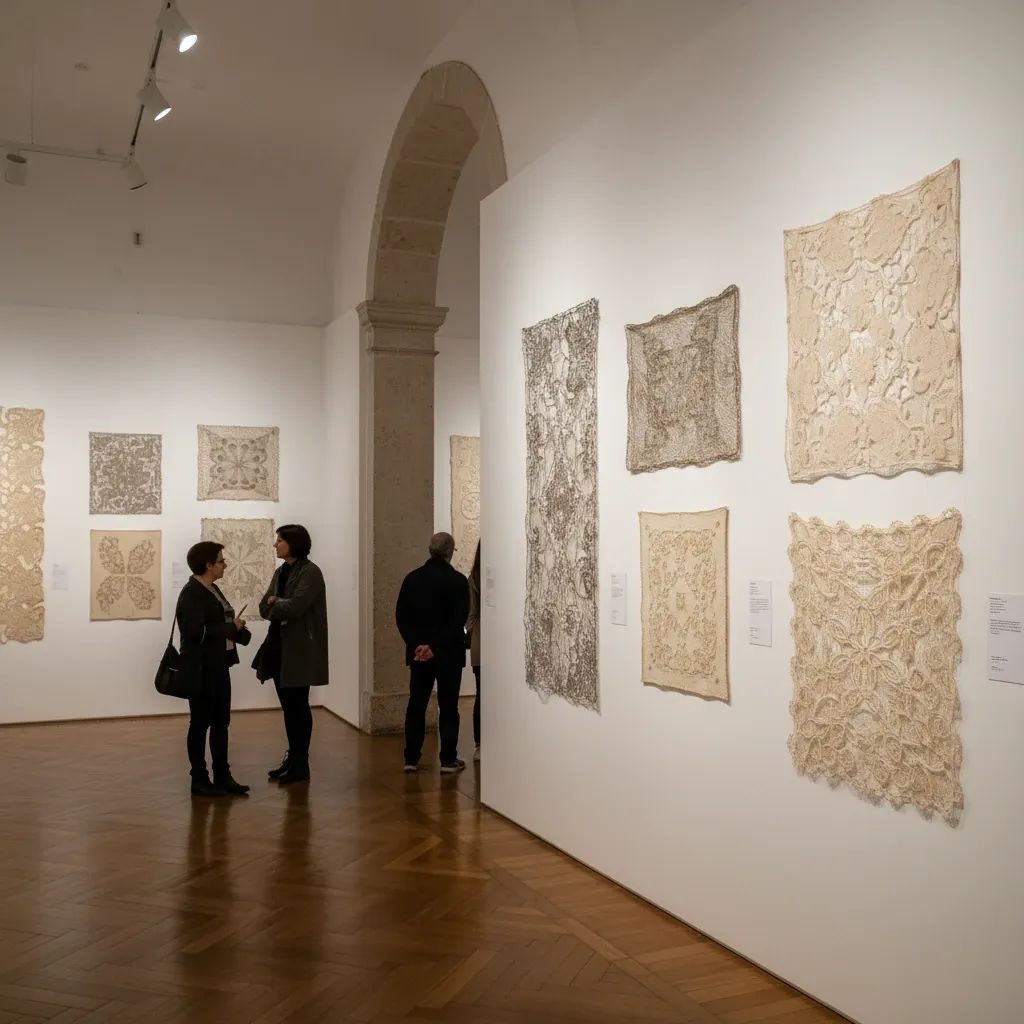
The Portugal National Museum of Contemporary Art – Museu do Chiado has just opened its doors to a significant programming shift, inaugurating four exhibitions that place a long-overlooked 19th-century female artist at the heart of a conversation with modern-day creators—and signaling a strategic pivot toward international reach.
Why This Matters
• Rediscovery of forgotten talent: Maria Augusta Bordalo Pinheiro, sister of two cultural giants, finally gets recognition as an industrial designer and lace innovator who shaped Portuguese craft.
• Cultural tourism boost: Four new shows, plus a major 360-piece donation in March, position the Chiado museum as a must-visit for art travelers.
• Cross-border vision: New director Filipa Oliveira is pushing the museum's collection beyond Portugal, with touring exhibitions and international partnerships already in motion.
Practical Information for Visitors
Admission to the MNAC-MC, located in the converted Convento de São Francisco near the Teatro Nacional de São Carlos, is €4.50 (free on Sundays until 14:00). The museum is open Tuesday through Sunday, 10:00–13:00 and 14:00–18:00.
The Forgotten Sister Returns
At the core of the museum's fresh programming is "Linhas Cruzadas" (Crossed Lines), an exhibition running until May 2 that resurrects the work of Maria Augusta Bordalo Pinheiro (1840–1915). While her brothers—caricaturist Rafael and painter Columbano—remain household names in Portuguese art history, Maria Augusta spent decades in the shadows despite pioneering bobbin lace design and directing the Industrial School Maria Pia in Peniche from 1887 to 1889.
"She was the first director of that school, which trained a generation of lacemakers and turned a traditional craft into a professional livelihood," said Filipa Oliveira, who assumed the museum's directorship in March 2025 after an international competition organized by Museus e Monumentos de Portugal (MMP). "But she was completely erased from art history."
The exhibition pairs Maria Augusta's rarely seen paintings, lace patterns, and decorative faience with contemporary pieces by Joana Vasconcelos, Angolan artist Ana Silva, and Brazilian sculptor Sónia Gomes—all of whom work with textile and found materials. Vasconcelos, who spent years restoring the Rafael Bordalo Pinheiro Factory in Caldas da Rainha, discovered a ceramic pot co-created by the siblings and credited Maria Augusta's ethical rigor and genre-bending approach—merging "minor" crafts like lace with "major" arts like ceramics—as a direct influence on her own "Bestiário" series.
What This Means for Residents
For Portugal-based art enthusiasts and cultural tourists, the new exhibitions mark the Chiado museum's most ambitious thematic cluster in years.
Beyond "Linhas Cruzadas," two emerging artists are receiving their first major institutional showing: Jaime Welsh presents "A Oferta", a photographic interrogation of how Estado Novo-era architecture (1933–1974)—specifically buildings by Cristino da Silva and interiors by Daciano da Costa—still projects authoritarian ideology. His lens focuses on the National Library of Portugal, the University of Lisbon Rectorate, and the former Banco Nacional Ultramarino.
Meanwhile, Mariana Duarte Santos debuts "Calafrio" in the museum's project gallery, translating her signature mural language onto canvas. A fourth exhibition, "Anti-Isto. Manifesto-Poema", is a performance-driven group show curated by graduate students from the University of Coimbra's College of the Arts.
International Ambitions and Collection Growth
On March 3, the museum will formally accept a donation of approximately 360 works of modern and contemporary art from the private collection of Alberto Caetano, significantly expanding its holdings beyond the current 6,000-piece archive spanning 1850 to the present. Four days later, on March 7, a solo exhibition by Adriana Molder—previously shown at the Contemporary Culture Centre of Castelo Branco—will open, underscoring Oliveira's commitment to circulating the museum's collection across Portugal and abroad.
"Opening the collection, making it travel in partnership with national and international institutions, is essential," Oliveira explained. "A national museum cannot limit itself to what happens within its territory. The story of Portuguese art history is porous, tentacular—it must be told here and beyond our borders."
Oliveira, who served as Visual Arts Programmer for Almada Municipality from 2018 to 2025 and directed the Casa da Cerca gallery and other municipal venues, envisions the Chiado as a hub for festivals, seminars, and university partnerships. She singled out the nearby Faculty of Fine Arts as a priority target for institutional collaboration, acknowledging that relations have been "very difficult" but calling the relationship "a very important question for me."
The Stalled Expansion Project
Despite the programming renaissance, a cloud remains over the museum's physical future. An €8M renovation and expansion project—announced in January 2023 by then-Culture Minister Pedro Adão e Silva and designed to double exhibition and storage space—collapsed in November 2024 due to lack of funding.
"The project is still fallen," Oliveira confirmed. "We are trying to rally teams and goodwill to put it back on the table, because unification and more space are essential for a museum located in such a central area of the capital, alongside São Carlos, Teatro São Luiz, the Design Museum, and Teatro Nacional D. Maria II."
When contacted by press, the MMP communications office stated there was "nothing new" on the expansion timeline.
The museum has secured critical backing from the Millennium BCP Foundation, which is underwriting portions of the programming and physical restoration work inside the convent complex. Without that partnership, Oliveira noted, several of the current exhibitions would not have been feasible.
A Manifesto for Historiographic Rigor
Oliveira describes "Linhas Cruzadas" as a manifesto for her curatorial philosophy: serious historiographic research into Portuguese art history, read through a contemporary lens. The choice to foreground Maria Augusta Bordalo Pinheiro—who won a gold medal at the 1889 Paris Universal Exposition and the Grand Prix at the 1904 St. Louis International Exposition for her lace designs—is deliberate.
"She was the first to develop what became known as the 'Portuguese stitch,' using finer materials and original designs inspired by local flora and shells," Oliveira said. "She ran a workshop in Lisbon, trained a generation of artisans, and professionalized work that was predominantly female. Yet she disappeared from the canon."
Ana Silva and Sónia Gomes bring a postcolonial reading to the exhibition, Oliveira added, both using lace as a medium to interrogate Estado Novo narratives of national identity and the colonial archive.
"They recover lace to question how that identity was constructed," she explained. "This is exactly the kind of dialogue—modernism in conversation with contemporary practice—that defines what the Chiado should be."
The four exhibitions collectively signal that Portugal's contemporary art museum is positioning itself as a testing ground for new curatorial models, a partner for emerging artists, and a traveling ambassador for Portuguese visual culture on the global stage.


