

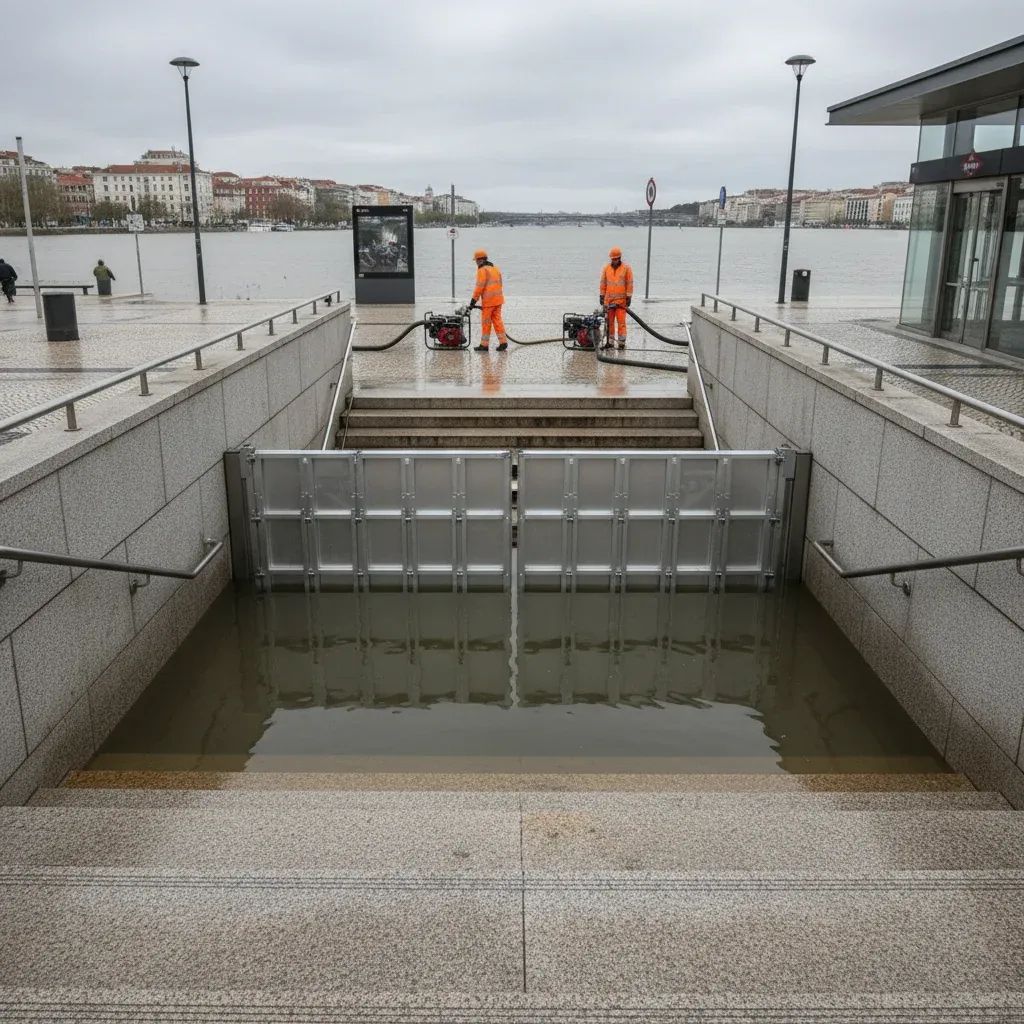
Metropolitano de Lisboa has switched back to its usual timetable across the Blue, Green, Yellow and Red lines, a relief that trims unexpected delays for hundreds of thousands of commuters but comes with a caveat: further rain could still block selected station entrances along the waterfront.
Why This Matters
• Normal service resumed: All four lines returned to the standard 06:30-01:00 schedule on 6 February, ending three days of rolling suspensions.
• Targeted closures remain possible: Exits at São Sebastião, Terreiro do Paço and Rossio may shut again if the Tejo overflows.
• Commuter costs: Each hour of disruption adds an estimated €1 M in lost productivity across Greater Lisbon, according to transport economists.
• Cold-weather support: Three stations will stay open overnight as emergency shelters while temperatures hover near 2 °C.
How We Got Here
Propelled by the winter depressions Kristin, Leonardo and Marta, February’s storms dumped the equivalent of a month’s rainfall in four days. The Portugal Civil Protection Authority issued red-level flood warnings along the riverfront, prompting Metropolitano de Lisboa to pre-emptively close stretches of the Blue and Green lines. At the height of the crisis on 5 February, water tables near Jardim Zoológico surged so fast that pumps could not keep pace, forcing a 4-hour stoppage between Pontinha and Marquês de Pombal. Simultaneously, a signalling fault paralysed the Green line at Campo Grande, compounding the chaos.
The Fixes Now in Place
To restore service, engineers installed high-capacity pumps, rerouted overnight train parking, and erected removable flood gates at seven vulnerable accesses. A new sensor network now relays water-level data in real time to the control room, allowing staff to seal entrances within minutes. The Lisboa City Council says the measures cost roughly €800 000, a sum it calls 'modest' compared with the €748 M the network will receive from the Recovery and Resilience Plan (PRR) for longer-term expansion. Crews have also positioned standby diesel generators to keep pumps running during power cuts.
What This Means for Residents
Even with the trains running, riders should expect a more cautious operating model.
Check the 'ML' mobile app or @metro_lisboa on X before leaving home; push alerts flag any exit closures in real time.
Build an extra 10 minutes into journeys on riverfront sections—staff may impose speed restrictions during downpours.
If you rely on lifts at Terreiro do Paço or Rossio, note that power can be cut to prevent electrical shorts; plan an above-ground transfer where possible.
During nights below 3 °C, unhoused neighbours will be sheltered at Santa Apolónia, Rossio and Oriente; expect higher foot traffic at opening time (06:30).
Failure to plan around these tweaks could still mean missed rail connections at Oriente or surcharges on ride-hail alternatives.
Funding the Next Layer of Resilience
While emergency work was paid out of operating cash, the PRR envelope earmarks €155 M specifically for modern drainage and tunnel waterproofing on the existing network. The upcoming Violet Line will be built with raised track beds and separate pump rooms, features absent from 1950s tunnels. Portugal’s Environment Ministry argues that every euro in prevention avoids four euros in shutdown costs, a ratio corroborated by the European Investment Bank.
Looking Ahead
Meteorologists warn that Atlantic storm tracks are shifting south, making flash-floods in Lisbon more frequent. Metropolitano de Lisboa says it will drill a second drainage gallery under Praça de Espanha by early 2027 and trial platform screen doors that double as water barriers. For now, the message is simple: the metro is back, but climate volatility has rewritten the rulebook on 'normal'. Riders who stay informed will feel little difference; those who don’t may learn the old Lisbon saying the hard way—quem vai à chuva, molha-se.


