

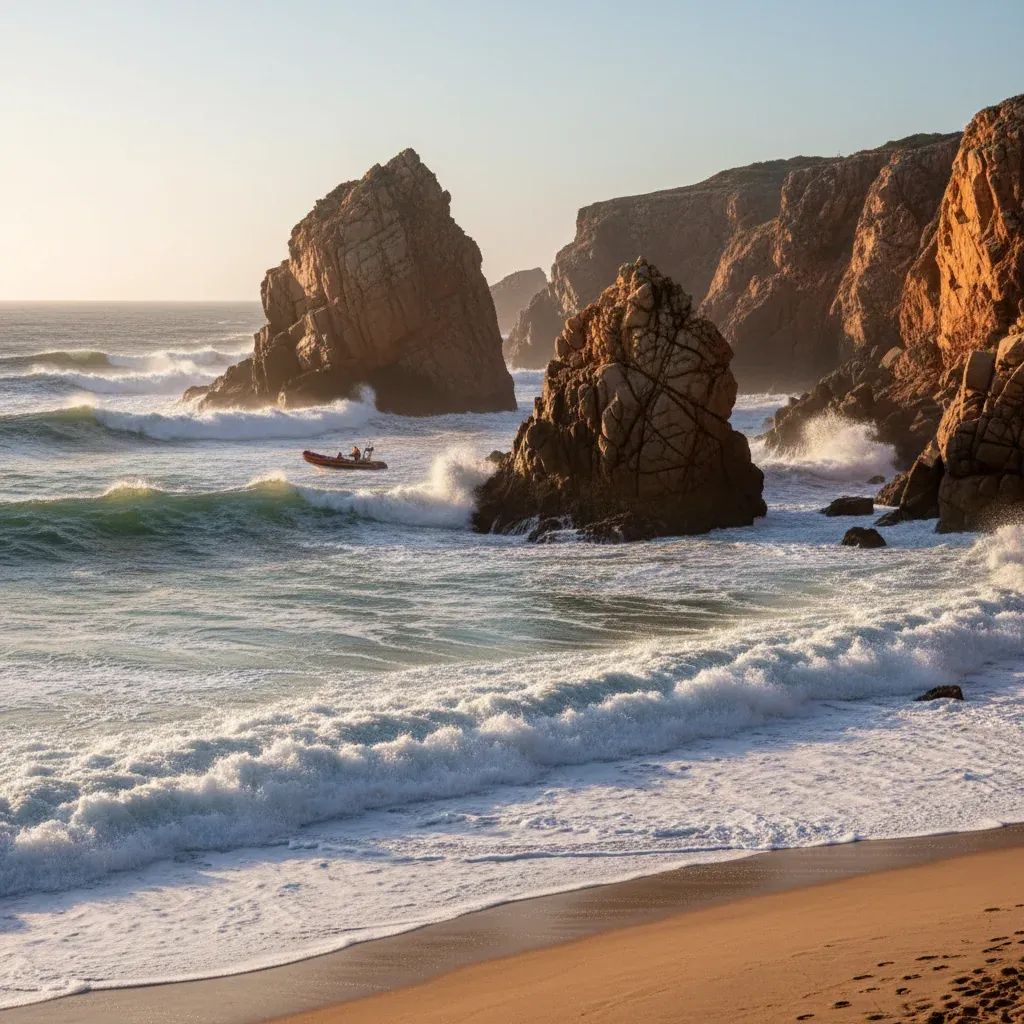
The Portugal Maritime Police successfully extracted two foreign tourists—an American woman, 60, and a British woman, 45—from the base of a cliff near Samoqueira Beach in Porto Covo, Sines municipality, after rising tide stranded them on the afternoon of 8 March 2026. Both women were unharmed and required no medical attention, according to the Portugal National Maritime Authority (AMN).
Why This Matters
• Tide awareness is critical: Portugal's Alentejo coast features some of Europe's last stretches of wild, exposed shoreline, where tides can shift rapidly and trap unwary beachgoers.
• No deaths on record: Sines has maintained a 28-year zero-fatality record on supervised beaches during swim season, but unmonitored zones and off-season visits carry elevated risk.
• Emergency response framework: The incident highlights the coordinated rescue capability between Maritime Police and specialized high-angle fire brigade units.
The Rescue Operation
The alarm reached emergency services at approximately 3:30 PM on Sunday via the Sines Volunteer Fire Brigade. Local Maritime Police Command dispatched officers immediately to the scene, where they confirmed the two women were physically stable but inaccessible due to incoming waves cutting off their exit route.
Sines Volunteer Fire Brigade's high-angle rescue team—trained for interventions in difficult-access terrain such as cliffs and ravines—successfully extracted both tourists using specialized rope equipment. The operation concluded without injury, and the Local Maritime Police Command of Sines assumed oversight of the incident report.
Alentejo Coast: Beauty and Hazard
Portugal's southwestern coastline is characterized by dramatic sandstone cliffs, exposed headlands, and minimal human infrastructure. While this makes the region a magnet for hikers, photographers, and tourists seeking unspoiled beaches, it also presents distinct safety challenges absent from more developed resort areas.
The Samoqueira Beach zone sits within a stretch of coast where cliffs rise steeply from narrow sand strips that vanish at high tide. Unlike urban beaches with constant lifeguard presence, many Alentejo coves remain unmonitored, particularly outside the official swim season (1 May to 31 October). Visitors unfamiliar with Atlantic tidal patterns—which can advance several meters in under an hour—frequently underestimate the speed at which retreat paths disappear.
The Portugal Environment Agency (APA) has identified multiple beaches along this coast where cliff instability adds a secondary hazard. Risk signage defines the "danger zone" as a strip extending 1.5 times the cliff height—the maximum distance rubble from a collapse could reach. Despite these warnings, authorities report that enforcement relies primarily on education rather than fines, recognizing that many accidents result from ignorance rather than willful negligence.
What This Means for Residents and Visitors
If you're planning coastal excursions in Sines or neighboring Alentejo municipalities, understanding tidal dynamics is not optional—it's essential. The region's wild character means mobile network coverage can be patchy, and emergency response times lengthen the farther you venture from main roads.
Key precautions include:
• Check tide tables before any cliff-base walk. The Portuguese Institute for Sea and Atmosphere (IPMA) publishes forecasts accessible via mobile apps, showing predicted high and low water times with precision.
• Allow ample retreat time. Even if the tide chart suggests you have two hours, wave action and surf can advance faster than predicted during storms or spring tides.
• Avoid zones marked with yellow-and-black warning triangles. These indicate either cliff collapse risk or restricted access due to maritime hazards.
• Carry a charged phone and know your exact location. Emergency responders need coordinates, not vague beach descriptions. The European emergency number 112 works throughout Portugal.
National Context: Rescue Statistics
During the 2025 swim season, the AMN recorded 18 drowning fatalities nationwide, with 7 occurring on supervised beaches and 8 in unmonitored maritime zones. The authority also logged 1,162 rescues and 3,918 first-aid interventions across the country's beaches during that period. These figures aggregate incidents from Porto to the Algarve and serve as important context for understanding coastal safety challenges.
Portugal's coastline generated 511 search-and-rescue operations in 2025, coordinated by the Portuguese Navy, resulting in 589 people saved. Of these, 318 actions took place along the continental coast, managed by the Maritime Rescue Coordination Centre (MRCC) in Lisbon, which oversees the entire western seaboard including Alentejo.
Sines stands out as a statistical anomaly: The municipality has recorded zero swimming fatalities on supervised beaches since 1995, a remarkable achievement given the exposure of its coastline. This record reflects both the effectiveness of local lifeguard deployment and the relatively lower tourist density compared to southern resort zones.
Recent incidents in the region include a November 2025 fishing vessel sinking off Sines, where seven crew members reached shore suffering from hypothermia, and a July 2024 spike when Alentejo's 10 fire brigades responded to 46 coastal emergencies in a single day, including two search-and-rescue calls.
How Portugal Compares: European Coastal Safety
Portugal's approach to tide and cliff warnings mirrors broader European practice but adapts to local conditions. The APA's arriba signage program follows the same visual language used across the EU—yellow triangles with black pictograms—ensuring tourists from any member state recognize the hazard even without reading Portuguese text.
In contrast, countries like the United Kingdom and France deal with similarly dramatic tidal ranges (especially in Brittany and the Channel Islands) by deploying real-time digital displays at beach access points, showing countdown timers until high water. Portugal has yet to adopt this technology widely, relying instead on static signage and mobile apps.
The European Union's Integrated Coastal Zone Management (ICZM) framework, established under Recommendation 2002/413/EC, encourages member states to balance tourism development with erosion mitigation and public safety. Portugal's National Maritime Authority participates in the SeaWatch program, deploying 4x4 patrols along remote stretches during peak season—a model similar to Australia's surf lifesaving clubs but scaled to Portugal's smaller coastline.
Lessons from the Porto Covo Incident
The March 2026 rescue underscores three realities for anyone living in or visiting Portugal's coastal regions:
First, language barriers matter. While the two women's nationalities were disclosed, it's unclear whether they accessed Portuguese tide forecasts or understood warning signs. The AMN and municipal tourism offices could expand multilingual digital outreach, particularly targeting Airbnb and rural accommodation platforms frequented by independent travelers.
Second, the "wild coast" reputation cuts both ways. Marketing campaigns tout Alentejo's undeveloped beauty, attracting precisely the adventurous demographic most likely to take risks. Balancing tourism revenue with safety messaging remains a delicate task for local authorities.
Third, Portugal's emergency coordination works. The rapid deployment of Maritime Police and the fire brigade's specialized unit demonstrates a mature, well-drilled system. Yet the fact that the women became stranded at all suggests preventive signage and education still have gaps.
Practical Takeaways
For expatriates, long-term residents, and Portuguese locals alike, the Porto Covo rescue serves as a seasonal reminder: the Alentejo coast demands respect. Its beauty is inseparable from its hazards, and the absence of guardrails, fences, or constant surveillance is both its charm and its danger.
If you're hosting foreign guests, brief them on tidal patterns before any beach outing. If you're exploring solo, treat the coastline as you would a mountain trail—with preparation, appropriate gear, and a clear exit plan. And if you see someone in difficulty, dial 112 immediately rather than attempting a rescue yourself, as secondary casualties are common in maritime emergencies.
The two women who walked away uninjured on 8 March 2026 were fortunate. Others in similar circumstances have not been. The difference often comes down to a single decision: checking the tide table before stepping onto the sand.


