Why This Matters
• Road Safety Alert: The National Republican Guard (GNR) confirmed that disorientation on flooded rural roads led to the deaths of two elderly residents, a scenario authorities warn could recur with future storms.
• Infrastructure Vulnerability: The vehicle remained hidden under flood water from the Mondego River for 8 days, revealing gaps in emergency response capacity during prolonged inundations.
• Funeral Scheduled: Services for the couple will be held Friday afternoon at the Verride Parish Church, with burial at the local cemetery.
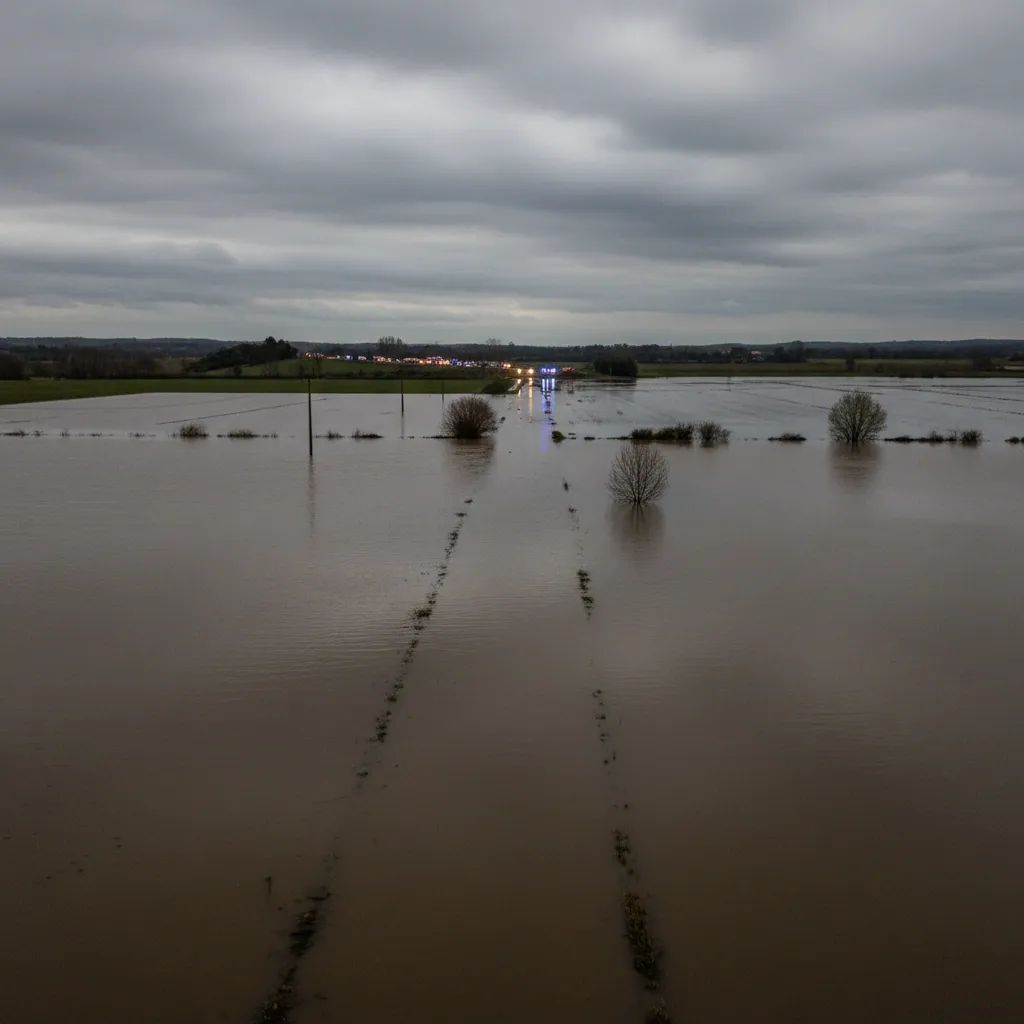
The National Republican Guard recovered the bodies of Venâncio dos Santos Gomes, 65, and Maria de Fátima Pereira Soares Pinto, 68, from their submerged Citroën Saxo in a flooded rice field near Porto Godinho, a hamlet straddling the Figueira da Foz and Soure municipal borders. The discovery ended an 8-day search that began when the couple failed to return home from a medical appointment in Coimbra on 10 February.
Two local residents spotted a greenish object partially visible in the waterlogged paddies during an early-morning walk on 18 February. Using a reed pole to push aside vegetation, they confirmed it was a vehicle—roof up, one window ajar—and immediately contacted authorities. GNR dive teams arrived by 7:30 a.m. and retrieved both bodies, which were transported to the Coimbra Institute of Legal Medicine for autopsy. As of publication, the exact cause of death has not been officially determined, nor has a link to the flood been forensically established.
What Led to the Wrong Turn
Captain Celso Marques of the GNR Coimbra Detachment told reporters the couple's final route made no geographic sense. The road through Porto Godinho lies well outside the direct path from Coimbra back to their home in Verride, a village in Montemor-o-Velho roughly 15 km southwest of the city. "Very probably they became disoriented," Marques stated, according to SIC Notícias. "This road was not the likely route for them to return home."
Witnesses and family records indicate the couple dined at a friend's restaurant in Coimbra after the hospital visit, then set off around nightfall. At some point during the journey, they veered onto a secondary rural route—one that runs parallel to the Mondego's eastern floodplain—and into standing water. The couple's disorientation during a stressful nighttime drive in flooded conditions may explain the navigational error.
The area where the car was found—Vale do Pranto rice fields—had been submerged for more than a week. Water levels dropped roughly 20 centimeters overnight on 17–18 February, finally exposing the vehicle's roof and allowing the discovery.
Impact on Residents and Regional Safety
The tragedy underscores vulnerabilities in Portugal's flood-response protocols, particularly for drivers navigating unfamiliar detours during storm emergencies. Storms Kristin, Leonardo, and Marta—three successive Atlantic depressions that struck between late January and mid-February—produced 18 confirmed deaths nationwide and forced the evacuation of 3,000 residents in the Coimbra metropolitan area alone. The Mondego River basin, one of the country's most flood-prone watersheds, saw multiple dike breaches, including one near the A1 motorway that severed the main Lisbon–Porto artery for several days.
For rural communities in the Centro Region, the cascading effects were severe:
• Road Closures: The EN-341 and EN-111 highways remained impassable for up to 10 days, isolating villages and delaying emergency services.
• Agricultural Losses: Rice paddies in Soure and Montemor-o-Velho absorbed tens of millions of liters of overflow, with crop damage still being assessed by the Portugal Ministry of Agriculture.
• Infrastructure Strain: Local fire brigades and civil-protection units operated at maximum capacity, leaving little margin for simultaneous search-and-rescue operations.
Captain Marques emphasized that even after the floodwaters recede, the zone remains hazardous: "Silt deposits, submerged debris, and unstable road edges continue to pose risks. Drivers unfamiliar with the terrain should avoid these rural corridors entirely."
Search Efforts and Technology Gaps
Family members reported the couple missing on 13 February, triggering an immediate search protocol involving 4 GNR officers, 5 Soure Volunteer Fire Brigade operatives, and two all-terrain vehicles. By 17 February, the operation expanded to include drone surveillance over the Vinha da Rainha parish, a 12 km² area encompassing the Vale do Pranto floodplain. Yet the car remained undetected until two civilians on foot stumbled upon it the following morning.
The incident highlights the limitations of current search protocols when vehicles are fully submerged under murky water. Current methods rely heavily on aerial reconnaissance, which proves ineffective in such conditions.
The Human Cost Behind the Statistics
Venâncio and Fátima had lived in Verride for decades, a tight-knit agricultural village of fewer than 800 inhabitants. Their daughter launched a social-media appeal on 14 February, sharing photographs and vehicle details, but the post generated no actionable leads. Neighbors described the couple as punctual and predictable, making their prolonged absence immediately alarming.
The Verride Parish Church will host funeral rites on Friday at 3:30 p.m., followed by interment at the adjacent cemetery. Local officials estimate several hundred mourners will attend, reflecting the couple's deep roots in the community.
According to obituary notices, both were retired agricultural workers. Venâncio had volunteered with the Verride Cultural Association for over 30 years; Fátima was known for organizing the village's annual harvest festival.
Broader Context: Portugal's Flood Crisis
The Centro, Lisbon Metropolitan Area, and Alentejo regions bore the brunt of the three-storm sequence. Peak rainfall exceeded 200 mm in 48 hours in parts of Coimbra District, overwhelming century-old levee systems designed for lower discharge volumes. The Portugal Civil Protection Authority declared a state of calamity for 68 municipalities on 8 February, a designation that expired 16 February after waters began to recede.
Key infrastructure failures included:
• A1 Motorway: A 9 km section near Coimbra remained closed for 6 days after a dike breach near the Centro Náutico neighborhood.
• Rail Disruption: The Linha do Norte main rail artery suspended service for 4 days, stranding thousands of commuters.
• Power Outages: An estimated 140,000 households lost electricity at the crisis peak, with some rural areas waiting more than a week for reconnection.
The Portugal Cabinet has commissioned an urgent engineering review of the Mondego basin's hydraulic infrastructure, with findings expected by mid-March.
What Authorities Recommend
Transport safety advocates recommend specific precautions for drivers during severe-weather episodes:
Immediate Actions:
• Cancel Non-Essential Travel: Medical appointments can often be rescheduled; the Portugal National Health Service now offers telemedicine alternatives for routine consultations.
• Real-Time Alerts: Subscribe to SMS warnings from the Civil Protection Authority (free service via the "Alerta Portugal" app).
• Route Verification: Use updated GPS apps that incorporate live traffic data and road-closure alerts—Google Maps and Waze both integrate Portugal road authority feeds.
Experts note that even shallow water—10 cm depth—can trigger hydroplaning at speeds above 60 km/h. Standing water deeper than 30 cm can float a standard sedan, making current-swept scenarios highly probable.
What Happens Next
The GNR criminal investigation unit is reviewing traffic-camera footage from the Coimbra Hospital vicinity to reconstruct the couple's departure route. Authorities confirmed that the Citroën Saxo showed no signs of mechanical failure prior to submersion, and toxicology results from the autopsies are pending.
Meanwhile, the Montemor-o-Velho Municipal Council announced it will install additional road signage at flood-prone junctions, warning drivers of "high inundation risk" during storm alerts. The council allocated €120,000 for the signage project, funded through emergency relief disbursements from the Portugal Recovery Fund.
For residents across the Mondego basin, the incident serves as a reminder that infrastructure and protocols must adapt to changing flood patterns. Normalizing water levels and repairing agricultural land could take three to four weeks, according to Civil Protection estimates, leaving communities on edge as spring rains approach.
Anyone with information related to the couple's movements on 10 February is asked to contact the GNR Coimbra Detachment at 239-851-040.