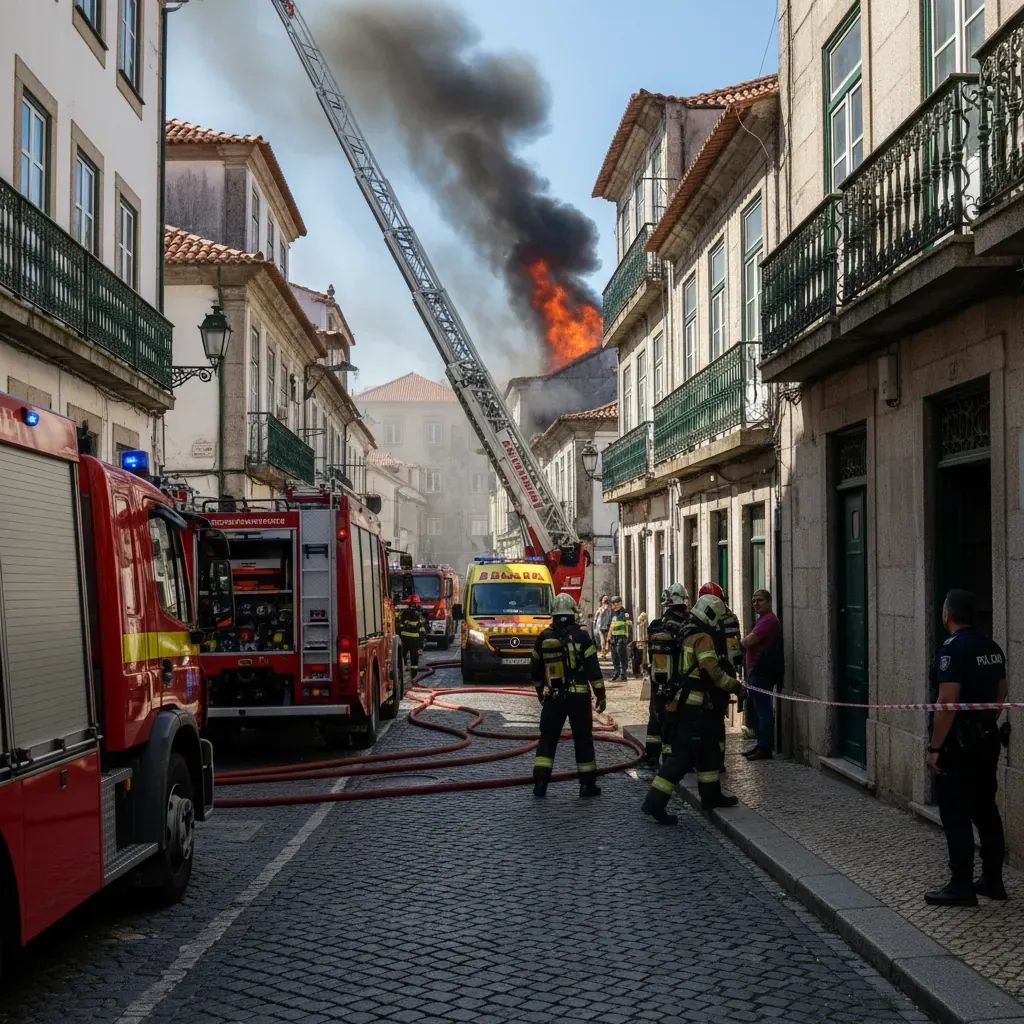
A car crash in central Coimbra claimed two lives and critically injured two more after a vehicle veered off course and struck a gas installation early this morning, triggering a violent fire that spread to a residential building on Avenida Sá da Bandeira, one of the city's busiest thoroughfares. Emergency teams battled flames and gas leaks for hours, evacuating residents from upper-floor apartments as the situation unfolded near Praça da República, a landmark square in the heart of Portugal's historic university city.
Why This Matters
• Two fatalities confirmed: Both victims were inside the crashed vehicle and died at the scene.
• Four injured total: Two women in their 30s remain in serious condition at Hospital da Universidade de Coimbra after being found unconscious in the building's attic space. A third vehicle occupant, approximately 20 years old, walked away with minor injuries.
• Gas infrastructure breach: The collision ruptured a gas installation, causing what firefighters described as "violent combustion" and raising safety concerns in a densely populated urban zone.
• Major response: Over 40 emergency personnel and 14 vehicles deployed to contain the blaze, which was reported under control by 9:15 AM.
Timeline of the Emergency
The Portugal National Emergency and Civil Protection Authority received the first alert at 6:18 AM, dispatching units from the Coimbra Sapadores Fire Brigade and regional emergency services. By the time crews arrived, the vehicle was engulfed in flames, with fire spreading rapidly to adjacent structures.
Paulo Palrilha, commander of the Coimbra Sapadores Fire Brigade, told reporters that the two critically injured women were discovered in the attic of the affected building, both unconscious and requiring immediate medical evacuation. The Sub-Regional Command for the Coimbra Region confirmed that operations extended past 9:00 AM as teams worked to secure the gas line and extinguish remaining hotspots.
The vehicle carried three occupants in total. Two died on impact or shortly thereafter. The third, a young adult estimated to be around 20 years old, managed to exit the wreckage independently and suffered only minor injuries, according to emergency sources.
What This Means for Residents
This incident underscores the vulnerability of densely built urban centers in Portugal to cascading emergencies when vehicular accidents involve critical infrastructure. Avenida Sá da Bandeira runs through the commercial and residential core of Coimbra, lined with multi-story buildings, many of which house families, students, and small businesses.
Gas installations in Portuguese city centers are typically regulated under strict safety protocols, but the force of a high-speed collision can rupture containment systems designed to withstand far less physical stress. When gas ignites in close proximity to residential structures, the risk of mass casualties and structural collapse escalates rapidly.
For residents of Coimbra and similar Portuguese cities, this event highlights the importance of knowing evacuation routes from upper floors—particularly attics and converted roof spaces, which are common in older Portuguese architecture. The two women found unconscious were in the águas-furtadas, a traditional Portuguese term for attic or garret spaces often used as living quarters or storage. Smoke and toxic fumes rise quickly in such confined areas, making early detection and swift evacuation critical.
Emergency Response and Containment
Firefighters described the scene as "preoccupying due to gas release and violent combustion," a technical designation that indicates both explosion risk and accelerated fire spread. The Sub-Regional Command coordinated a multi-agency response, including hazardous materials teams trained to handle gas leaks in urban environments.
By 9:15 AM, the National Emergency and Civil Protection Authority classified the situation as "under resolution," meaning the fire was largely contained and no further structural collapses were anticipated. However, teams remained on-site to monitor gas levels and ensure the safety of nearby buildings.
The rapid deployment of over 40 operatives and 14 vehicles reflects the scale of the threat. In Portugal, urban fire incidents involving gas infrastructure trigger automatic escalation protocols, bringing in specialized equipment and personnel trained in both firefighting and chemical hazard mitigation.
Infrastructure and Safety Concerns
The collision's impact on a gas installation raises questions about the placement and protection of such facilities in high-traffic urban corridors. Avenida Sá da Bandeira is a major artery connecting residential neighborhoods to the city center, with heavy pedestrian and vehicle traffic throughout the day.
Portuguese municipalities are required to conduct periodic safety audits of public utilities, but the increasing density of urban centers—especially in historic cities like Coimbra, Lisbon, and Porto—means that legacy infrastructure often sits mere meters from active roadways. While modern construction standards mandate protective barriers and setback distances, older installations may lack such safeguards.
For local government officials and urban planners, this incident will likely prompt a review of gas line protection measures in other high-risk zones. Similar accidents in Portugal have previously led to retrofitting of protective bollards, speed-reduction measures, and rerouting of utility lines in areas with high accident rates.
Broader Implications for Urban Safety
This is not the first time a vehicular accident in central Portugal has exposed vulnerabilities in urban infrastructure. In recent years, collisions involving utility installations—including electrical substations and water mains—have prompted calls for enhanced protective measures.
For residents and property owners, the incident serves as a reminder of the importance of functioning smoke detectors and clear evacuation plans, particularly in buildings with multiple floors or attic conversions. Portuguese fire safety regulations mandate such equipment in residential properties, but enforcement varies, and many older buildings remain under-equipped.
The Hospital da Universidade de Coimbra, one of the region's primary trauma centers, received the two critically injured women and is expected to provide updates on their condition. The facility is well-equipped to handle burn injuries and smoke inhalation, both common in gas-related fires.
What Comes Next
Authorities have not yet released details on the cause of the despiste (loss of control), and an investigation is underway. Factors such as speed, driver distraction, mechanical failure, or impairment will be examined by the Portugal Public Security Police (PSP) or Republican National Guard (GNR), depending on jurisdiction.
For now, the focus remains on stabilizing the injured and ensuring the structural integrity of the affected building. Residents displaced by the evacuation are expected to be allowed back once engineers clear the property for occupancy.
This tragedy in Coimbra is a stark illustration of how quickly routine traffic incidents can escalate into life-threatening emergencies when critical infrastructure is involved—and a sobering reminder for cities across Portugal to reassess the safety of utilities in high-traffic zones.