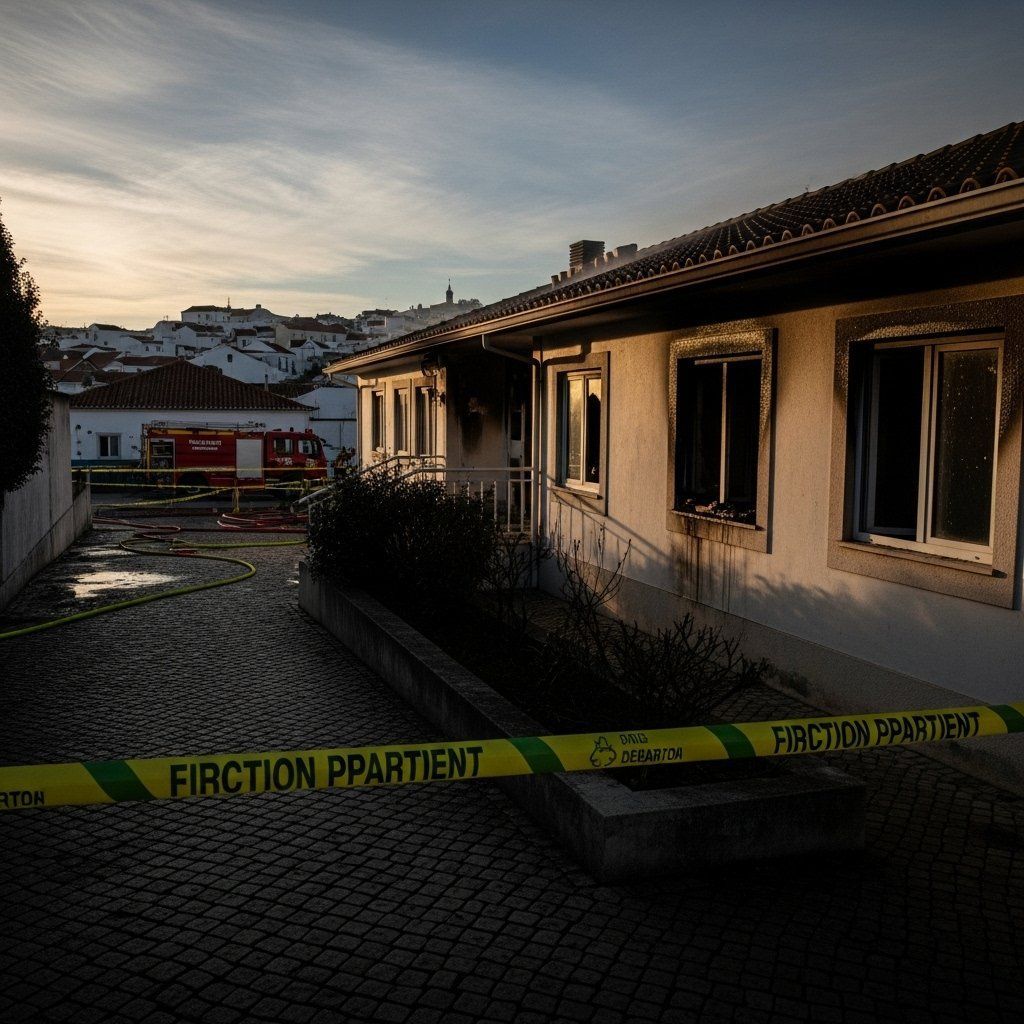
A duct fire at a biomass pellet manufacturing plant in Alcobaça's industrial zone has left one worker with serious injuries and another moderately hurt. The incident unfolded at 3:58 PM in the Casal da Areia Industrial Area, prompting a multi-brigade emergency response that brought the blaze under control within two hours.
Why This Matters:
• Worker Safety: One 42-year-old employee sustained grave injuries requiring emergency transport to Leiria Hospital; a 32-year-old colleague suffered lighter wounds
• Industrial Context: Pellet factories generally operate with elevated risks from combustible wood dust, which can ignite at relatively low temperatures and propagate rapidly through ventilation systems
• Containment Success: Damage was limited to the duct system where the fire started, preventing a wider factory blaze
Anatomy of Monday's Incident
The blaze erupted inside factory ductwork—a common location where fine wood particles collect in biomass operations. According to the Portugal Sub-Regional Emergency Operations Command for the West, flames spread through the ventilation conduit but did not reach bulk storage silos or production halls.
Emergency crews from Alcobaça, Pataias, and Nazaré fire brigades deployed 26 personnel and 10 vehicles, supported by the Portugal National Republican Guard (GNR) and a mobile intensive-care ambulance (VMER) from Leiria Hospital. By 6:00 PM, commanders declared the fire "in resolution," meaning active flames were suppressed and teams had shifted to cooling and ventilation work.
The two injured workers were evacuated to Leiria Hospital. Official sources have released no updates on the condition of the 42-year-old, whose injuries were classified as severe at the scene, nor whether the pair were exposed to burns, smoke inhalation, or trauma from escaping pressurized equipment.
General Hazards in Pellet-Industry Operations
While the cause of Monday's fire remains under investigation, the Portuguese pellet sector generally faces several well-documented hazards. Wood-pellet manufacturing combines combustible dust, mechanical friction, and bulk biomass storage—factors that have historically contributed to incidents across the industry.
Combustible-dust ignition represents a key industry concern. When fine wood particles become suspended in air inside confined spaces—mills, cyclones, or ducts—a spark from equipment friction or electrical malfunction can pose ignition risk. Industry standards recognize that wood dust requires careful management in manufacturing environments.
Autoignition in storage is another recognized hazard in the sector. Large piles of wood chips or finished pellets can self-heat through biological processes, potentially generating flammable conditions. Portuguese regulations mandate temperature monitoring in silos, though enforcement varies across facilities of different sizes.
Mechanical failures—jammed conveyors, misaligned rollers, electrical short-circuits—add friction and heat to dust-laden environments. Factory operators must balance production efficiency with preventive maintenance schedules.
Regulatory Framework for Worker and Employer Safety
Portugal's Labor Conditions Authority (ACT) enforces a safety regime drawn from European ATEX directives (transposed as Decree-Law 236/2003) and national fire-prevention statutes (Ministerial Order 1532/2008). Key obligations include:
ATEX Zone Classification: Employers must map areas where explosive dust clouds can form and install appropriate electrical fittings in those zones.
Fire Detection & Suppression: Modern facilities typically employ infrared sensors, automated water-mist systems, and spark-detection technologies, though retrofitting older plants remains a consideration.
Dust Management: Continuous vacuum systems, sealed transfer points, and regular cleaning schedules are standard safety practices to reduce dust accumulation.
Worker Training: Annual drills, hazard briefings, and protective-equipment protocols—including respirators, flame-resistant clothing, and hearing protection—are mandatory.
Enforcement of these regulations involves both administrative oversight and inspection procedures. The Alcobaça plant's compliance status has not been disclosed. Investigators will examine whether the duct was equipped with automatic fire dampers, whether staff had conducted recent hot-work permits, and whether the factory held valid ATEX certification.
Economic and Regulatory Context
Portugal's pellet industry has expanded rapidly as households and commercial boilers shift away from fossil heating fuels. Domestic production now supplies both the retail ENplus-certified market and industrial buyers, creating employment in rural districts like Alcobaça. At the EU level, wood-biomass facilities fall under broader industrial-safety and emissions-trading directives, with Portugal's Environment Agency monitoring greenhouse-gas output and the ACT overseeing occupational health.
Investigation and Recovery Outlook
Authorities have not yet announced whether a formal investigation will be opened. Standard procedure would involve site inspection, witness interviews, equipment forensics, and review of maintenance logs and training records.
For the two injured workers, recovery timelines remain unclear. Serious injuries from industrial incidents can require significant hospitalization and rehabilitation, with long-term implications possible. Portuguese labor law provides for sick pay and potential disability compensation through employer liability insurance or social-security schemes.
The incident underscores that even contained industrial fires can cause serious harm to workers. Residents near pellet plants should familiarize themselves with emergency evacuation routes and air-quality alerts, as smoke from biomass combustion can travel several kilometers downwind. Employers must prioritize prevention measures to protect their workforce.