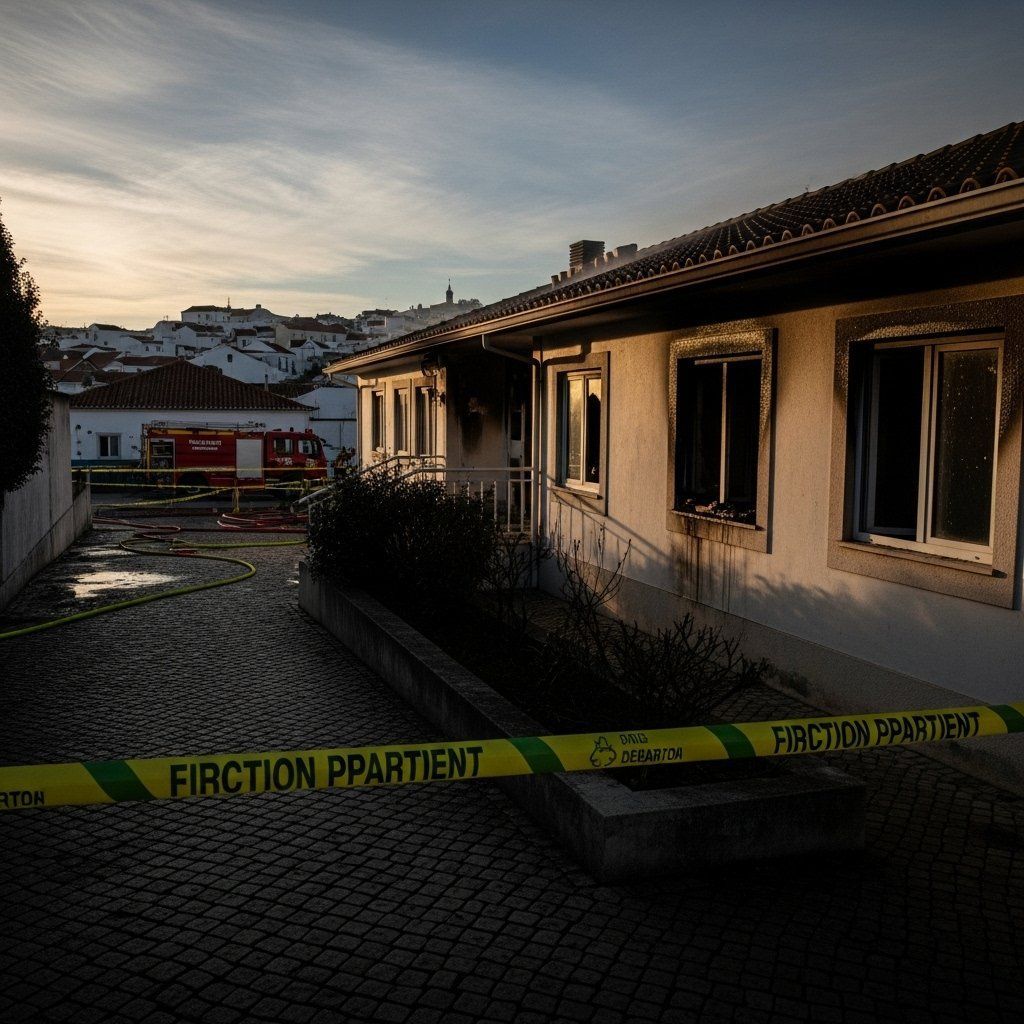
The Portugal Fire Service responded to an early-morning fire on 8 March that left a three-story building in central Coimbra uninhabitable and forced eight people—two of them children—into temporary accommodation. The fire underscores persistent concerns about enforcement of fire safety regulations in historic student housing across Portugal's university cities.
Why This Matters
• Student housing remains unregulated: The building on Rua Couraça dos Apóstolos was predominantly occupied by students, but the exact number of residents is unknown because many were away for the weekend.
• Municipal responsibility expands: Coimbra's civil protection authority covered emergency accommodation costs indefinitely, a pattern replicated across multiple recent fire incidents in the city.
• Investigation ongoing: Authorities have not yet determined whether negligence, faulty wiring, or structural deficiencies caused the blaze.
Fire Damages Alta District Building
The alarm was raised at approximately 4:40 AM on Sunday, mobilizing 45 personnel and 14 vehicles from Bombeiros Sapadores de Coimbra, Bombeiros Voluntários de Coimbra, and Bombeiros Voluntários de Brasfemes, along with units from the PSP (Public Security Police) and municipal civil protection. Mário Miranda, deputy chief of Coimbra's Sapadores, confirmed the fire originated on the third floor and spread rapidly to the roof and attic space.
Water damage from firefighting efforts compounded the destruction. Floors below the ignition point suffered severe infiltration, rendering the entire structure unsafe for occupancy. One resident attempted to extinguish the flames using portable extinguishers but was driven back by the intensity of the blaze. Firefighters also encountered a ruptured water pipe inside the building, which complicated containment efforts.
One young woman sought treatment at Hospital da Universidade de Coimbra for smoke inhalation and minor injuries, though no serious casualties were recorded. Firefighters remained on-site through the morning conducting salvage operations to prevent rekindling.
The Student Housing Blind Spot
The Rua Couraça dos Apóstolos building typifies a widespread regulatory gap in Portugal: multi-tenant older properties leased informally to students often fall outside systematic safety inspections. Miranda noted that multiple rooms in the structure were rented to university students, but because the incident occurred on a weekend, many occupants were elsewhere—leaving authorities unable to confirm the building's total resident count.
According to Portuguese fire safety regulations under Decree-Law 220/2008 and Portaria 1532/2008, residential buildings are classified as Use Type I and must comply with fire-safety standards that include extinguishers in common areas, emergency lighting, evacuation signage, and fire-rated doors where structurally indicated. Enforcement responsibility for low-risk residential buildings falls to municipal authorities rather than the national ANEPC (National Emergency and Civil Protection Authority).
Yet Coimbra's historic center presents acute challenges. Many buildings date back centuries and were never designed to accommodate modern electrical loads or compartmentalized layouts. Retrofitting these structures to meet current code requirements can be architecturally or financially impractical, sometimes requiring performance-based engineering assessments that few landlords pursue voluntarily.
Portugal's RJUE (Legal Regime for Urbanization and Building) mandates that property owners conduct conservation works at least once every eight years and execute necessary repairs to maintain safety and sanitation. Municipal councils hold the authority to order corrective works—or even partial demolition—when a building poses a public-safety hazard. In practice, enforcement is sporadic, particularly in university districts where transient tenancy obscures ownership accountability.
Temporary Shelter, Uncertain Timeline
The eight displaced residents were transferred to a local guesthouse on the same street, arranged through coordination with Coimbra's municipal civil protection office. Miranda confirmed the arrangement has no fixed end date, with residents awaiting permanent housing solutions.
This approach mirrors recent responses to other residential emergencies in the city. In January 2026, a gas explosion in the Vale das Flores neighborhood displaced 35 people; Coimbra City Council covered accommodation costs for three families while others moved in with relatives. Such incidents place strain on municipal housing resources across Portugal's university cities.
Long-term solutions typically route displaced residents into the city's social-housing pipeline. Coimbra has ongoing rehabilitation projects intended for households in substandard conditions, though whether fire victims qualify and timelines for placement remain unclear.
What This Means for Residents
If you live in older multi-unit housing in Coimbra—especially buildings subdivided into student lets—consider these practical steps:
Verify compliance: Ask your landlord for documentation of the most recent fire-safety inspection. Under Portuguese law, landlords are required to provide evidence that common areas contain functioning extinguishers, emergency lighting, and posted evacuation routes.
Check electrical safety: Overloaded circuits are a leading ignition source. Avoid daisy-chaining power strips and inspect outlets for scorch marks or loose fittings.
Know your exits: Walk your building's stairwells and identify at least two egress paths. Many historic structures have narrow layouts that may not meet current codes.
Document belongings: Take photos and maintain an inventory of valuables. Renters insurance policies in Portugal typically exclude fire damage unless explicitly added; check your policy terms.
Report hazards: If you observe blocked exits, missing extinguishers, or structural deterioration, file a formal complaint with Coimbra's municipal civil protection services (contact your local junta de freguesia or municipal council). Councils possess statutory authority to compel repairs or issue safety notices.
Pattern of Residential Fire Incidents
Sunday's fire reflects broader challenges in historic Portuguese housing stock. Recent incidents in Coimbra and similar university cities highlight the gap between regulatory requirements and practical enforcement, particularly in older districts where complex ownership structures and transient tenancy complicate accountability.
Advocacy groups have called for strengthened inspection protocols and clearer landlord accountability mechanisms, though the debate continues between tenant-protection advocates and landlord associations regarding the balance between safety standards and housing affordability.
Investigation Continues
Portuguese investigative authorities have not yet released findings on the fire's cause. Structural engineers are expected to conduct a detailed assessment in the coming days to determine whether the building can be salvaged or must be demolished. Residents' personal belongings remain inside, inaccessible pending clearance from safety officials.
The incident adds focus to Portugal's ongoing discussion about housing-code enforcement and safety standards across municipalities. How local authorities respond to similar incidents in coming months will influence whether regulatory approaches shift toward stronger preventive frameworks.