The Portugal Ministry of Infrastructure and Housing has launched a €91 M public tender for the final stretch of the IC35 highway, 25 years after promising the road to families who lost 59 loved ones when the Hintze Ribeiro Bridge collapsed into the Douro River. The announcement came on the exact anniversary of the 2001 disaster—a timing that underscores both the weight of the unkept promise and the government's acknowledgment of what Infrastructure Minister Miguel Pinto Luz called a "double failure" by the State.
Why This Matters
• Road safety: The IC35 will replace the hazardous EN106, which has recorded persistent accident rates since 2001.
• Long-delayed justice: Of 12 km promised, only the Penafiel-Rans section was built; the Rans-Entre-os-Rios stretch has been stalled for a quarter-century.
• Psychological toll: More than 20 family members still require psychiatric treatment; 36 bodies were never recovered, leaving relatives in what psychologists term "ambiguous grief."
• No criminal accountability: All six engineers charged were acquitted in 2006 due to lack of technical standards at the time.
What Happened on That Night
At 9:10 p.m. on March 4, 2001, the fourth pillar of the Hintze Ribeiro Bridge—connecting Entre-os-Rios in Penafiel to Castelo de Paiva—gave way without warning. The central deck plunged into the Douro, dragging a coach carrying 53 passengers returning from an almond-blossom tour in Trás-os-Montes, along with three cars. All 59 people aboard perished. There were no survivors.
The recovery operation stretched across months and hundreds of kilometers. Only 23 bodies were retrieved; the first surfaced in Spain, more than 400 km downstream, a grim testament to the river's force. Rescuers found personal effects scattered along the Douro—keys, wallets, a bus seat washed ashore in Matosinhos. One victim was identified house-by-house in the parish of Melres, Gondomar, after investigators tried keys found in a pair of trousers until a lock finally turned.
The Portugal Parliament approved a unanimous resolution in February 2026—one month before the 25th anniversary of the disaster—memorializing the tragedy, and a new monument was inaugurated in Penafiel on the anniversary. Yet for dozens of families, closure remains elusive.
A Decade of Warning Signs Ignored
According to Jornal de Notícias reporting from the time, the bridge had shown signs of structural distress a full decade before the collapse. Expert assessments flagged the risk of failure, yet no decisive action was taken. Government and parliamentary inquiries later concluded that the disaster resulted from "a convergence of factors": upstream sand extraction that undermined the pillars, heavy rainfall that swelled the Douro, and inadequate monitoring.
The political shockwave was immediate. Then-Minister of Equipment Jorge Coelho resigned within hours, declaring, "Guilt cannot die alone." His words became a national refrain, yet they did not translate into criminal convictions. In October 2006, a court acquitted four engineers from the defunct Autonomous Roads Board (JAE) and two from a design firm, ruling that no clear technical standards existed at the time to sustain charges. The Portugal Ministry of Justice found insufficient proof to hold individuals accountable.
Families received €50,000 per household from the State, plus €10,000 to €20,000 per heir depending on kinship—compensation that, in 2001 euros, represented roughly two to three times Portugal's average annual household income at the time, though such sums would prove inadequate as inflation eroded their purchasing power over two decades. In 2008, many families gave up pursuing further compensation, having lost faith in a justice system that attributed no blame. Some refused to spend the money at all, viewing it as an attempt to silence them.
The Lives Still Suspended
Arlindo Lopes lost three relatives that night: his brother, sister-in-law, and a 4-year-old nephew. None of their bodies were found. Every month, he and his sisters return to the "Anjo de Portugal" monument in Castelo de Paiva—a sculpted memorial by architect Henrique Coelho inscribed with all 59 names—to pray the rosary and leave fresh flowers.
"We unfortunately could not recover any of the victims, and coming here to pray is a spiritual moment to keep the memory of our family alive," Lopes told reporters. He brought a bouquet in February to mark what would have been his brother's 63rd birthday.
Augusto Moreira, president of the Association of Families of the Victims of the Entre-os-Rios Tragedy, estimates that more than 20 relatives still depend on psychological and psychiatric care. "There are many cases of people who cannot bring themselves to touch a family member's room," he said, adding that some families continue monthly vigils at the riverside memorial.
Research conducted in 2012 found that 95% of relatives suffered from "complicated grief" and 100% from "traumatic grief." A psychologist who supported 120 families from 2002 onward saw her government funding threatened in 2007, when officials deemed the need no longer justified. Private practitioners stepped in, but Moreira lamented that the State "abdicated a responsibility that was its own."
The Infrastructure Promises That Never Came
Beyond the emotional toll, the collapse triggered commitments to upgrade regional connectivity. A Commission of Inquiry led by Manuel Castro Almeida—now Portugal's Minister of Economy—declared the IC35 a national priority and inscribed it in the official gazette. A replacement bridge was completed in record time and inaugurated on May 4, 2002. The 300-meter structure, built with steel-encased piers anchored in the granite riverbed, stands today as a daily reminder for residents like Paulo Teixeira, a former local official who spent 30 days at the disaster site.
"I turn off the car radio every time I cross the new bridge, out of respect for those who are resting in the cemetery nearby," Teixeira said. "It's something that marks you forever." He recalls the horror of bodies appearing hundreds of kilometers away and the painstaking work of identifying remains. To this day, he cannot bathe in the waters of the Douro.
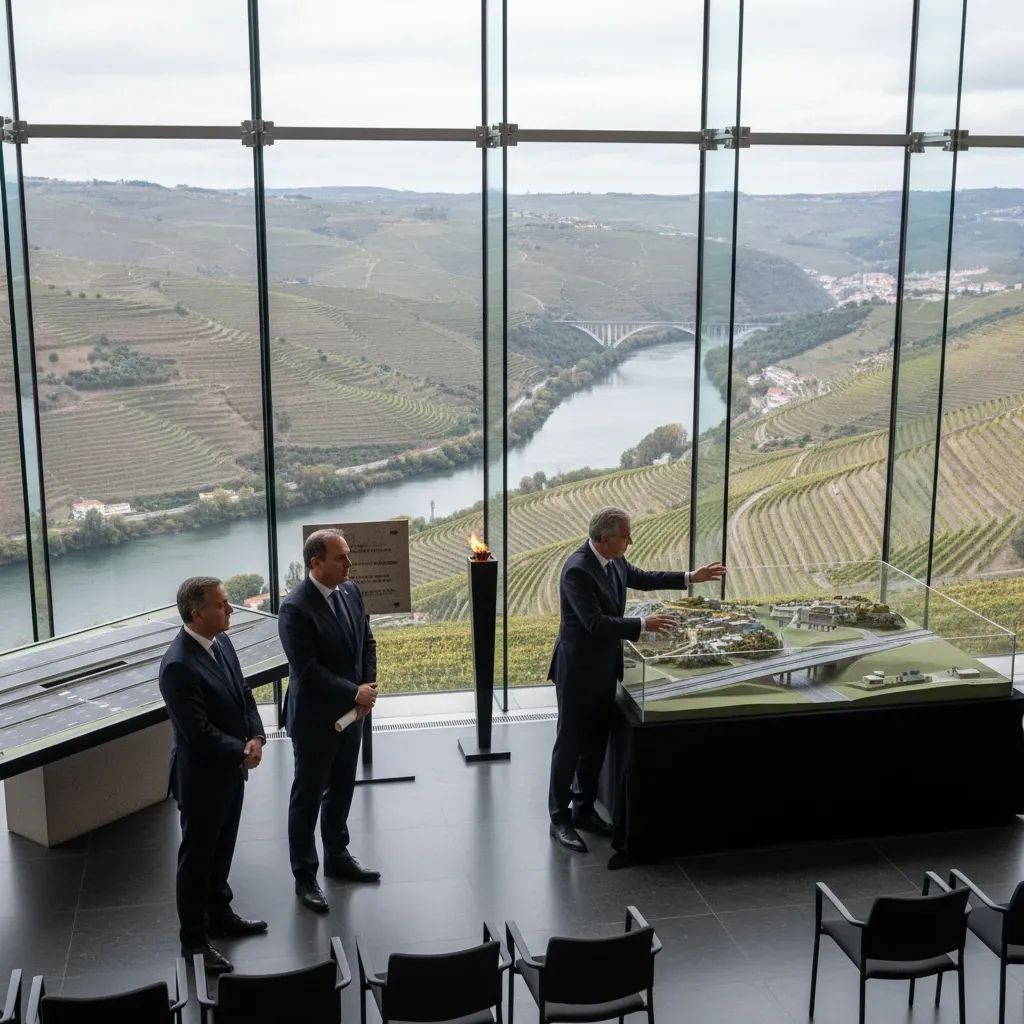
Yet the promised highway remained unbuilt. On March 4, 2026, Infrastructure Minister Miguel Pinto Luz stood in Castelo de Paiva and acknowledged the betrayal. "The State failed when it did not monitor that bridge, and we had the tragedy. But then it failed again when it committed to the people of Castelo de Paiva and did not deliver the infrastructure that was a matter of enormous justice," he said.
The tender announced today covers the 12 km stretch from Rans to Entre-os-Rios, with an estimated cost between €89.5 M and €100 M. A separate €7 M contract to link the existing Rans interchange to EN106 at Vila Só was launched in January 2026, with completion expected by late 2027. Adjudication timelines for the main IC35 stretch have not been disclosed, though the minister vowed, "I will not rest until I see the machinery on the ground."
A long-delayed variant to National Road 222 (EN222)—another post-collapse promise—has been awarded and is set for groundbreaking in June 2026. Local mayor Ricardo Cardoso praised the progress but cautioned that "these promises will only gain full credibility in the eyes of the population when they become visible works on the ground."
Understanding Portugal's Road Classifications
For international residents and those unfamiliar with Portuguese infrastructure hierarchy, it is important to note that the IC35 is an Itinerário Complementar (Complementary Route), a classification between national roads (EN, such as EN106 and EN222) and motorways (A-roads, such as the A4). The IC35 represents the intermediate tier of Portugal's highway system, designed to provide safer, more efficient connectivity than national roads while requiring less investment than full motorway construction.
Lessons for a Nation Facing Climate Chaos
The tragedy imposed lasting regulatory change. Portugal banned sand extraction from riverbeds nationwide, acknowledging the role of dredging in destabilizing bridge foundations. Minister Pinto Luz announced that the National Laboratory of Civil Engineering (LNEC) has been tasked with producing an exhaustive audit of all bridges, retaining walls, embankments, and critical infrastructure within one year. He stressed that Infraestruturas de Portugal and highway concessionaires already conduct ongoing monitoring, but insisted, "There can be no infrastructure at risk. There can be no unjustified improvidence."
Paulo Teixeira, who lived through the disaster response, sees parallels with the storms that battered central Portugal in recent months, claiming at least 19 lives. "Communication in a catastrophe is fundamental," he said. "We didn't all have the same skills—I'd never done a TV briefing before. But without the media, many problems wouldn't have been solved."
He advocates for a "white book" protocol compiling lessons from Entre-os-Rios, Pedrógão Grande, and other disasters, so future responders do not start from zero. "Climate change will unfortunately provoke more situations like these," he warned. He also urged the creation of dedicated ministerial units to process business and household disaster claims, fearing that "when the spotlight fades, many problems will remain unresolved."
Impact on Residents and Travelers
For anyone living in or traveling through the Douro valley, the new IC35 will offer a safer, faster alternative to the EN106, a road that has seen repeated accidents over two decades. The infrastructure will also strengthen economic links between Penafiel, Castelo de Paiva, and the A4 motorway, supporting logistics, tourism, and population retention in an aging, rural region.
Yet the emotional geography remains raw. Two families still gather monthly at the monument. Arlindo Lopes lights candles. Paulo Teixeira silences his radio. And 36 names remain without graves, their stories carried downstream by a river that has never given them back.