

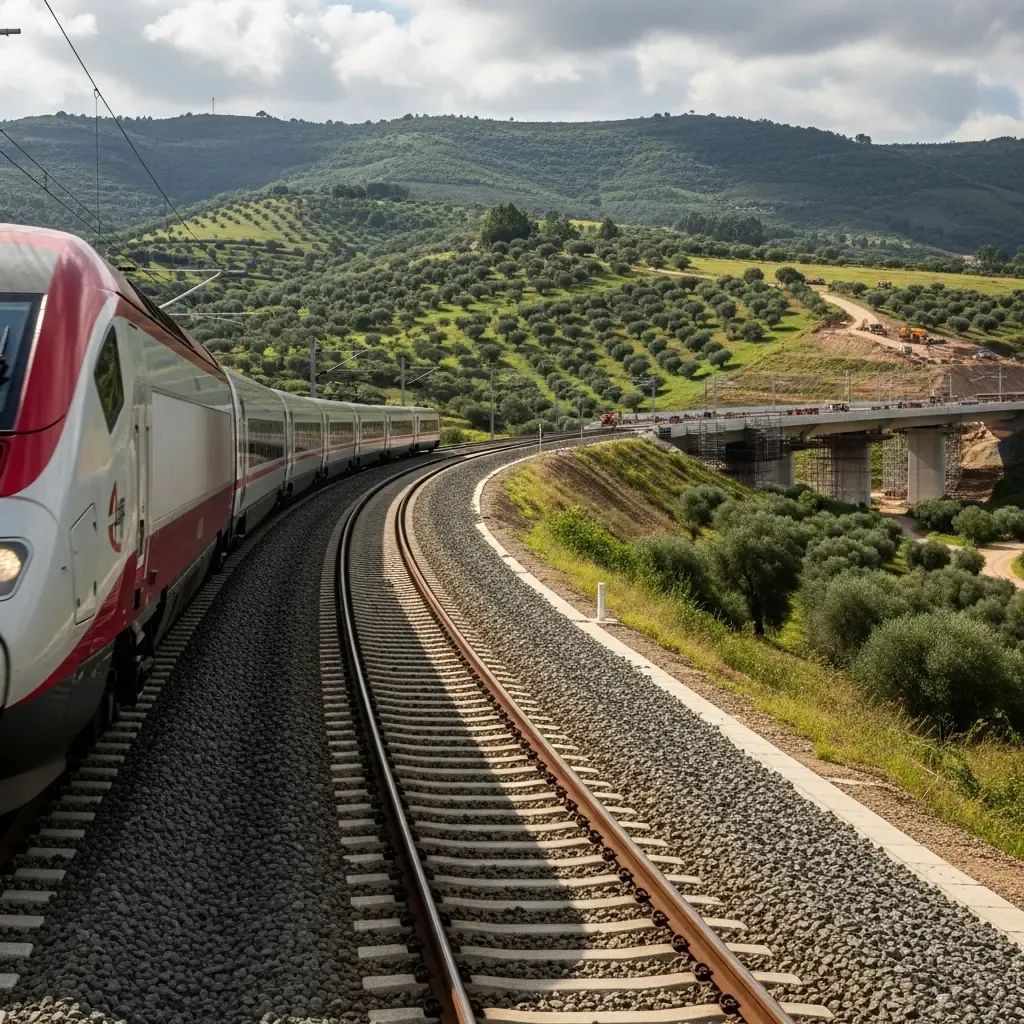
Portugal’s most expensive infrastructure plan in a generation is no longer an abstract PowerPoint. The Council of Ministers has now green-lighted a fresh tender for the Oiã–Soure high-speed rail section, unlocking billions in long-term spending and signalling that the Lisbon–Porto bullet-train dream is finally edging toward concrete and steel.
The essentials at a glance
• €4.8 B in headline payments spread over 30 years for PPP2, plus another €600 M for expropriations and project management
• First invoices start landing in July 2026; construction on the ground expected in 2027
• Roughly €366 M of Connecting Europe Facility (CEF 2) cash already committed; more Brussels funding applications in the pipeline
• Contract covers 61 km of new track, the overhaul of Coimbra-B station, and the quadruplication of the Northern Line near Coimbra
What actually changed this week
The Cabinet resolution published in the Diário da República does two things: it revokes the failed 2024 tender—scrapped after a single non-compliant bid—and hands Infraestruturas de Portugal (IP) a refreshed mandate to launch an international contest by late May. Officials capped the net-present-value exposure at €1.603 B, holding the line on the figure announced in 2024 even as inflation bites.
Where the money will come from
A complex cocktail of EU grants, state capital injections and IP’s own revenue underpins the deal:
• About €365.8 M has already been awarded through the CEF 2 call dedicated to cross-border transport links.
• IP expects another €234 M once additional applications clear Brussels.
• The remaining balance will rely on Portuguese Treasury guarantees wrapped into a public-private partnership that stretches until 2056.
The government also carved out €360 M for signalling, telecoms and safety gear on the first segment (Porto–Oiã). That pot breaks down into €268.5 M for installation by 2031 and €91.5 M for maintenance through 2051.
Timeline: from paperwork to passenger service
May 2026 – Bid deadline for consortiums eyeing PPP2.
Late 2026/early 2027 – Preferred bidder selection, financial close and environmental conformity checks.
2027-2032 – Civil-works blitz: one tunnel, 25 bridges/viaducts and 18 links to the legacy network.
2032-2056 – Availability payments kick in while rolling-stock trials reduce Porto-Lisbon travel time to roughly 75 minutes.
Environmental checkpoints still ahead
The Oiã–Soure corridor already holds a “conditionally favourable” environmental ruling from the Portuguese Environment Agency, but each concessionaire must draft a Relatório de Conformidade proving that the detailed design respects the earlier impact study. A public consultation on that compliance report is mandatory and could still reshape viaduct alignments near Coimbra’s floodplain.
Local and expert reactions
• Mayors in the Centre Region applaud the quadruplicated Northern Line, arguing it will unclog commuter traffic around Coimbra.
• Activist group GEOTA remains sceptical, insisting the state should first modernise existing tracks instead of pouring cash into all-new alignments.
• Transport economists caution that any slippage on PPP1—already delayed when the environmental watchdog rejected an execution plan last December—could ripple into the Oiã–Soure schedule.
Why this matters for people living in Portugal
A functioning Lisbon-Porto bullet train would redraw the national map: day-trips between the two largest metro areas become routine, Coimbra gains hub status, and exporters see trucking hours replaced by reliable rail slots. Just as crucially, the CEF money hinges on Portugal hitting predefined milestones—meaning every missed deadline puts hundreds of millions in EU grants at risk and pushes taxpayers further onto the hook.
Key insights to remember
• No cost increase versus last year’s ceiling despite new inflation data.
• Environmental licences remain a potential wild card.
• First tracks will be laid south of Oiã as soon as 2027, not in the more politically visible Porto suburbs.
• Availability payments run through mid-century, locking the state into multi-decade obligations comparable to those of earlier motorway PPPs.
Portugal’s prestige rail gamble is therefore moving, albeit on a tightrope of financing conditions, engineering logistics and ecological scrutiny. The coming months—when bidders submit price tags and route refinements—will reveal whether the nation can keep its high-speed promise without derailing the public purse.


