

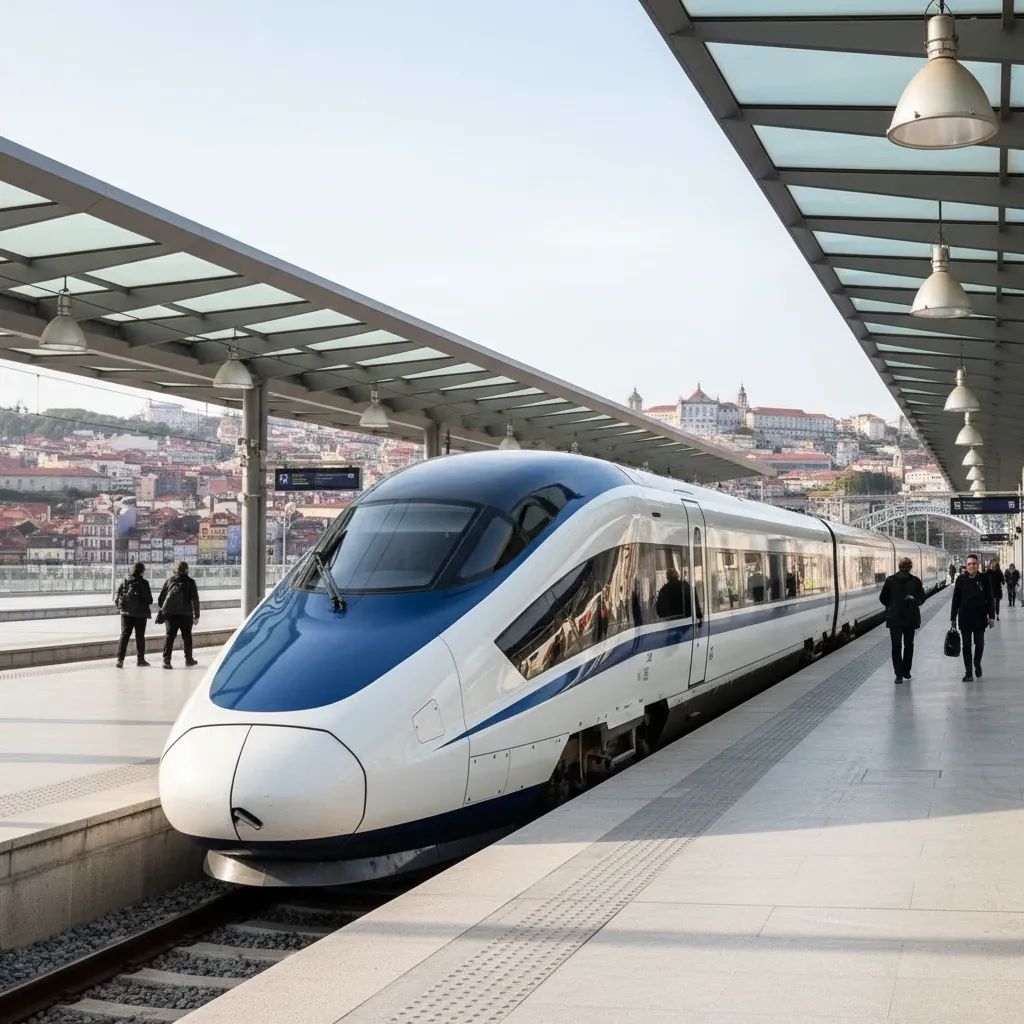
Portugal's €15 Billion Wager: A New Rail Network Takes Shape
Portugal's state railway operator has placed its full institutional weight behind a transformative overhaul of the national network, betting that high-speed corridors will anchor the country's transport infrastructure for the next three decades. The Comboios de Portugal (CP) leadership has positioned rapid rail not as a luxury but as the operational foundation connecting urban commuters, regional economies, and European trade routes in a unified system—if the government can keep its hands off the profitable routes.
Why This Matters:
• Network redesign underway: Three major lines (Porto-Lisbon, Porto-Vigo, Lisbon-Madrid) will compress travel times from hours to under 90 minutes, reshaping business connectivity and tourism patterns.
• €15 billion—roughly 6% of Portugal's annual GDP—in fleet and infrastructure spending through 2033, with the first high-speed trains arriving in 2029.
• The privatization debate: Government moves to auction off four profitable suburban routes could fracture the network's financial viability and undermine CP's integration strategy.
• An aging workforce (75% over 40) threatens to constrain operations precisely when new technology arrives.
What This Means for Residents: Practical Impact by 2032
For residents across Portugal's urban and secondary cities, the implications are immediate and personal. Assume all timelines hold: by 2032, Porto and Lisbon become 75-minute neighbors, down from the current travel time of approximately 3 hours, transforming weekend trips and business commutes. Regional connections improve as new trains replace stock that dates to the 1990s, reducing delays and breakdowns that currently plague services to Covilhã, Guarda, and Alentejo towns.
Tourism patterns will shift. Secondary cities like Coimbra, Aveiro, and Faro become weekend destinations rather than multi-hour commitments. The Algarve, accessible from Lisbon in under two hours, becomes realistic for day trips. Cross-border mobility to Salamanca, Huelva, and eventually Vigo opens labor market flexibility that doesn't currently exist.
Economically, the multiplier effects compound. Research embedded in the planning documents suggests each €1 million in rail infrastructure spending generates €20.84 million in GDP growth over time, plus €17.78 million in private investment and 72 permanent jobs. Construction sector firms, engineering consultancies, and hospitality businesses in secondary cities will experience sustained demand. The real estate sector in Porto and Lisbon may cool slightly as commuting from peripheral towns becomes viable, potentially tempering housing inflation.
Environmental benefits are tangible. High-speed rail emits a fraction of the carbon produced by cars or short-haul flights. Portugal's network is projected to cut 5 million tonnes of CO₂ equivalent by 2050, a meaningful reduction given the transport sector accounts for roughly 30% of national emissions.
The Scale of Transformation
What CP is attempting rivals any infrastructure commitment Portugal has undertaken since the motorway network expansion of the 1990s. The company will acquire roughly 200 new trains across three tranches, backed by approximately €1.5 billion in hardware spending alone. This includes 12 confirmed high-speed units capable of 300 km/h (with 8 optional additions), 117 electric multiple units for regional and urban services, and 22 bi-mode regional trains (electric and diesel-capable) from Switzerland that have already begun arriving.
The centerpiece is the Porto-Lisbon corridor, a €4.5 billion undertaking where the European Investment Bank committed €3 billion and EU structural funds provided €480 million for Phase 1. Construction begins in earnest this year, with the first segment (Porto Campanhã to Oiã) already under contract since July 2025. The second phase, between Oiã and Soure covering 60 kilometers of new track plus 18 kilometers of feeder connections, represents a €2.4 billion public-private partnership where payments will flow from 2026 through 2056.
Timelines are compressed but realistic. The infrastructure agency Infraestruturas de Portugal (IP) has scheduled the Porto-Oiã segment for completion by 2030, with the full corridor operational by 2032. Cross-border links to Spain are advancing in parallel. The Lisbon-Madrid international route won't see tenders until early 2028, but construction is targeted for 2030-2034, creating a three-nation rail spine connecting Portugal's capitals to Madrid and eventually Vigo.
Why Fleet Modernization Matters More Than Headlines Suggest
New trains aren't simply about comfort or speed. For a country where 75% of rail employees have entered their fifth decade or beyond, modern rolling stock demands operators equipped with knowledge of electrified signaling systems, advanced braking, and digital diagnostics—precisely the expertise CP lacks.
The company's procurement strategy reflects this reality. The €746 million Alstom/DST order for 117 electric units prioritizes reliability over prestige; these trains reduce maintenance demands compared to aging diesel stock. Deliveries begin in 2029, ramping through 2033. The Swiss Stadler units—22 trains combining electric and bi-mode capability—arrived starting in December 2025, adding flexibility for partially electrified routes across the interior and south.
High-speed trains occupy a different category. The €584 million procurement for 12-20 TGV-class units (Train à Grande Vitesse, the French high-speed standard) isn't extravagant for what they accomplish: each train carries 500 passengers, reducing transport demand on congested highways and enabling a single operator to manage integrated ticketing, scheduling, and maintenance across the entire network. A second procurement round for six international trains would bring the high-speed fleet to 26 units, sufficient to serve daily Porto-Lisbon, Porto-Vigo, and Lisbon-Madrid services with reserve capacity.
But here's where budget constraints bite. CP is demanding fiscal autonomy from the State budget perimeter—a fiscal framework that limits CP's ability to take on independent debt financing—to secure the debt financing necessary to acquire and maintain this fleet. Without that independence, the operator warns, payment schedules will slip, delivery dates will collapse, and the network integration strategy dies on the bureaucratic vine. The company won't see full visibility on whether urban and regional orders arrive as scheduled until 2033—a decade-long window where passengers endure overcrowded, aging trains while waiting.
The Infrastructure Dependency No One Can Ignore
CP's strategic plan is only as viable as the government's commitment to modernizing the physical network. Infraestruturas de Portugal controls the rails, the signaling systems, the electrification, and the station capacity—everything the new trains require.
The South Line modernization was formally inaugurated on March 2, 2026, with €16.7 million allocated for immediate work plus €40 million budgeted for broader interventions covering construction, land acquisition, technical oversight, and telecommunications upgrades. The Elvas station received a €1.4 million investment starting in January 2026, extending platforms to accommodate longer trains.
The North Line, Portugal's spine connecting Porto to Covilhã and beyond, is being upgraded in segments. Sub-section 3.1 (Pampilhosa to Quintans) is undergoing a 52-month modernization covering catenary replacement (removal and replacement of overhead electrical lines), track renewal, and station reconstruction. These projects are critical: without them, high-speed trains cannot operate at design speeds, and regional service reliability won't improve.
This is where past performance matters. The Ferrovia 2020 initiative, launched to complete €2 billion in upgrades by 2021, missed its deadline by multiple years. The Douro line electrification between Marco de Canaveses and Régua wasn't finished until late 2025. The Válega-Espinho North Line renewal took until the same period. The Algarve line electrification, scheduled for 2024, has slipped into this decade.
The National Investment Programme 2030 (PNI 2030) allocates €8.8 billion for rail modernization and full network electrification, with €885 million budgeted for 2025 alone. These numbers are substantial, yet the execution track record suggests optimism is warranted only with vigilance.
Workforce Age Challenges: An Existential Issue
As of early 2026, CP's workforce profile is among Europe's most unfavorable. Across eight major European rail operators, CP ranks worst in age distribution: only 24% are under 40, while more than 75% have passed 40. Among women, representation stands at just 12.5%, creating both an equity problem and an operational vulnerability.
High-speed rail operations require younger technicians trained in electrification, computer-assisted maintenance, and dynamic signaling—expertise an aging workforce simply doesn't possess. CP acknowledges this is existential. Without a deliberate hiring and training program beginning immediately, the arrival of new trains will coincide with a mass retirement of experienced staff, creating a dangerous window where operational errors become likely and safety margins compress.
The gender imbalance is particularly acute in technical roles. Portugal's rail sector has historically been male-dominated in operations, engineering, and maintenance. CP has made no meaningful progress reversing this, a failing that limits the talent pool and sends a signal that modernization doesn't extend to workplace culture.
The Privatization Debate: Strategic Miscalculation or Ideological Inevitability?
The Ministry of Infrastructure announced its intention in early 2026 to extend CP's public service contract through 2034 but simultaneously ordered the company to draft subconcessioning proposals for four profitable suburban lines: Cascais, Sintra/Azambuja, Sado, and Porto metro services. A decision on the first privatization is expected by mid-2026, with tenders potentially launching before year-end.
This approach reveals a fundamental contradiction. High-speed integration requires a single operator managing ticket sales, maintenance scheduling, crew assignments, and asset allocation across urban, regional, and express services. Fragment the system—handing profitable routes to private operators while retaining unprofitable regional and rural lines—and you destroy the financial logic that makes integration possible.
CP's position is unambiguous: carving out the Cascais line, which generates roughly €120 million annually, starves the operator of revenue needed to cross-subsidize services to Covilhã, Guarda, and Bragança where ridership is lower but social obligation remains. Private operators cherry-picking wealthy commuter corridors leaves CP managing a skeleton network serving populations with limited ability to pay.
Transport unions and the Portuguese Communist Party have seized on the privatization proposal as evidence of ideological drift toward full commercialization. The Fectrans/CGTP-IN federation warns that suburban privatization triggers a domino effect: once private operators prove profitable on urban routes, pressure mounts to hand off regional lines, then eventually long-distance services. The public operator becomes a rump service operator for economically marginal routes.
The government's position, articulated by Infrastructure Minister Miguel Pinto Luz, rests on a narrower logic: competition for profitable routes will force CP to improve efficiency and service quality, attracting more riders and generating economic surplus. The proposal references a prior CP study identifying market interest and operational viability.
Yet this argument ignores network effects. A passenger traveling from Lisbon's suburbs to Porto needs a single ticket, unified scheduling, and integrated loyalty programs. Scatter operations across multiple carriers and journey friction multiplies, pushing travelers back to cars and planes. The supposed efficiency gains evaporate when you account for the loss of network revenue and the costs of coordination failures.
The 18-Month Decision Window
Portugal's rail future crystallizes between now and September 2026. Three variables will determine whether the country builds an integrated European network or a fragmented system controlled by multiple operators:
The first is whether IP delivers on construction schedules. The Oiã-Soure tender, launched in January 2026, must advance to active construction by mid-2027 to avoid delays that cascade through 2030-2032. Early signs are positive, but infrastructure projects in Portugal have repeatedly disappointed.
The second is whether CP secures budget autonomy. Without it, new train financing collapses under bureaucratic constraints, and the fleet modernization strategy withers into decade-long delays.
The third—and most politically charged—is whether the government proceeds with suburban line privatization. A decision to reject subconcessioning would signal confidence in the integrated model and release CP to focus on high-speed operations. A decision to privatize Cascais and Sintra/Azambuja would fracture the network, likely triggering legal disputes that delay service launch dates and undermine investor confidence in Portugal's transport sector.
For residents, the advice is pragmatic: monitor whether the first privatization decision materializes by mid-summer 2026, whether contracts for the Oiã-Soure segment move to active construction, and whether CP's budget request receives government approval. Those three developments will reveal whether Portugal is building a modern rail network or managing slow-motion fragmentation dressed in rhetoric about modernization.


