
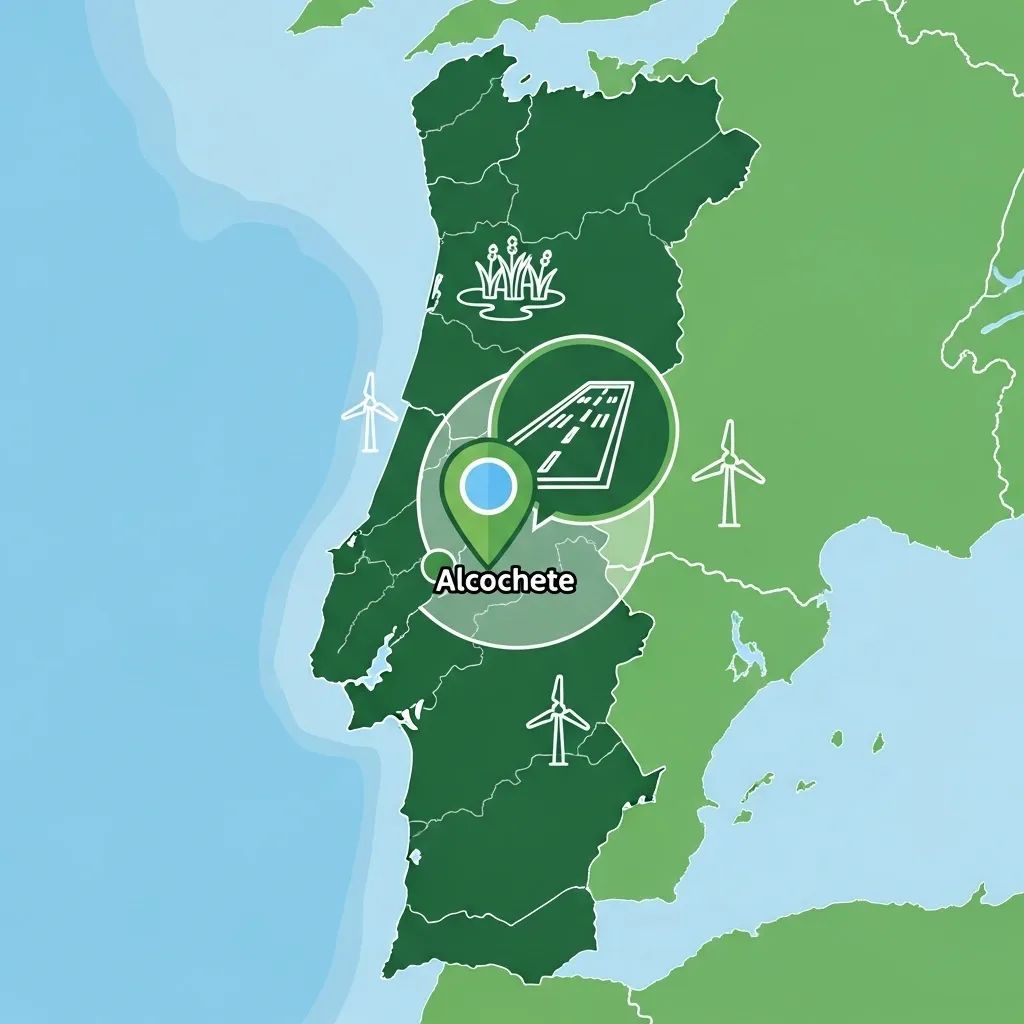
The debate over Lisbon’s next aviation hub has finally left the realm of abstract studies and landed on the negotiating table. In a move that could reshape how Portugal connects to the world, the Government and airport operator ANA have begun direct, highly technical talks to redefine the blueprint of the future Aeroporto Luís de Camões, slated for Alcochete.
At a Glance
• Contract add-on from 2012 is being rewritten to match today’s aircraft and passenger realities.
• Runway length, fuel autonomy and catering facilities dominate the first round of discussions.
• €8.5 B price tag is under scrutiny; the State hints it may chip in after all.
• Environmental groups warn that Alcochete’s wetlands could pay a heavy price.
What triggered the sudden urgency?
For a decade, the growth of tourism, low-cost carriers and overnight cargo has pushed Humberto Delgado Airport to breaking point. Summer queues now spill onto the apron, and airlines complain of slot shortages that limit Portugal’s competitiveness. Yet the guiding document for the new airport—Annex 16, written in 2012—still assumes aircraft mixes and passenger flows from a very different era. A surge to 34 M travellers in 2024 and looming EU climate-efficiency targets convinced the Infrastructure Ministry that a quiet refresh would no longer cut it. By choosing an accelerated, commission-free procedure, officials hope to lock in fresh specifications before the next tourist high season.
The technical shopping list on the table
Engineers on both sides have exchanged a 400-page dossier that zeroes in on a few make-or-break items:
• Runways – ANA proposes two strips of ≥3 500 m, down from the historic 4 000 m vision, claiming most wide-bodies can still depart at max payload. A future third runway would sit 1 525 m from the second to allow triple independent operations.
• Contact stands – The operator wants more aircraft stands that permit walk-on boarding, a model favoured by low-cost carriers, even if that means fewer jet bridges.
• Fuel farm autonomy – Regulators insist on larger reserves to avoid refuelling disruptions, while ANA argues for a leaner setup to trim capex.
• Catering blocks – Government experts remain adamant that at least one air-side kitchen must be built by the concessionaire; ANA would outsource that duty.
• Passenger capacity – The layout must handle 45 M passengers from day one and grow to 52 M by 2060, with baggage belts stretching 93 m to clear simultaneous European and long-haul arrivals.
• Green power – Photovoltaic roofs sized for 35.1 GWh/year are pencilled in to meet the airport-net-zero pledge by 2045.
Money: the elephant in the departure lounge
Behind the laser-focused technical language lies an unruly financial debate. ANA’s latest model suggests an €8.5 B investment, financed by hiking Lisbon airport fees until each passenger pays €23.37 in 2030 and by prolonging the concession to 2092. The Treasury calls the horizon too distant and the fees too steep. Finance Minister Miguel Silveira even floated, for the first time, a "limited public contribution" if that would shave billions off the final bill. Low-cost airlines immediately warned that higher charges could dampen Portugal’s record-breaking tourist streak. No euro of State money is committed yet, but the possibility is officially on the table.
Environment and local voices are not boarding quietly
Field ecologists remind policymakers that Campo de Tiro de Alcochete overlaps bird-migration corridors and sensitive aquifers. The watchdog ZERO labels the site the second-worst option after Montijo for biodiversity, while the Agency for the Environment (APA) fears under-rated water-table risks. Nearby freguesias worry about noise footprints they still endure from the current airport. ANA answers with promises: an acoustic-insulation fund, a standing noise-consultative committee and carbon-neutral operations by 2030. Whether those gestures calm public hearings in the first quarter of 2026 remains to be seen.
Logistics and connectivity: will the rest of the system keep up?
Freight forwarders question whether Portugal’s export machine can wait until 2036. The Transitários’ Association complains that today’s cargo sheds in Lisbon already force perishables to detour via Madrid. Meanwhile, success hinges on the long-planned third Tagus crossing, high-speed rail links and an upgraded A12 corridor—projects that have slipped down successive budgets. The Government now promises a "bundled tender" that couples airport works with road and rail contracts so that planes, lorries and Alfa Pendular trains converge on the same timeline.
What happens next?
December’s kick-off meetings cover only the technical skeleton. By spring, negotiators expect to draft a revised Annex 16, feed it into the Strategic Environmental Assessment and then reopen the room for the crunch issue of financing. ANA must file its full application by January 2028, though ministers hint at a tighter deadline. Construction could then begin in 2030, with the first passengers stepping onto the tarmac of Aeroporto Luís de Camões in late 2036—if, and it is a big if, every permit and euro falls into place.
Why it matters for passengers and taxpayers
A state-of-the-art airport 40 km east of Lisbon would slash delays, unlock routes to Asia and the Americas, and support 100 000 jobs across tourism and logistics. Yet the same project could drive up ticket prices and reroute billions in concession income away from the public purse for decades. As negotiations enter their decisive phase, Portuguese residents are effectively sitting in the control tower, watching to see whether efficiency, environment and economics can share the same flight plan.


