

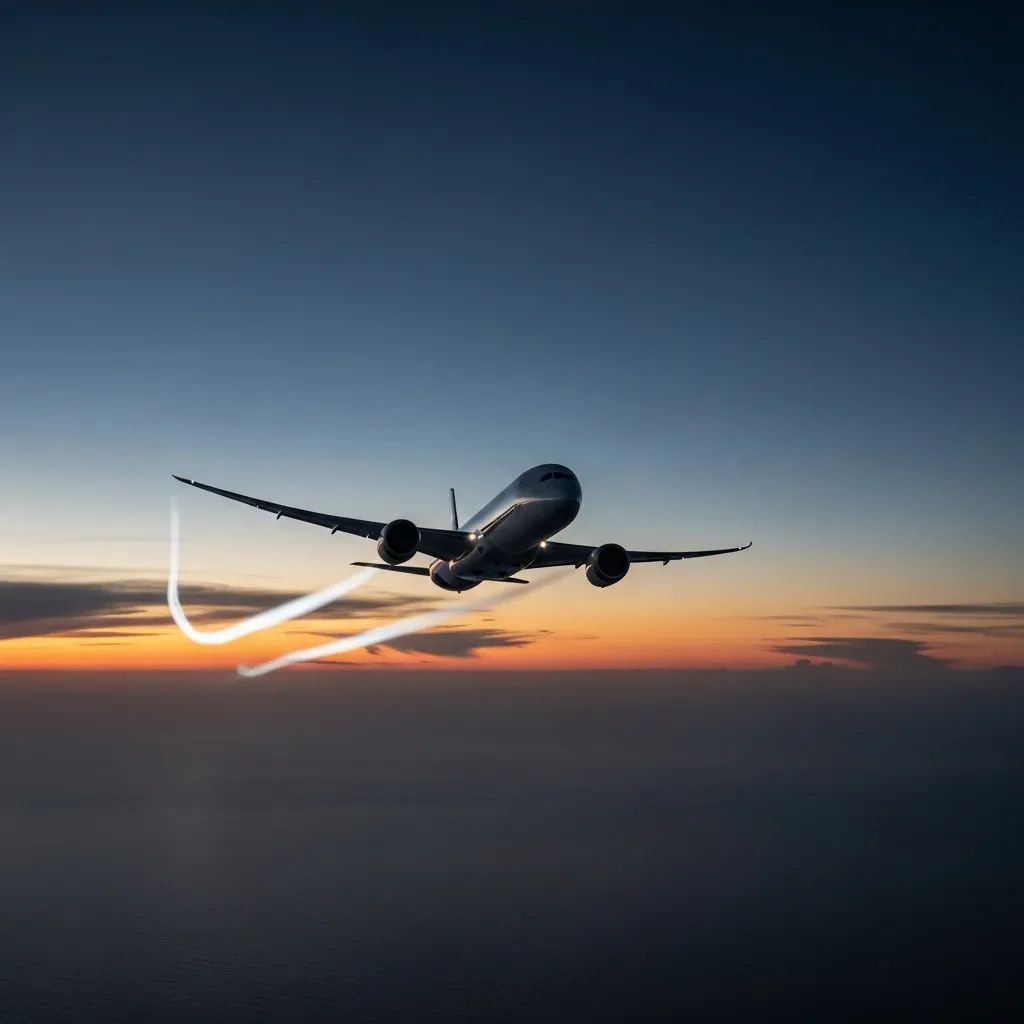
A brisk change in flight paths over the Azores could shave a surprising slice off aviation-related warming. That is the central takeaway from a new analysis by environmental group Zero and its Brussels-based partner Transport & Environment (T&E), which says Portugal’s air-traffic authorities sit on one of Europe’s easiest climate wins.
Fast facts for Portuguese readers
• 72 % of persistent contrails above Europe form in the North Atlantic flight corridor that Portugal helps manage.
• Just 3 % of global flights generated 80 % of contrail-linked warming in 2019.
• Redirecting certain night-time winter flights could eliminate roughly 70 % of the heating tied to European contrails without crowding the skies.
Why ice-cloud “exhaust” is a hotter issue than fuel burn
Contrails—those icy streaks tailing jetliners—sound harmless, yet they trap outgoing infrared radiation. Although they typically vanish within minutes, the stubborn ones behave like cirrus clouds and can amplify warming almost as much as the CO₂ those aircraft emit. Scientists now estimate contrails account for 1–2 % of global heating, a share comparable to the entire output of Germany.
Santa Maria FIR: a strategic patch of sky
Portugal’s Santa Maria Flight Information Region (FIR) spans 5.8 million km² of the Atlantic, policing routes used by long-haul flights between Europe and North America. Low-traffic density and predictable jet-stream patterns make this airspace a sweet spot for contrail avoidance manoeuvres: minor climbs, descents or lateral shifts that slip aircraft out of the frigid, humid layers where ice crystals persist.
The low-cost climate hack: tweak winter night routes
Analysis of 2019 radar and weather data found that 25 % of contrail warming stemmed from autumn-winter flights after sunset, even though those flights represented only 10 % of traffic. Because surface sunlight is absent at night, any heat trapped by contrails is not offset by daytime reflection, making nocturnal rerouting disproportionately effective. T&E argues that a combination of dynamic weather forecasting and flexible air-traffic management (ATM) could slash radiative forcing with negligible impact on schedules or fuel bills—often under 0.5 % extra burn.
Brussels sharpens its toolkit
The European Commission’s 2025 update to the Monitoring, Reporting and Verification (MRV) rules obliges airlines to log non-CO₂ effects such as contrails and NOₓ on intra-EU flights. By 2027 that disclosure will extend to every departure and arrival in the bloc, feeding into a possible EU-ETS surcharge for stubborn contrails as early as 2028. Parallel legislation is pushing air-navigation providers to integrate climate-optimised trajectories into the future Single European Sky.
Portugal’s own moves: ASA and RONDA
Lisbon is already threading contrails into a broader decarbonisation push:
• The Aviation Sustainability Alliance (ASA), launched in 2025 with €40 M, is exploring low-aromatic sustainable aviation fuels (SAF) that cut soot particles and thus ice-crystal formation.
• The National Roadmap for the Decarbonisation of Aviation (RONDA) pledges to fold non-CO₂ metrics into airport slot allocation and fee structures by 2027.
• NAV Portugal has written contrail metrics into its 2025-2030 sustainability scorecard, opening the door to pilot programs in the Azores FIR.
The forecasting hurdle
Weather models have become good at pin-pointing cold, moist layers but still struggle with micro-scale humidity shifts. The German-led A4CLIMATE consortium—whose next test flights are slated for November 2025—aims to refine one-hour-ahead contrail probability maps. Sources in NAV Portugal say Santa Maria control officers will join simulation trials this spring, a first for the Lusophone world.
What it means for passengers and exporters
Travellers are unlikely to notice much beyond a few extra minutes aloft on some winter red-eyes. Airlines, for their part, face modest fuel penalties but could recoup costs if the EU attaches climate credits to avoided contrails. Portuguese exporters dependent on swift Atlantic crossings—from Azorean seafood to Porto’s tech cargo—should see negligible delays under the proposed routing tweaks.
The bottom line
From an environmental cost-benefit view, contrail avoidance looks like low-hanging fruit. With Lisbon controlling a vast slice of critical sky and Brussels readying both the carrots and sticks, Portugal could become Europe’s first laboratory for ice-cloud-free aviation—and a rare example where a climate fix does not start with the word “tax”.


