

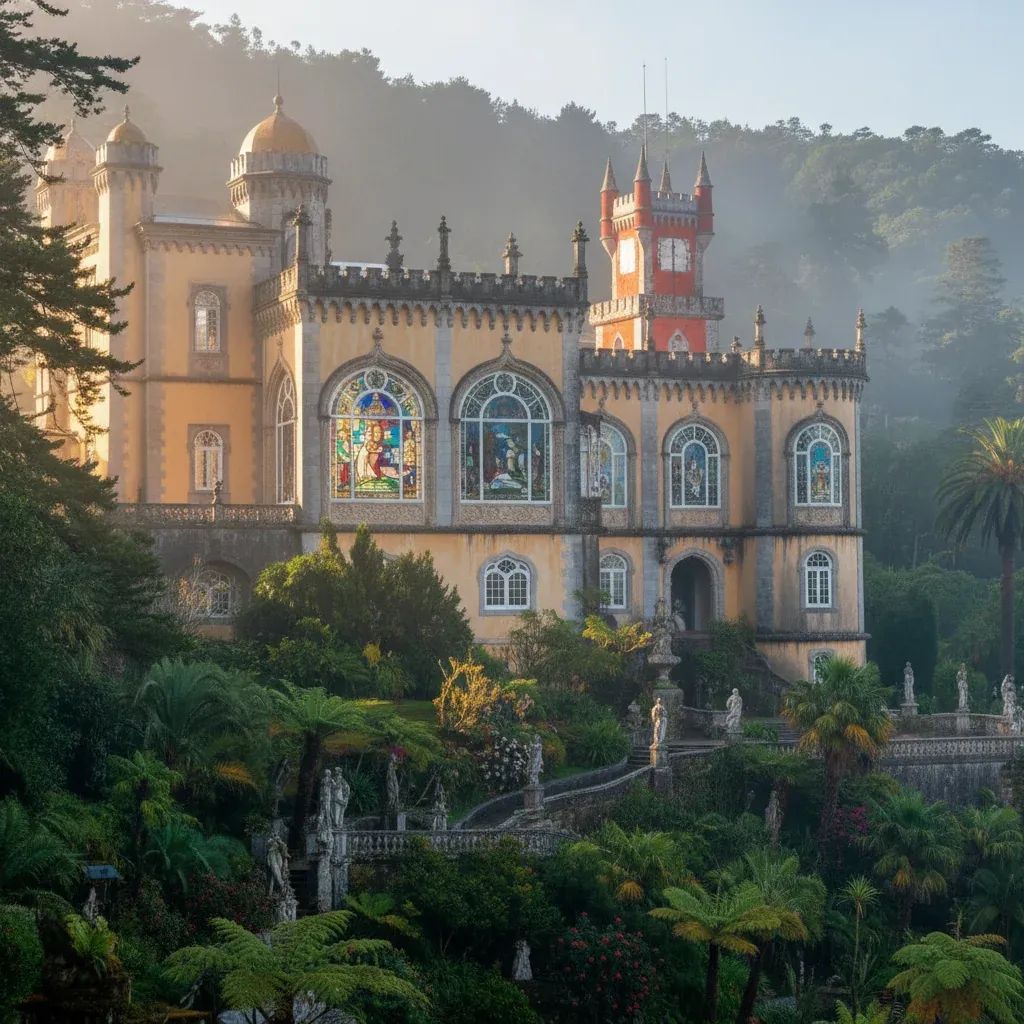
The Palácio Biester in Sintra has long played second fiddle to its more famous neighbors—the Pena Palace, Monserrate, and Quinta da Regaleira—yet this 19th-century jewel in the heart of the historic center offers something those landmark attractions increasingly struggle to provide: breathing room. And for cinema buffs, it holds an unexpected claim to fame: it's where Roman Polanski filmed key scenes of "The Ninth Gate" with Johnny Depp back in 1998, turning its salons and gardens into the shadowy mansion of a doomed book collector.
Why This Matters
• Authentic alternative: The Biester remains far less crowded than Sintra's marquee palaces, making it ideal for visitors seeking a quieter cultural experience without sacrificing architectural grandeur.
• Hollywood connection: A life-size poster of Johnny Depp from "The Ninth Gate" greets visitors at the garden entrance, marking one of the few major international film productions shot in Portugal in the late 1990s.
• Updated pricing and access: As of 2026, adult tickets cost €16, with family passes at €45 (two adults plus up to four youths), and the palace is closed only on December 25 and January 1.
The Film Set That Put Biester on the Map
Summer 1998 brought Roman Polanski's production team to Sintra for a supernatural thriller adapted from Arturo Pérez-Reverte's novel "The Club Dumas." The director needed a location that could convey decadent decay and occult mystery without heavy special effects, and the Biester Palace delivered both in spades. Its gilded salons, stained-glass windows, and ornate library became the mansion of Victor Fargas, a tragic bibliophile played by Jack Taylor, in one of the film's most atmospheric sequences.
The production exploited the palace's natural light filtering through colored glass to cast eerie shadows across carved woodwork by Leandro de Souza Braga and frescoes by Luigi Manini, two of Portugal's leading decorative artists at the turn of the 20th century. Exterior shots in the six-hectare botanical park, designed by French landscape architect François Nogré, reinforced the screenplay's themes of isolation and esoteric knowledge.
Local crew members recall that Johnny Depp described the palace as "a place that looks like it came out of an old book," a sentiment that captures the Romantic-era fantasy embedded in every cornice and turret. The film remains a notable example of how Portugal's period architecture has attracted international productions seeking authentic European settings.
Architectural Pedigree and Recent Restoration
The palace was commissioned in the 1890s by the Biester family and designed by José Luiz Monteiro, a heavyweight of Portuguese architecture whose portfolio includes Lisbon's Rossio railway station. Monteiro enlisted Luigi Manini—an Italian scenographer who also worked on the Quinta da Regaleira—and Leandro de Souza Braga to create interiors that blend neo-Gothic, neo-Manueline, and Romantic motifs into a cohesive vision of 19th-century eclecticism.
After decades of neglect, the palace underwent a two-year restoration completed in April 2022, focusing on the preservation of original frescoes, stucco work by Domingos Meira, carved wooden ceilings, and vibrant stained glass. The project extended to the park, where rare botanical species, grottoes (including the Gruta da Pena), lakes, and panoramic viewpoints—some offering direct sight lines to the Castelo dos Mouros—were brought back to their former splendor.
What This Means for Visitors
For residents and expats looking to host out-of-town guests without the scrum at Pena, the Biester offers a boutique alternative with cultural depth. The palace is open year-round except for Christmas Day and New Year's Day, with extended hours from April through September (10:00 to 20:00, last entry 19:00) and shorter winter hours October through March (10:00 to 18:30, last entry 17:30).
Inside, the circuit takes visitors through a music salon, a chapel rich in Templar symbols, the main bedroom, and a mysterious initiation chamber in the attic connected to the garden by a tunnel—a detail that fuels speculation about the family's ties to esoteric societies. The park itself is a six-hectare canvas of winding paths, hidden grottoes, and specimen trees, with a greenhouse café and terrace where you can sit with a drink and absorb the Instagram-ready scenery without the usual tourist onslaught.
Ticket pricing for 2026 is as follows: adults pay €16, youths and seniors €12, and families €45 (two adults plus up to four youths). Children under five enter free. Booking online in advance is strongly recommended, especially during high season when limited capacity keeps the experience intimate.
Positioning Within Sintra's Tourism Ecosystem
Sintra's UNESCO World Heritage landscape attracts millions annually, but the traffic choke points are well known: queues for buses up to Pena, bottlenecks at Quinta da Regaleira, and summer crowds that turn contemplation into claustrophobia. The Biester's location—walking distance from the historic center—and its relatively low profile make it a tactical choice for anyone seeking depth over checklist tourism.
Hollywood's Portuguese Footprint
While Portugal has emerged as a favored location for international productions—from the Bond franchise's use of Lisbon in "On Her Majesty's Secret Service" to recent Netflix series—"The Ninth Gate" represents an earlier wave of European film production that leveraged the country's period architecture and natural landscapes as compelling backdrops for international cinema.
Polanski's choice of the Biester was both practical and aesthetic: the palace's interiors required minimal set dressing, and the Sintra microclimate—often shrouded in mist—gave exteriors a naturally moody atmosphere.
Still, the life-size Johnny Depp cutout at the garden entrance signals that management understands the appeal of that Hollywood connection, especially as Portugal continues to attract international film and television productions.
Practical Considerations
Sintra's microclimates mean weather can shift rapidly, so bring layers even in summer. The Biester's wooden floors and delicate furnishings require visitors to follow strict no-touch protocols, and photography is permitted but without flash. The park paths, while scenic, include uneven terrain and steps, so comfortable footwear is essential.
For lunch or a break, the greenhouse café serves light fare and beverages, with seating that spills onto a terrace overlooking the park. Prices are moderate by Sintra standards, though not bargain territory.
If you're combining visits, the Biester pairs well with the nearby Palácio da Vila or a walk up to the Castelo dos Mouros, creating a half-day itinerary that balances palace interiors with hilltop views. Unlike Pena, where advance tickets are near-mandatory in high season, the Biester's lower visitor numbers mean walk-ins are sometimes possible—but booking online guarantees entry.
The Verdict
The Palácio Biester won't replace the Pena on anyone's must-see list, nor should it. But for residents tired of recommending the same overcrowded circuits to visiting friends, or for expats seeking a quieter window into Portuguese Romantic architecture, it delivers substance without the circus. The fact that Johnny Depp once prowled its library in pursuit of a demonic manuscript is a quirky bonus—one that underscores how even lesser-known corners of Sintra have stories worth telling.


