
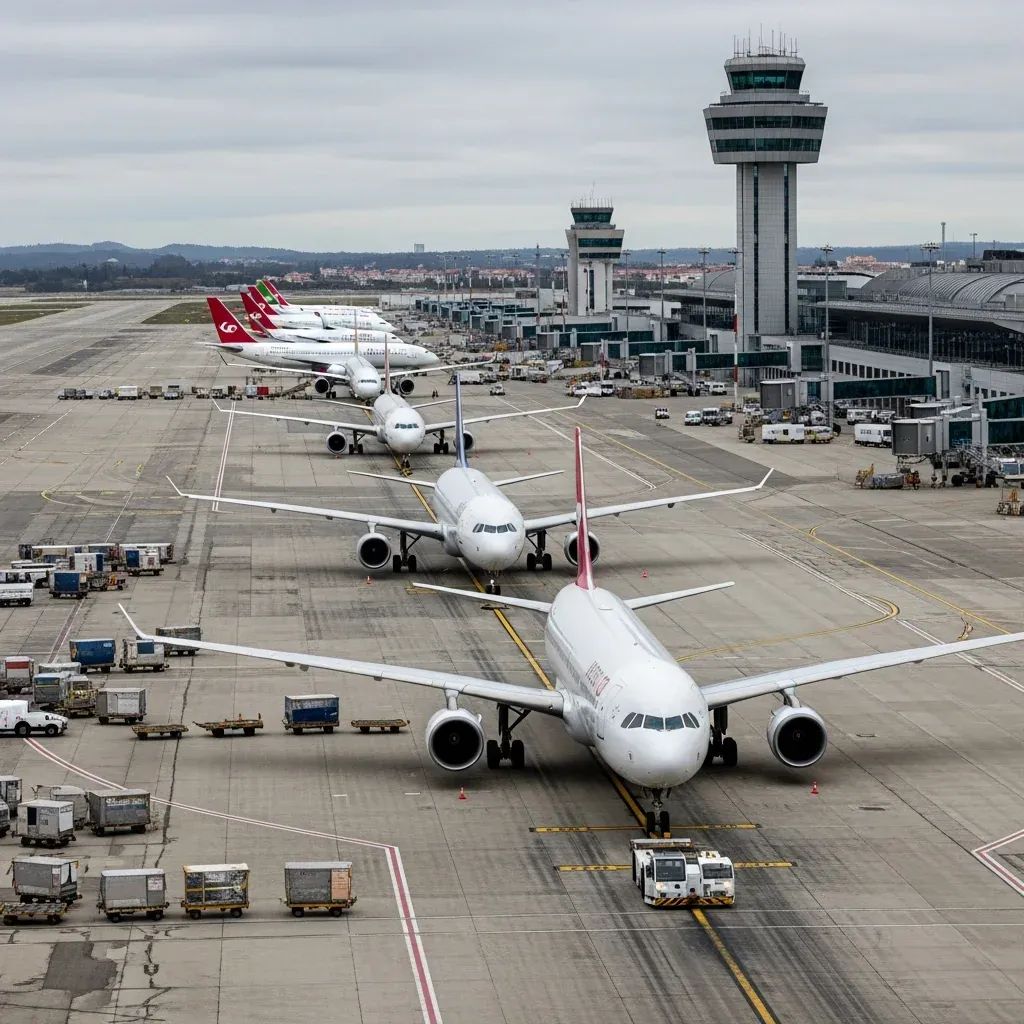
Europe’s summer of crowded departure lounges and nervous gate agents is not just a holiday anecdote—persistent air-traffic bottlenecks are quietly inflating ticket prices, burning extra fuel, and reshaping airlines’ winter schedules. For Portuguese travellers, every hop from Lisbon to Paris or a connection in Frankfurt now carries an invisible surcharge: minutes, sometimes hours, of avoidable delay.
At a glance
• €16.1 B lost to air-traffic hold-ups since 2015
• Delays have climbed 114 % while traffic grew just 6.7 %
• France and Germany generate >50 % of the backlog
• July–August 2024 alone produced 38 % of yearly delays
• Staffing shortages—rather than weather—drive 87 % of 2024 setbacks
Why flights leaving Portugal feel the pain firstThe vast majority of routes from Lisbon, Porto or Faro to central or northern Europe must cross French or German airspace. When those control centres reach their capacity ceiling, aircraft departing Portugal are forced to fly longer arcs over the Bay of Biscay or the Alps. Even a modest re-routing adds fuel burn, complicates crew-duty limits and ultimately triggers the “gate-hold” announcements we hear at Humberto Delgado Airport.
To make matters worse, TAP’s tight wave of morning departures relies on swift turnarounds in Paris-Orly, Amsterdam and Munich. A single upstream slot restriction cascades through the day, affecting Azores connections, Madeira services and long-haul links to the Americas.
The arithmetic behind the angerIATA’s latest dossier shows 7.2 M flights impacted over the last decade. Of these, 700 000 were delayed by more than half an hour—roughly the time it takes to taxi, take off and reach cruising altitude. The raw minutes are even starker: 30.4 M minutes lost in 2024, more than doubling 2015’s figure.
Portugal’s share is small in absolute terms, yet proportionally harsh: Portugal-based airlines operate lean fleets, so a single aircraft tied up on the ground can wipe out an entire sequence of routes, forcing a domino of re-bookings and compensation claims under EU261, the EU’s passenger-rights regulation. A single delayed A321neo can disrupt multiple day-trip itineraries for passengers.
Paris and Karlsruhe in the spotlightEuropean controllers pride themselves on safety, yet the laboratories of congestion sit squarely in France and Germany. Combined, their navigation agencies created over half of the continent’s holdups last year. Staffing, not storms, is the villain: controller rosters shrank during the pandemic and have bounced back far slower than passenger demand. Recruitment pipelines can take up to three years before a trainee receives full certification.
French unions add another layer. While strike-related cancellations were excluded from the headline data, the mere threat of industrial action often forces neighbouring centres—including NAV Portugal—to dispatch aircraft on longer routings to avoid sensitive skies.
The elusive Single European SkyBrussels promised that a unifying legal framework, dubbed the Single European Sky, would slash delays by allowing airlines to pick the most direct trajectory regardless of national borders. Two decades and countless white papers later, Portuguese crews still juggle 27 sets of flight rules before reaching Scandinavia. Willie Walsh, IATA’s chief, labels the situation “completely unacceptable,” arguing that EU regulators obsess over passenger-compensation tweaks while root causes stay untouched.
Home-grown initiatives: can Portugal do more?NAV Portugal has quietly upgraded radar sites in Monchique, installed new voice-communication systems and opened a third Lisboa ACC sector during peak hours. Those steps helped local delay minutes fall by 14 % in 2024, but they cannot shield flights once they cross into France’s saturated Marseille FIR. Industry insiders now push for regional back-up centres capable of temporarily taking over a neighbour’s workload—an idea Lisbon has signalled it is “open to discussing.”
Traveller toolkit: minimising disruptionFrequent flyers from Portugal can shave risk with a few tactics:
Book early-morning departures, when European flow programmes reset and congestion is lighter.
Choose itineraries that avoid tight <60-minute connections north of the Alps.
Monitor your flight’s slot via tools like FlightAware; if the number turns red, contact the airline before queues form.
Keep receipts—EU261 refunds only cover direct costs, but hotel and meals fall under “reasonable expenses.”
The road—or sky—aheadEurocontrol forecasts a modest dip in delay minutes for 2025, yet even its optimistic scenario leaves congestion well above 2019 levels. For Portugal’s tourism-anchored economy, that means higher operating costs for carriers, pricier fares for holidaymakers and longer planning buffers for tour operators. Until the continent’s air-navigation jigsaw is re-engineered, Iberian travellers may need to pack a little more patience in their carry-ons.


