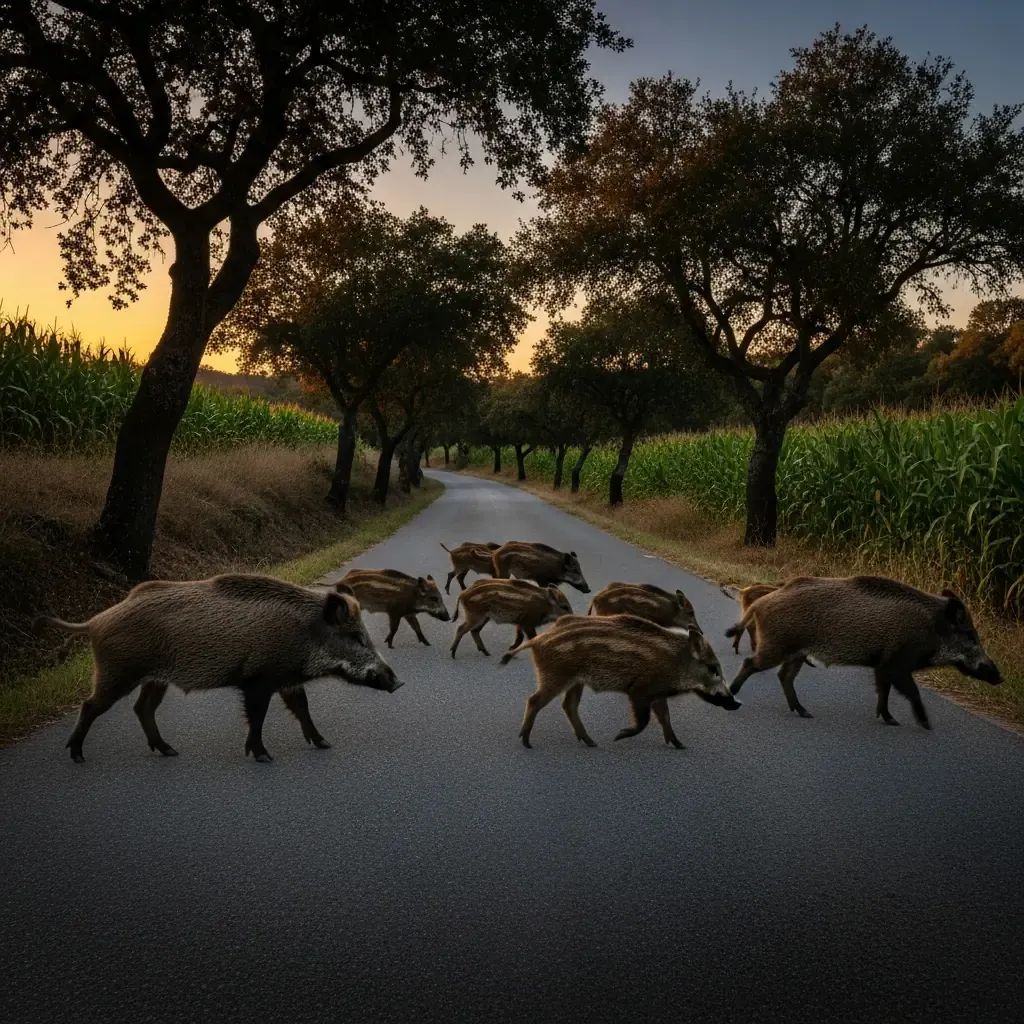
Villages from Bragança to Beja have long shared their hills with wild boar, but the animals are now so numerous that they are reshaping hunting rules, farm economics and even road-safety campaigns. Fresh European mapping puts Portugal’s population at almost 400 000 – a record that leaves local authorities scrambling for new answers.
At a glance
• 395 600–398 800 wild boar now roam mainland Portugal, according to the ENETWILD consortium.
• Annual European culls climbed from 2.2 M to almost 4 M in 15 years, yet numbers keep rising.
• Damage to maize alone was valued at €8 M in 2024; final 2025 figures are still being tallied.
• Spain’s first cases of African swine fever (ASF) in Catalonia have pushed Portugal to strengthen surveillance although the virus has not crossed the border.
• The government hopes to cut boar numbers by 10–20 % within a decade through looser hunting schedules and targeted drives.
A Wildlife Boom With a Price Tag
European ecologists have watched a “constant and accelerated” growth in boar for more than a decade. Even with hunters removing nearly 4 M animals a year, densities continue to rise in western and central Europe, a trend fuelled by milder winters, abundant maize and the species’ adaptable diet. In Portugal, the sweet-spot lies in the Interior Centro, where contiguous oak forests and irrigated cropland provide perfect cover and year-round food. The new ENETWILD map, the first to standardise data across all member states, ranks Portugal alongside France and Italy for high local densities, albeit on a smaller national scale.
Why Portugal Is Feeling the Heat
For farmers, the surge translates into flattened fences, uprooted pastures and shredded cereal fields. ANPROMIS calculates that boar gobbled roughly €8 M worth of maize in 2024; early reports suggest similar figures for 2025. The animals also wander onto roads: in Moura municipality, 12 of 80 recorded wildlife collisions last year involved boar, a statistic officials fear will climb as populations move south toward the Alqueva reservoir. Urban fringes are not spared; recent social-media videos show sounders rooting through Porto’s suburban gardens, prompting calls for municipal response teams.
African Swine Fever: A Border Away
Portugal has remained ASF-free since 1999, but November’s discovery of nine infected wild boar just across the border in Catalonia jolted Lisbon. Health agency DGAV intensified passive surveillance, urging hunters to report every carcass via the ANIMAS app and mandating stricter disinfecting of vehicles returning from Spanish hunts. While officials say no “extraordinary” measures are needed yet, pork producers fret that a single case would close export markets overnight and devastate the €400 M industry. Boar are key vectors because they can carry the virus silently across long distances.
What Authorities Are Doing – and What Farmers Still Want
Under the Strategic & Action Plan for Wild Boar, the Institute for Nature Conservation and Forests aims to reduce numbers by up to 20 % in 5–10 years. Key tools include:
• Decree-Law 71/2024 – allows night stalking all year, previously limited to full-moon periods.
• Extraordinary density-reduction licences – enable quick authorisation of battues in irrigated farmland.
• Smaller tourist hunting zones (<400 ha) – granted earlier in 2024 to spread pressure across private estates.
Farm unions welcome the flexibility but insist that compensation schemes must accompany control. The National Farmers’ Confederation says many smallholders abandon crops after repeat raids, an outcome that undercuts Portugal’s food-sovereignty goals. Negotiations over state-funded insurance remain stalled.
Can the Numbers Be Tamed?
Ecologists warn that success hinges on better data, not just more bullets. The University of Aveiro is updating its landmark 2020–22 study to verify whether recent measures have slowed growth. Meanwhile, climate projections suggest warmer winters could further boost litter survival, meaning that culling must exceed natural population growth — estimated at 30 % per year — to reverse the curve. Conservationists also remind policymakers that boar play a role in seed dispersal and soil turnover, advocating for balanced landscapes rather than blanket eradication.
Three Takeaways for Landowners and Drivers
Report every sighting: Citizen data feed the national monitoring grid.
Reinforce perimeters before harvest: Electric fencing and repellents cut losses by up to 60 %, according to ICNF trials.
Slow down at dusk: Nearly 70 % of boar collisions occur between 17:00 and 23:00, when animals travel between feeding areas.
Wild boar are an undeniable part of Portugal’s natural heritage; the question now is whether people, policy and the animals themselves can settle on numbers the countryside can bear.