The Portugal Ministry of Internal Administration has approved the revival of the Guarda Nacional Republicana's Traffic Brigade nearly two decades after it was dissolved. The decision promises to reshape enforcement on the country's roads but carries echoes of a troubled past. Minister Luís Neves announced the reactivation alongside sweeping changes to road safety law, including unannounced checkpoints, stricter license revocations, and stricter penalties for alcohol-related offenses.
Why This Matters
• Centralized enforcement returns: A specialized national command will coordinate traffic patrols, reversing the 2007 decentralization that left Portugal's road safety strategy fragmented.
• No advance warning: Drivers will no longer receive public notice of police checkpoints, creating unpredictability aimed at deterring violations.
• Heavier penalties ahead: The government will draft a new Highway Code by year-end, consolidating scattered regulations and expanding the criteria for permanently revoking driving licenses.
• Budget and staffing unclear: Details on recruitment, funding, and oversight mechanisms for the revived brigade remain unannounced.
Why the Brigade Was Disbanded in the First Place
The Traffic Brigade once symbolized the GNR's most visible identity—2,400 officers dedicated exclusively to highway enforcement. Its 2007 dissolution under the Socialist administration of Prime Minister José Sócrates sparked internal rebellion, with officers staging protest actions including selective enforcement leniency. The official rationale emphasized decentralization and administrative efficiency, transferring responsibilities to regional commands. But the untold story involves a cascade of corruption scandals that gutted public trust.
Operation Centauro in 2002 swept up nearly 200 defendants, including 173 Traffic Brigade personnel. Courts in Sintra eventually handed prison sentences to 16 officers and suspended terms to 65 others. Two years later, investigators dismantled a network in Albufeira, prosecuting 25 officers and convicting 10. These cases, investigated by the Polícia Judiciária, exposed systemic bribery schemes—officers accepting payoffs to ignore infractions or manipulate citations.
Tiago Gonçalves da Silva, president of the National Association of Guard Officers (ANOG), told Lusa that the environment enabling such misconduct would be "difficult to replicate today." He argued the GNR should gain authority to investigate internal corruption independently, similar to Spain's model, rather than relying on external agencies—a structural reform not yet part of the government's announced package.
The Case for and Against Centralization
Gonçalves da Silva described the reactivation as a mixed proposition: "There are advantages and disadvantages. The biggest advantage is centralization under a single command to effectively combat road fatalities." A unified command could impose consistent tactics and training standards, addressing the patchwork approach critics say emerged after 2007. Regional commands, stretched across multiple policing duties, diluted specialized traffic enforcement, leaving gaps in coverage and expertise.
Yet the ANOG leader cautioned that restoring a brigade alone cannot reverse Portugal's worsening road safety record. He called for an "integral strategy" linking the Institute of Mobility and Transport (IMT), the National Road Safety Authority (ANSR), prevention advocacy groups, and both security forces. Coordination among these entities has historically been weak, with overlapping mandates creating bureaucratic friction.
Enforcement That Bites: The Flagrante Delito Problem
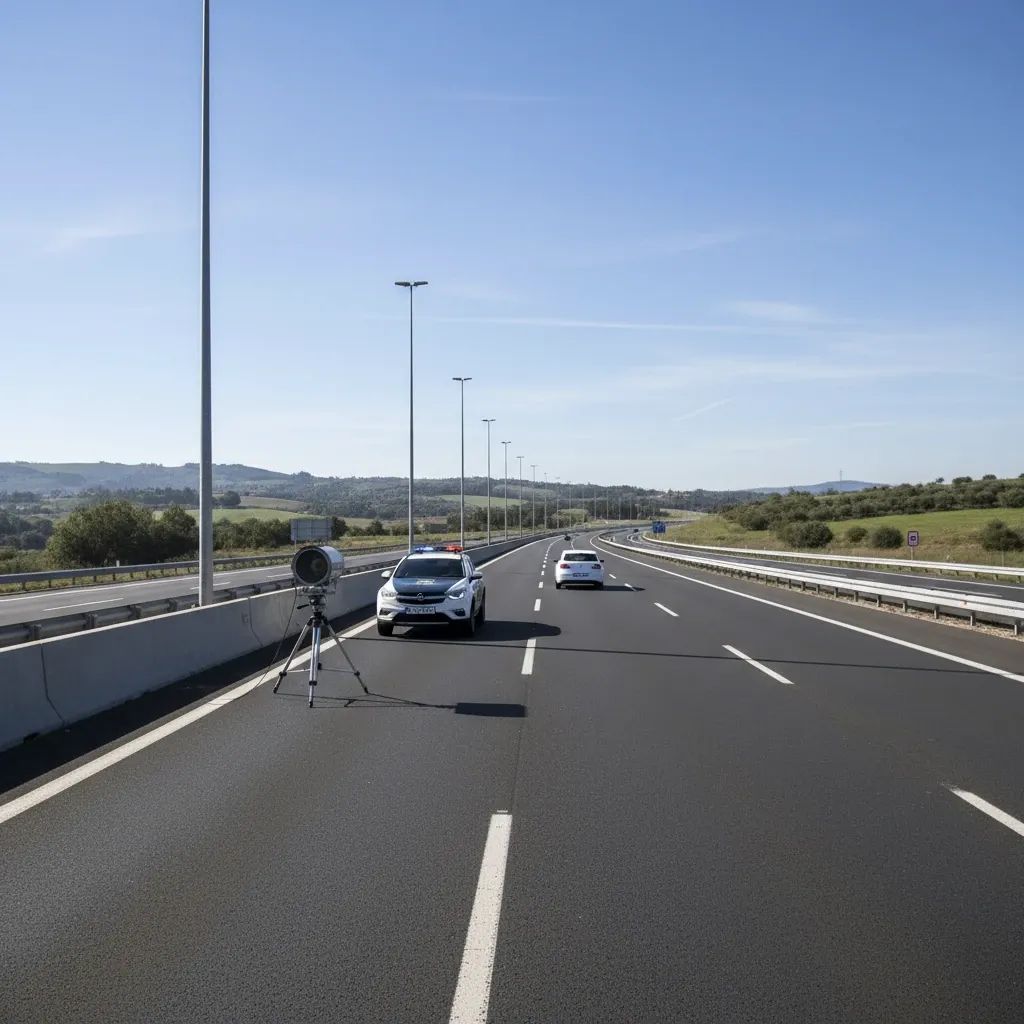
Current enforcement relies heavily on automated speed cameras that generate citations without direct officer intervention. Gonçalves da Silva identified this as a fatal flaw: "We will never solve the road fatality problem with the current highly protective system for defendants charged with contraventions outside of flagrante delito. With radars where there is no direct patrol intervention, the probability of the citation being invalidated by prescription is enormous."
Portugal's contraordenação (infraction) framework gives defendants broad procedural protections when violations occur outside an officer's immediate observation. Legal challenges frequently succeed on technicalities, and administrative delays push cases beyond statutory limits for prosecution—a problem the government pledged to address by extending prescription periods to the maximum allowed by law and digitizing citation workflows.
The new strategy pivots toward officer-initiated stops, eliminating the prior practice of announcing checkpoint locations. The Interior Ministry framed this as restoring an "element of surprise," forcing drivers to assume enforcement is omnipresent. Whether the GNR's current personnel levels—already stretched thin—can sustain increased stop operations remains an open question. The association noted a 50% reduction in traffic enforcement staffing over the past two decades, a deficit the government has not yet specified how it will fill.
What the New Rules Will Change for Drivers
The forthcoming Highway Code revision, expected for parliamentary approval before December, will tighten the screws on repeat offenders and high-risk behavior:
• Alcohol penalties escalate: Driving under the influence will trigger harsher fines and longer suspensions. Current thresholds sit at 0.5 grams per liter of blood; penalties rise steeply above 0.8 g/L, but enforcement often falters due to procedural delays.
• License revocation expands: The 2016 points system already strips licenses after 12 points are lost, but new criteria will widen the categories of violations leading to cassation, potentially including severe speeding, reckless passing, and multiple infractions within short windows.
• More speed cameras: The government will install additional fixed and average-speed radars, particularly on high-risk stretches and motorways.
• Reincidência (repeat offenses) hit harder: Second and third violations for the same infraction will carry multiplied fines and mandatory re-education courses.
How Portugal Compares to Its Neighbors
Portugal's road fatality rate stood at 60.8 deaths per million inhabitants in 2023, well above the EU average of 45.6, ranking the country 22nd among the 27 member states. Provisional 2024 data—the most recent available—counted 477 road deaths and 2,756 seriously injured, figures that represent a modest 8.3% decline in fatalities compared to 2019 but an alarming 8.8% rise in serious injuries. The data suggests accidents are becoming more violent, even as overall death counts edge downward.
Spain, by contrast, employs the Dirección General de Tráfico and the Guardia Civil for interurban enforcement, with municipal police handling cities. That model has faced its own integrity challenges: Portuguese trucking associations in 2025 accused Catalan and Basque traffic officers of "multa hunting" against Portugal-registered vehicles, allegedly stopping buses and trucks to levy outsized fines payable on the spot—a practice critics labeled extortion. Separately, Spain's Guardia Civil investigated fraud schemes involving counterfeit traffic citations left on windshields, embedding fake QR codes to harvest payment card details.
France and Germany rely on decentralized regional forces (Gendarmerie and Landespolizei, respectively) but integrate automated enforcement and cross-border data sharing through EU frameworks. The United Kingdom disbanded dedicated traffic units decades ago, folding enforcement into general patrol duties—a move some British road safety advocates now regret, citing gaps in specialized training.
What Residents and Visitors Should Expect
If the revived brigade follows the timeline hinted by the Interior Ministry, expect recruitment announcements and uniform redesigns within months, with operational deployment likely by late 2026 or early 2027. In the interim, the immediate shift to unannounced checkpoints takes effect now—drivers on the A1, A2, and other trunk routes should anticipate random stops without prior media alerts or social media warnings.
For expats navigating Portugal's bureaucracy, the new license revocation rules matter: foreign license holders who gain Portuguese residency and later face cassação must restart the entire licensing process, including written and practical exams. Reincidência penalties apply equally to residents and non-residents; a second speeding citation above 30 km/h over the limit within a year could trigger suspension even if neither violation alone would.
The Corruption Question Lingers
Neither the minister's announcement nor supporting documents addressed oversight mechanisms for the reborn brigade. Civil society groups and opposition legislators will likely demand safeguards: independent complaint channels, regular audits of citation patterns, and external investigation authority for suspected misconduct. The ANOG's call for internal investigative powers within the GNR itself has merit—Spanish precedent shows that specialized anticorruption units embedded in police forces can act faster than external prosecutors—but it also risks insulating wrongdoers if accountability structures are weak.
Portugal's Council of Europe evaluation in 2023 flagged shortcomings in public sector corruption prevention, urging greater scrutiny of procurement and personnel management in security agencies. The Traffic Brigade's past collapses began with small compromises—overlooking a speeding ticket for a €50 note, manipulating weight-station records for trucking firms—that metastasized into organized networks. Rebuilding specialized enforcement without robust ethics infrastructure invites history to repeat.
The government framed the reactivation as a return to proven methods, but whether 2026 conditions differ enough from 2007 to prevent the old pathologies remains an open bet. Drivers will feel the difference first—more stops, faster penalties, less room for procedural escape. Whether the result is genuinely safer roads or merely more friction for Portugal's motoring public depends on execution details still unwritten.