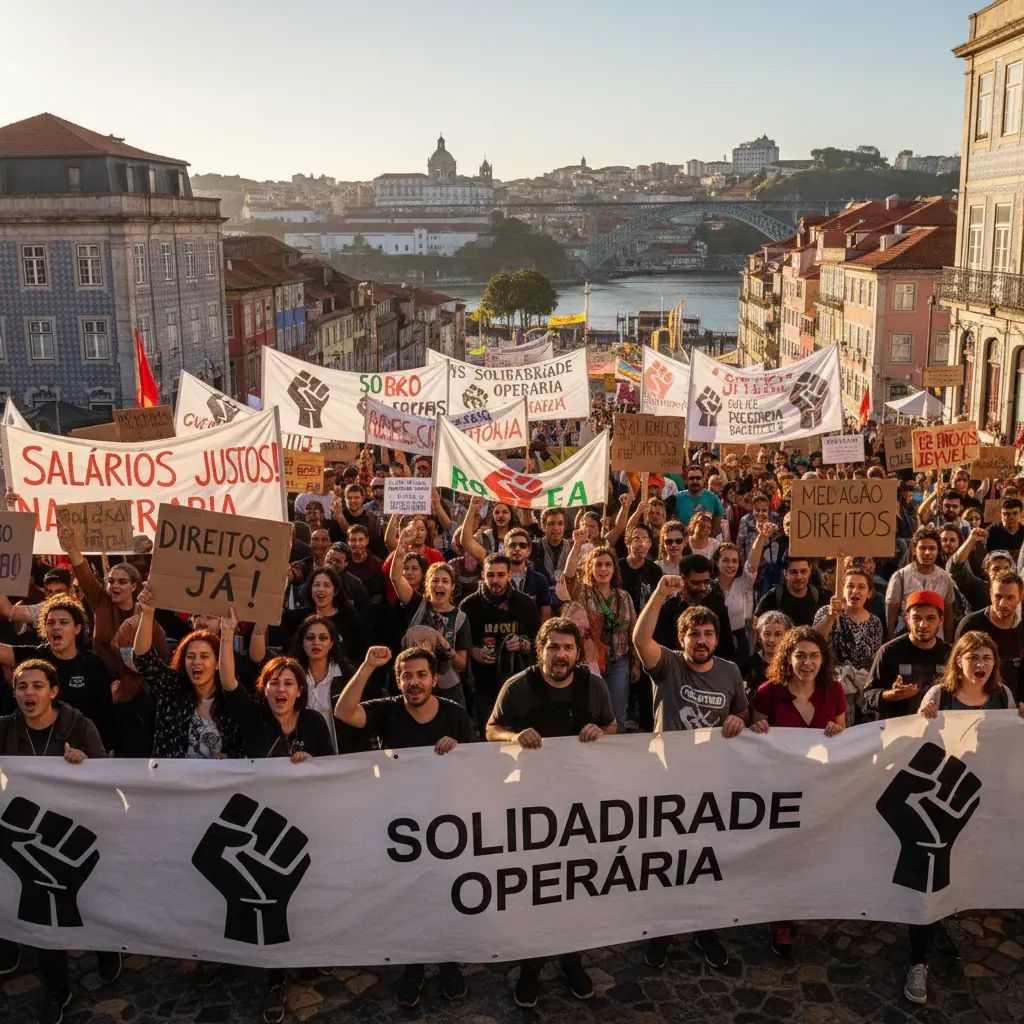
Portugal's largest union federation is mobilizing for mass street demonstrations on Saturday, March 1, 2026, against a sweeping labour code overhaul, escalating a months-long standoff between workers and the cabinet that has already triggered one general strike and threatens to derail the government's flagship economic reform.
Why This Matters:
• Strike notices have been issued across retail and other weekend-shift sectors to free workers for the protests.
• Negotiation deadlock: The CGTP union has been excluded from bilateral technical meetings, deepening distrust.
• Next flashpoint: A Social Concertation Council session on March 3 will determine whether further industrial action follows.
Twin-City Mobilization Planned
Portugal's CGTP union confederation expects "many thousands" of workers to fill the streets of Porto and Lisbon on March 1, under the banner "Down with the labour package." In Porto, demonstrators will gather at 10:30 AM between Praça da República and Avenida dos Aliados. Lisbon's rally is scheduled for 2:30 PM, departing from Cais do Sodré toward Rossio.
Tiago Oliveira, the CGTP secretary-general, framed the marches as a continuation of a combative tradition. "History shows that when workers' rights are trampled, it is the struggle in the streets that forces advances, recovers ground, and achieves what was denied," he told reporters, invoking past victories to galvanize current resistance.
To ensure participation from employees scheduled to work Saturday, multiple strike notices have been filed, particularly targeting the retail sector. Oliveira confirmed that additional industries have issued pre-emptive work-stoppage warnings tied to specific companies and worksites, though he declined to name the sectors involved.
The "Trabalho XXI" Controversy
The Portugal Cabinet's proposed "Trabalho XXI" reform package, unveiled in July 2025 by the PSD-CDS coalition government led by Prime Minister Luís Montenegro, seeks to rewrite over 100 articles of the nation's labour code. Official rhetoric emphasizes modernization, productivity gains, and flexibility. Business confederations have applauded the direction, though they argue room for improvement remains.
Portugal's union movement sees it differently. The CGTP and its smaller counterpart, the UGT, jointly organized a general strike on December 11, 2025, in protest—a rare show of unity that underscored the depth of alarm. The March 2026 protests represent an escalation of resistance that began in mid-2025, signaling the conflict has only intensified over the past months. Core grievances include:
• Extended fixed-term contracts: Expanding the maximum duration from two to three years. For example, a retail worker on a fixed-term contract could see their temporary status extended from 2 to 3 years before gaining permanent employment rights.
• Individual working-time bank revival: Allowing employers to schedule 10-hour days and 50-hour weeks unilaterally. Restaurant workers and hospitality staff could face significantly longer daily shifts under these provisions.
• Outsourcing deregulation: Revoking the 12-month ban on subcontracting following collective layoffs.
• Expanded minimum-service rules during strikes: Covering creches, elderly care facilities, and private security—sectors the CGTP argues would gut the practical impact of industrial action.
• Parental leave trimming: Capping breastfeeding dispensation at two years.
• Remote-work refusal rights: Making it easier for firms to reject telework requests.
• Union activity restrictions: Imposing new limits on organizers in workplaces without enrolled members.
The CGTP counter-proposal, submitted September 3, 2025, has been sidelined, Oliveira contends. He accuses the cabinet of "fabricating artifices" to project openness while advancing core measures through back channels. "They camouflage their objective, pursuing their goals via indirect routes," he charged, pointing to the exclusion of his organization from the technical working groups that have convened with the UGT and employer bodies.
What This Means for Workers and Employers
For employees across Portugal, the reform represents a potential reshaping of job security, work-life balance, and collective bargaining power. Fixed-term contracts—already a source of precarity—would lengthen, meaning workers could remain in temporary status for up to three years instead of two. The return of individual working-time accounts could erode scheduling predictability, with employers able to impose extended shifts without consultation. The outsourcing provisions alarm those in industries where subcontracting has historically been used to sidestep permanent hiring and collective agreements.
For businesses, particularly small and medium enterprises, the package promises operational agility: longer trial periods for temporary hires, more latitude in scheduling, and reduced liability after layoffs. Employer confederations argue these measures are essential to compete in a digitalized, volatile global market.
The strike minimum-services expansion is especially contentious. Oliveira argues it amounts to an assault on the constitutional right to strike, transforming walkouts into symbolic gestures rather than economic pressure. Sectors such as elderly care and childcare, which have never been subject to compulsory skeleton staffing, would now face restrictions that organizers say render strikes toothless.
Government Claims Progress Amid Union Rejection
Following a Monday session with the UGT and four business confederations, Labour Minister Maria do Rosário Palma Ramalho announced "some areas of conciliation" had emerged, particularly around parental leave, artificial intelligence protections, and digital-platform worker classification. She emphasized that the process remains in a "position-alignment phase," with a full Social Concertation Council meeting set for March 3 to formalize any consensus.
The UGT delivered its own counter-proposal on February 4, branding it "Trabalho com Direitos XXI" (Work with Rights 21st Century) and drawing red lines on fixed-term contracts and outsourcing. The smaller union federation has criticized those provisions as "unacceptable" and pointed to past mass layoffs linked to subcontracting loopholes. Unlike the CGTP, however, the UGT has engaged in the bilateral technical sessions and signaled willingness to negotiate within boundaries.
The CGTP's harder line reflects ideological and tactical divergence. Oliveira insists his organization will reiterate the demand for total withdrawal at the March 3 meeting and reserves the right to escalate industrial action afterward, contingent on "the scale of the attack." That phrasing suggests a second general strike remains on the table if the government presses ahead with what the confederation considers non-negotiable red lines.
European Context: Reform Against the Grain
Portugal's push contrasts sharply with recent trends in neighboring economies. Spain revoked a controversial 2012 labour reform in 2021–2022, restoring collective-bargaining primacy, curbing temporary contracts, and mandating equal pay for outsourced workers. In February 2025, Madrid approved legislation to cut the maximum working week from 40 to 37.5 hours without salary reduction—a move backed by Spanish equivalents of the CGTP and UGT. Unlike Spain's recent worker protections, Portugal's reforms move in the opposite direction, raising concerns among residents who expected similar progressive changes across the region.
France's 2017 "Loi Travail" under President Emmanuel Macron capped compensation for unfair dismissal and prioritized enterprise-level agreements over sector-wide pacts, drawing sustained street protests. Germany, meanwhile, is exploring weekly rather than daily hour caps to modernize scheduling, though the proposal has split employers and unions.
The Portugal Cabinet's timing—amid economic growth and historically low unemployment—has puzzled critics, who question the urgency of deregulation when the labour market is tight. Government officials counter that demographic aging and digital transformation demand preemptive flexibility, lest the economy lose competitiveness to more agile jurisdictions.
What Happens Next
Saturday's turnout will serve as a barometer of grassroots sentiment and the CGTP's organizational reach. The union has invoked "the path of affirmation and combativeness," language echoing mobilizations that reversed austerity measures during the eurozone crisis. Whether the government blinks depends partly on whether the marches match or exceed December's general-strike participation and whether the UGT joins future escalation.
The March 3 Social Concertation Council session is the immediate decision point. If no breakthrough emerges, the CGTP has signaled it will weigh "new forms of struggle"—code for sector-specific rolling strikes, coordinated work-to-rule campaigns, or another nationwide stoppage. The cabinet has repeatedly stated it will not withdraw the package entirely, setting up a protracted collision.
For residents and businesses in Portugal, the coming weeks promise disruption beyond Saturday's marches. Retail and service sectors bracing for strike action may face staffing shortages, while investors monitoring labour-market stability will watch whether the standoff hardens or softens before the reform reaches parliament. The Labour Ministry has not committed to a submission date, leaving the legislative calendar uncertain and the political window fluid.
Bottom line: Saturday's demonstrations on March 1 are not a conclusion but an inflection point in a conflict that has already produced one general strike and threatens more. The outcome will shape not only the text of Portugal's labour code but also the balance of power between workers, employers, and the state for years to come.