

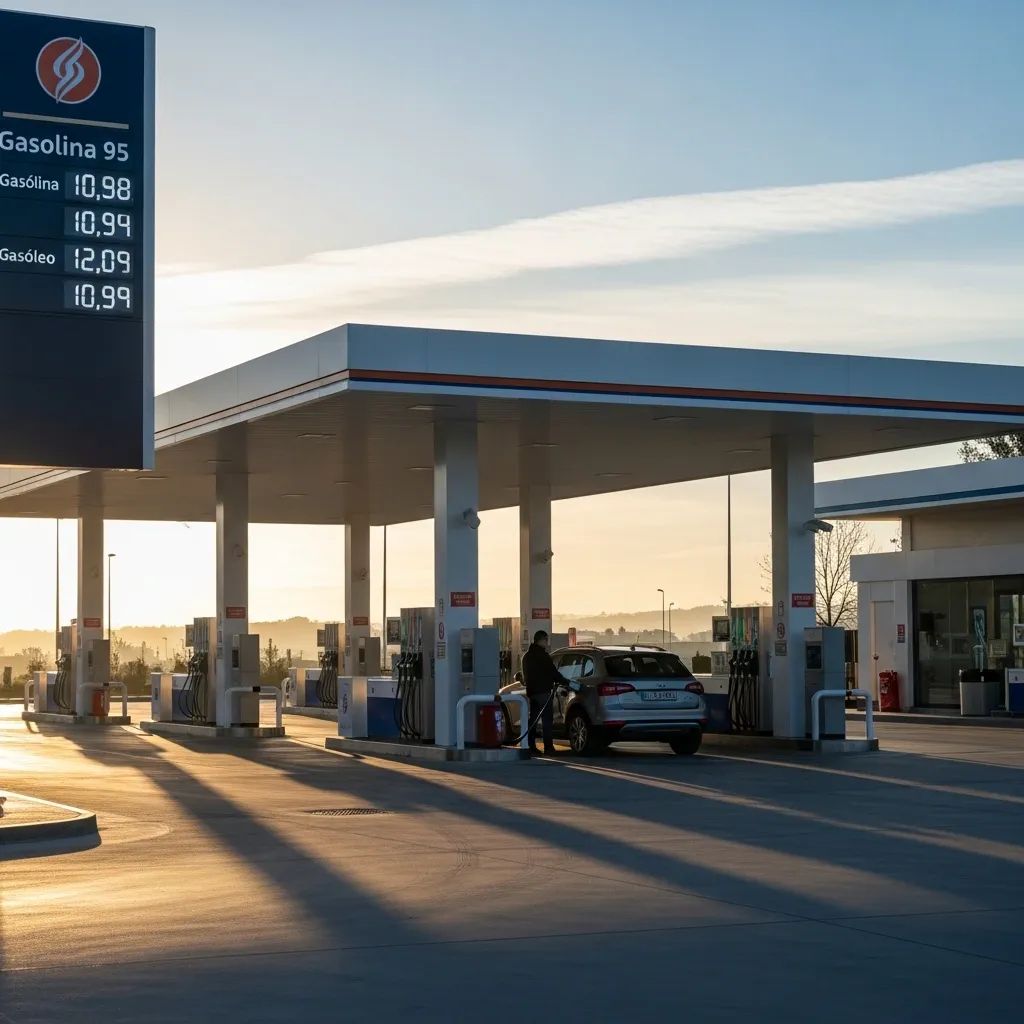
Diesel Gets Slight Relief While Petrol Rises—Here's What Actually Happened
The petrol pump in Portugal delivered conflicting news this week: drivers filling diesel tanks received a small reprieve, while those buying regular 95 octane gasoline faced a noticeable increase. But the real story isn't about global events thousands of kilometers away—it's about what happens when the Portuguese Government scales back its fuel-tax subsidy at a time when international crude prices are moving in different directions.
Why This Matters:
• Diesel prices fell less than expected: At €1.958/liter, the decline from last Friday's €1.967/liter came to just 0.9 cents—less substantial than raw international oil movements would have suggested.
• Gasoline surged beyond forecasts: The €1.927/liter closing price for 95 octane represented a 3.1-cent jump, rising more steeply than international quotations alone would indicate.
• Government's ISP cutback explains the gap: By reducing the temporary fuel-tax relief (the Imposto Sobre Produtos Petrolíferos e Energéticos, or ISP) by approximately 0.8 cents per liter for diesel, Lisbon effectively captured what should have been consumer savings.
• For haulage operators, it's meaningful: The logistics sector—already operating on tight margins—watched expected relief diminish in real time, with implications for grocery prices, construction materials, and consumer goods nationwide.
The ISP Reduction: Understanding the Tax Adjustment
Since early 2022, when international crude volatility first destabilized household budgets across Europe, the Portuguese Government deployed an extraordinary temporary discount on fuel excise duty. That shield has been shrinking steadily. This week, the government trimmed the ISP break for diesel by roughly 0.8 cents per liter, narrowing what would otherwise have been a more substantial relief gain into a more modest 0.9-cent fall.
The backdrop is budgetary: the 2026 State Budget formally anticipates the eventual phase-out of this emergency subsidy. Facing fiscal pressures and a mandate to normalize spending after years of crisis-era support, the Portugal Treasury is gradually withdrawing the relief. Officials describe the approach as "measured to prevent sudden price shocks," yet this week's adjustment demonstrates how gradual reductions can still translate into pinched household finances.
For gasoline, the situation was different. International crude quotations rose, and the government did not offset that increase with additional tax relief. Instead, motorists absorbed the full swing. By Friday, the average pump price had climbed from €1.896/liter to €1.927/liter—a move softened only by loyalty-card schemes and filling-station promotions.
The Portugal Energy Services Regulatory Authority (ERSE) calculates what it calls the "efficient price"—a theoretical benchmark reflecting genuine commodity costs plus legitimate logistics, retail margins, and taxes. For the current week, ERSE's efficient price sits at €1.989/liter for 95 octane and €2.091/liter for diesel (both post-tax). Interestingly, actual forecourt prices reported to the Portugal Energy and Geology Directorate (DGEG) remain modestly below these theoretical highs: gasoline averaged 1.8 cents cheaper, diesel 6.5 cents cheaper. Once loyalty discounts and promotions are factored in, the gap widens further.
This suggests that petrol-station operators are maintaining competitive discipline in the current environment—though pricing dynamics could shift if crude movements accelerate.
International Crude Price Movements and Portugal's Position
Fuel-price stability in Portugal depends significantly on international crude markets. Recent weeks have seen modest volatility in international quotations, creating the price swings Portuguese motorists experienced this week. The country imports essentially all refined petrol products, so these external market movements compress almost instantaneously into pump-price changes. Portugal's refining infrastructure cannot cushion external shocks; consumers and carriers alike are exposed directly to international market prices.
What Europe Pays: Portugal's Position
A review of Union-wide pump prices positions Portugal in Europe's middle tier for fuel costs. Portugal ranks among the more expensive EU member states for standard 95 octane gasoline, yet lacks the economic leverage of some larger economies to justify premium pricing.
Comparisons with neighboring countries are particularly relevant: Spain, immediately west of the Portuguese border, frequently offers significantly lower prices—a discrepancy that motivates cross-border fuel runs by residents and commercial operators from regions like the Alentejo and eastern Algarve.
Portugal's position in Europe's middle tier underscores a structural reality: the country lacks the integrated refining footprint of larger EU economies. The ISP discount mechanism, despite its role, cannot fully bridge that structural gap.
Road Freight and Cost Pressures
Portugal's logistics and road-haulage sectors operate on notoriously tight margins. Fuel represents a significant portion of their operating costs. When the Portuguese Government reduces tax relief while international crude prices remain elevated, carriers face immediate economic pressure.
This week's 0.9-cent diesel decline—rather than a larger drop—means carriers lose expected cost relief. Faced with this squeeze, haulage operators must choose between accepting lower margins or negotiating higher shipping fees with clients. Higher transportation costs ripple downstream, affecting grocery prices, construction materials, and consumer goods.
The logistics sector has already flagged concerns about the government's scheduled ISP withdrawal. Industry observers warn that as the extraordinary subsidy diminishes, carriers will face mounting pressure without corresponding relief from international commodity prices.
The Consumer Arithmetic: What This Week Meant for Your Wallet
For a household with a 55-liter fuel tank, this week's price movements translate into concrete changes:
Gasoline (95 octane): Filling up cost approximately €0.85 more than last Friday, based on the 3.1-cent rise. For a family that refuels weekly, that compounds into a meaningful annual impact.
Diesel: Drivers saw a negligible €0.05 saving from the week-over-week decline. For regular diesel-car owners, that amounts to a few cents salvaged per refuel.
These calculations highlight a broader concern. The Portuguese Government's trajectory of gradually reducing the ISP subsidy means pump prices will continue adjusting upward in the coming months as the extraordinary support gradually phases out. The combined effect, without further intervention, will push consumers and carriers to adapt to a new price environment.
Looking Forward: What Remains Uncertain
Fuel prices in Portugal through May and beyond will depend on several factors: international crude price movements, the pace of the government's ISP withdrawal, and seasonal demand patterns. Independent energy analysts anticipate fuel prices remaining in a moderately elevated range, though significant movements in international markets could shift this trajectory.
For now, Portuguese motorists and operators should recognize that the extraordinary fuel-tax support in place since 2022 is visibly receding. How the market and policy response evolves remains to be determined by international commodity markets and Portuguese government decisions.


