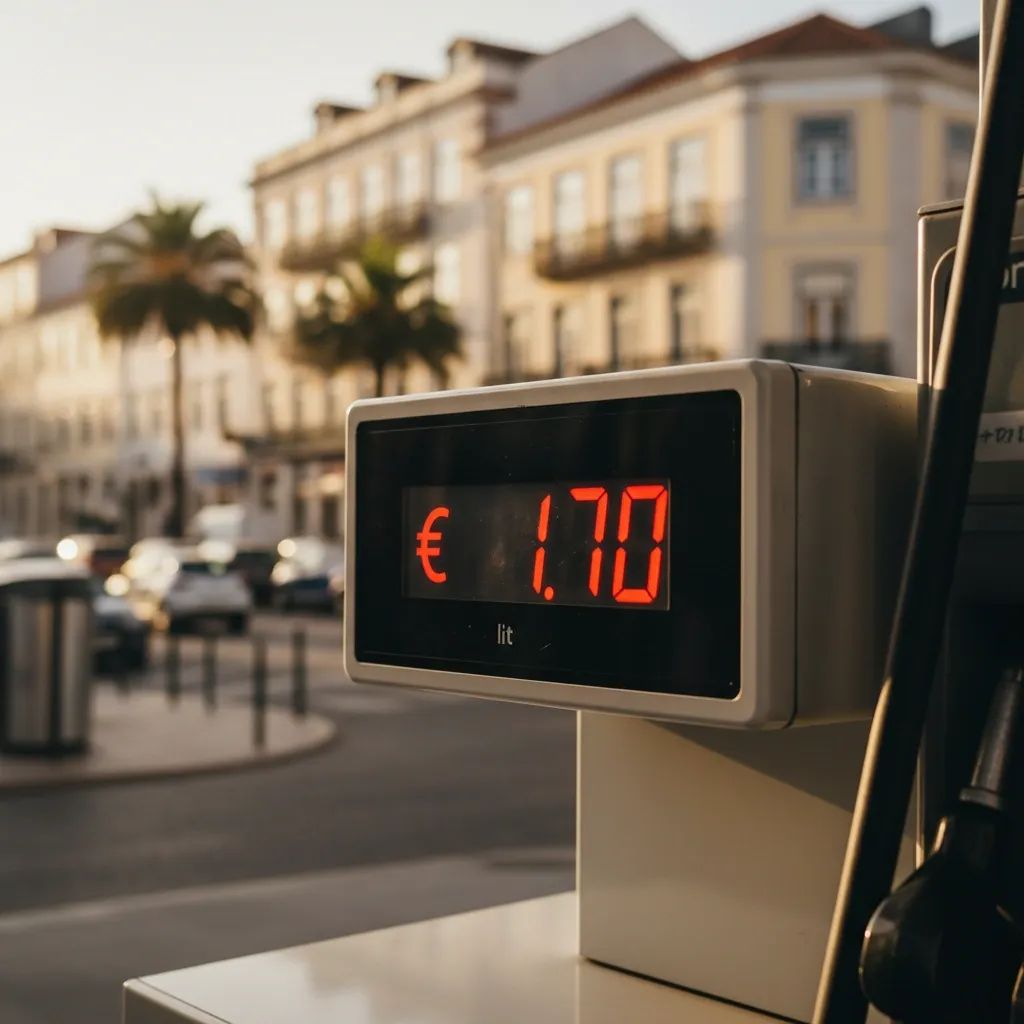
The Portugal Bureau of Economic Research at Universidade Católica has downgraded its 2026 GDP growth forecast to 1.5%, a sharp cut from the previous 1.8%, while warning that the country's economy could actually shrink during the first quarter of this year. Fuel prices driven by escalating tensions in the Middle East are the primary culprit, alongside weakening cement sales—a key proxy for construction investment—and a slowdown in exports.
Why This Matters:
• GDP growth cut: From 1.8% to 1.5% for 2026, with the fuel price spike alone shaving off 0.3 percentage points.
• First-quarter contraction risk: Sequential growth may slow from 0.9% in Q4 2025 to just 0.2% in Q1 2026, or even turn negative.
• Inflation on the rise: Expected to climb from 2.1% to 2.3% in 2026, driven by energy costs and the uncertainty around the Iran conflict.
What This Means for Residents
Anyone filling up at the pump in Portugal has already noticed the pain. The national fuel market has tracked the global surge in crude oil prices following U.S. and Israeli military actions against Iran in late February—and that spike is now rippling through the broader economy. Households face higher transport costs, while businesses in logistics, distribution, and those operating in the Interior regions are absorbing significant increases. With Portugal as a net energy importer, energy shocks translate directly into less purchasing power and tighter budgets for families.
The government's gradual adjustment of fuel-related taxes compounds the pressure on household budgets. With the scheduled phases of tax policy changes, consumers are facing additional costs at the pump. Even though refinery stocks can cushion immediate price shocks, sustained high crude costs will eventually hit the pumps—and wallets.
The Construction Sector Sends a Warning
Cement sales have long served as a bellwether for investment activity, and the latest figures are flashing red. In December 2025, cement sales showed a -7% year-on-year decline. By February 2026, the index had tumbled further, down significantly from February 2025. This contraction signals that private and public construction projects are slowing, a trend that threatens to drag down overall investment and employment.
Economists at the Católica-Lisbon Forecasting Lab explicitly cite this cement data when raising the possibility of a stagnation or even outright contraction in sequential GDP during the first quarter. Their central scenario remains a modest 0.2% expansion, but the downside risks are tangible. Export performance has also weakened, further eroding the growth cushion.
Revised Projections Through 2028
The Núcleo de Estudos Económicos da Católica (NECEP) released its quarterly forecast update on April 8, outlining a bleaker medium-term outlook. For 2026, the growth estimate dropped from 1.8% to 1.5%, with the fuel-price impact alone accounting for 0.3 percentage points of that cut. Looking ahead, the 2027 forecast was trimmed from 1.6% to 1.5%, while the 2028 projection holds steady at 1.9%.
The downgrade reflects a cocktail of headwinds: geopolitical uncertainty centered on the Middle East, the scheduled conclusion of the Plano de Recuperação e Resiliência (PRR) in mid-2026, and the broader deterioration in Portugal's external environment. The PRR has been a critical engine of public investment, and its exit could leave a noticeable gap in the second half of this year and beyond.
Fuel Prices and the Iran Conflict
The root cause of the current turbulence lies thousands of kilometers away. Attacks launched by the United States and Israel against Iran in late February 2026 triggered an abrupt spike in energy commodity prices. The potential disruption of critical global energy supply routes has markets on edge. Portugal, which imports virtually all of its crude, is especially vulnerable to this geopolitical volatility.
In March 2026, energy products in Portugal saw a 5.8% year-on-year increase, a sharp reversal from the -2.2% decline recorded in February. That surge single-handedly drove overall inflation to 2.7% in March, the highest reading since August 2025. Core inflation, which strips out volatile food and energy items, also ticked up from 1.9% to 2.0%, suggesting that price pressures are broadening beyond the fuel pump.
Broader Economic Indicators
Despite the gloom, some indicators provide a measure of stability. The Portuguese labor market remains resilient, with ongoing employment gains providing a cushion for household incomes. The Portugal Central Bank has highlighted factors that should support growth, including continued PRR disbursements in the first half of the year and an expansionary fiscal stance. Yet these positives are increasingly overshadowed by external shocks and the risk that energy costs will erode household consumption and business investment.
Inflation on the March
The Portugal Statistics Institute (INE) confirmed that March inflation hit 2.7%, up from 2.1% in February. The NECEP forecast now anticipates that inflation will average 2.3% for the full year 2026, up from the earlier 2.1% estimate. The Portugal Central Bank projects an even higher figure of 2.8%, citing the escalation in energy prices as the primary driver.
This divergence in forecasts underscores the uncertainty surrounding the duration and intensity of the Iran conflict. Should hostilities persist or escalate further, crude prices could climb even higher, pushing inflation beyond current estimates and further crimping real incomes. Conversely, a diplomatic resolution or ceasefire could ease pressure on both inflation and growth.
What Happens Next
The NECEP's quarterly bulletin makes clear that the central scenario is one of modest, fragile growth—but the margin for error is razor-thin. A confluence of weak cement sales, sluggish exports, and elevated import costs due to fuel prices means that Portugal's economy is walking a tightrope in early 2026. Economic observers have flagged the risk of a first-quarter contraction, pointing to adverse weather events and the Middle East conflict as compounding factors.
For households and businesses, the practical takeaway is straightforward: Budget for higher fuel costs, brace for potential price increases across transport-dependent sectors, and monitor the PRR's final disbursements. The second half of 2026 could see a pullback in public investment as the recovery plan winds down, potentially affecting construction employment and related services.
Economic policymakers in Lisbon retain options for supporting growth, but that cushion is narrowing. The government's fiscal stance remains expansionary, and the labor market continues to hold up, but external shocks are testing Portugal's resilience. If energy prices stabilize and global trade conditions improve, the economy may yet eke out the forecasted 1.5% growth. If not, the risk of a technical contraction in one or more quarters this year remains uncomfortably real.