

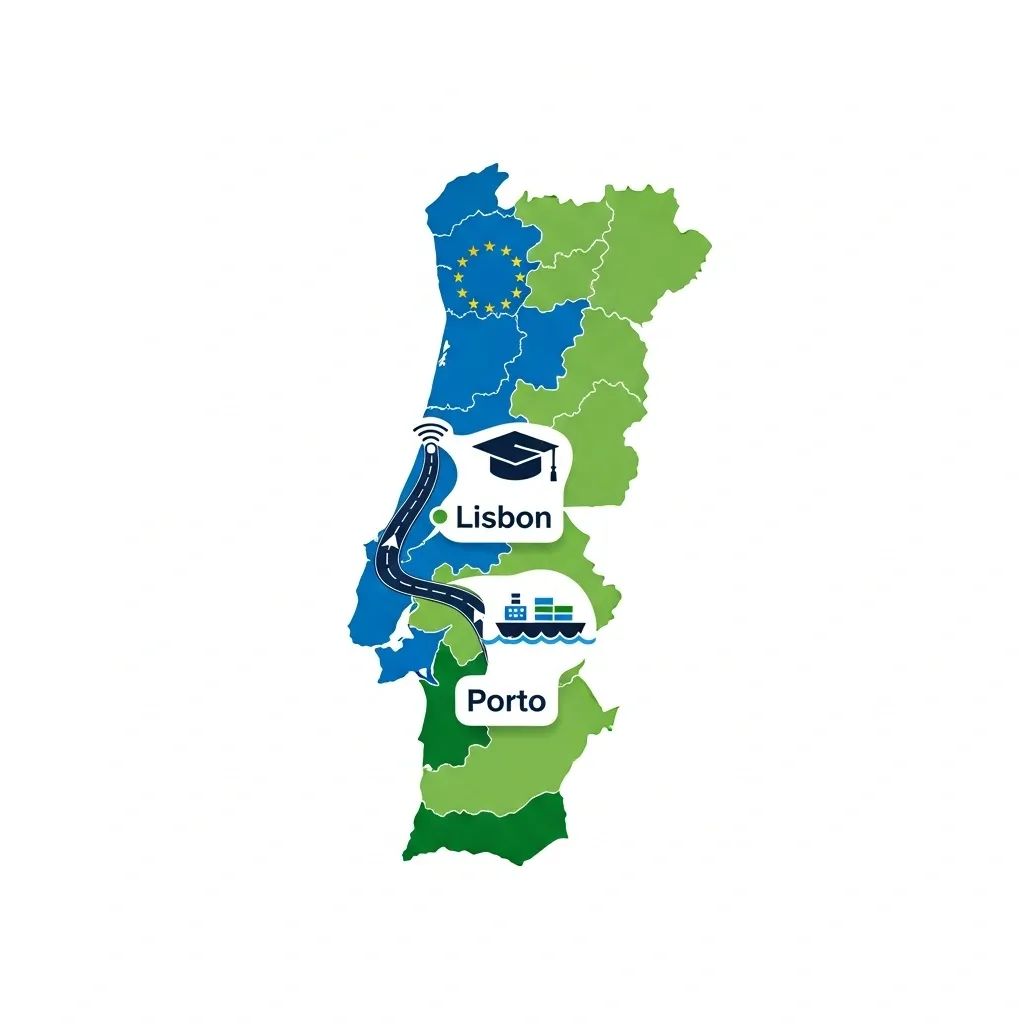
The Porto City Council has been tapped by the European Commission Representation in Portugal to host this year's Europe Day celebrations, transforming Portugal's second city into the national epicenter of a milestone anniversary: 40 years since Portugal joined the European Union. The selection reflects both the symbolic weight of the anniversary and the city's role as a gateway to understanding Portugal's profound transformation since 1986.
Why This Matters:
• Historical marker: Portugal entered the European Economic Community on January 1, 1986, a move that nearly doubled GDP per capita and increased life expectancy by more than eight years.
• Public celebration: May 9 features a 5-kilometer Europe Run, gastronomic fair, and evening concert by fado singer Katia Guerreiro on Avenida dos Aliados at 6:00 PM.
• Policy dialogue: Two conferences explore gender equality progress and youth-focused climate policy, culminating in the signing of the "Porto Charter for Europe" on May 15.
• Cultural immersion: Month-long exhibitions, firefighter heritage displays, and guided municipal tours run through May 31, with the EU flag projected onto City Hall on May 8-9.
A Four-Decade Transformation in Context
Portugal's European journey began formally on March 28, 1977, when the government submitted its application to join the CEE, barely three years after the Carnation Revolution ended 48 years of dictatorship. The strategic calculus was clear: political stability, economic modernization, and international legitimacy required anchoring the young democracy to a supranational project. After complex negotiations—Portugal's economy lagged far behind the Community average—the Accession Treaty was signed at Jerónimos Monastery in Lisbon on June 12, 1985, by then-Prime Minister Mário Soares.
Since that entry date, Portugal's real GDP has expanded 131%, and exports of goods have surged alongside structural fund investments from the European Regional Development Fund (ERDF) and European Social Fund (ESF). School dropout rates collapsed from 50% in 1990 to 6.6% today, while higher education enrollment nearly tripled. Employment rose from 4 million in 1986 to 4.8 million in 2024, and average life expectancy climbed from 72.9 years to 81.2 years. Opinion polling consistently shows that 91% of Portuguese citizens believe EU membership has benefited the country, making it one of the bloc's most pro-European populations.
Yet the integration process also forced difficult adjustments: legislation governing capital flows, labor mobility, and service provision had to be rewritten, agricultural subsidies restructured, and industrial sectors exposed to Continental competition. Regional disparities persist, and debates over national sovereignty in a supranational framework remain live issues. Still, scholars routinely describe EU accession as "the most powerful vector of modernization in Portuguese economic history."
What the Porto Programme Offers Residents
The Porto City Council has designed the Europe Day schedule to balance civic pageantry with substantive policy dialogue. The "Europe Run" departs early on May 9, finishing at City Hall for the ceremonial hoisting of the EU flag. Participants can sample cuisine from across the Union at a gastronomic fair in Praça General Humberto Delgado, and the evening concert pairs Guerreiro's haunting fado with the Portuguese Symphonic Band on the city's grandest avenue.
Starting May 9, the City Hall atrium will display "The Europeanization of Portugal's Higher Education System—A Deep Transformation in Education and Research," tracing how the Bologna Process and Erasmus mobility reshaped universities. On April 28, the Porto Sapadores Firefighters Regiment opens a heritage exhibit featuring trophies from European firefighting competitions, helmets and gear from partner brigades across the Continent, and historical artifacts documenting the evolution of civil protection. The goal, organizers say, is to "celebrate European values of unity and cooperation while honoring the material and symbolic legacy that testifies to firefighters' contribution to a safer, more solidaritan Europe."
Two conferences anchor the policy dimension. On May 7, City Hall hosts "40 Years of Portugal in the EU—The Journey Toward Gender Equality," examining how Directive 2006/54/EC and subsequent frameworks have reshaped labor law, wage transparency, and representation. The May 15 event at the Correios Building tackles "Youth in Europe" and "Environmental Challenges and Transition in Europe: Pathways to Sustainability," with a formal signing ceremony for the Porto Charter for Europe. Though the charter's full text has not yet been released, the conference themes signal a focus on youth participation and climate policy—areas where Portugal has both legislative ambition and implementation gaps.
Supplementary programming includes a photo exhibition in the pedestrian underpass at Campanhã Intermodal Terminal (May 1-31), guided tours of the municipal nursery, and the EU flag projection on City Hall's façade. The council frames these offerings as "cultural and civic activities that value European legacy, migrant integration, and reflection on the city's future in the European context."
Understanding Europe Day's Symbolic Weight
Europe Day commemorates the Schuman Declaration of May 9, 1950, when French Foreign Minister Robert Schuman proposed pooling French and German coal and steel production under a supranational authority, making war between historic rivals "not only unthinkable but materially impossible." The following year, the European Coal and Steel Community treaty was signed, creating the institutional embryo of today's 27-member Union. The European Communities formalized the holiday in 1985, placing it alongside the flag, anthem, motto, and euro as a shared symbol of European identity.
While Brussels institutions typically open their doors for free public visits, other member states adapt the celebration to local context. Germany, for instance, has extended the commemoration into a full "Europe Week" since 1995, and the European Commission in 2026 is promoting interactive sessions on unity and cohesion across its delegations. Porto's selection as Portugal's host city underscores the government's desire to decentralize celebration away from Lisbon and spotlight a municipality with deep historical ties to trade, migration, and Atlantic openness.
The Porto Charter and Future Commitments
The Porto Charter for Europe, set for signature on May 15, remains partially opaque ahead of the event, but conference organizers have flagged youth empowerment and environmental sustainability as its twin pillars. Expect language committing signatories—likely municipal leaders, youth councils, and civil society networks—to actionable timelines for carbon neutrality targets, green job creation, and structured youth consultation mechanisms in local governance.
This charter should not be confused with the "Porto Santo Charter" signed in April 2021, which focuses on cultural democracy and educational policy. The 2026 document appears more operationally oriented, aiming to translate European Green Deal commitments and the European Climate Law (Regulation EU 2021/1119) into municipal practice. If the text includes measurable benchmarks and reporting obligations, it could serve as a template for other Portuguese cities navigating the tension between EU climate mandates and local economic constraints.
Practical Information for Attendees
All events are free and open to the public. The Europe Run registration details have not been published yet but typically require advance sign-up through the City Council's digital portal. The Avenida dos Aliados concert begins at 6:00 PM and is expected to draw large crowds; arrive early for sight lines. Exhibitions at City Hall and Campanhã Terminal operate during standard municipal hours (generally 9:00 AM to 6:00 PM weekdays). Conference attendance may require registration; check the Porto City Council website for updates.
For residents interested in deeper engagement, the European Commission Representation in Portugal maintains a Lisbon office and regional information points that provide briefings on funding programs, citizens' rights under EU law, and upcoming policy consultations. The 40th anniversary year is likely to feature additional programming beyond Porto, including retrospectives on Portugal's EU Council presidencies (1992, 2000, 2007, 2021) and the legacies of figures like José Manuel Durão Barroso, who led the European Commission from 2004 to 2014, and Mário Centeno, who chaired the Eurogroup from 2018 to 2020.
A Moment of Reflection and Forward Planning
Porto's Europe Day agenda reflects a dual impulse: commemorating four decades of integration while confronting the next generation of challenges. The firefighter exhibit and higher education display look backward, cataloging concrete gains in safety standards, research collaboration, and professional mobility. The youth and climate conferences look forward, asking whether existing frameworks—Erasmus+, the Just Transition Fund, the European Green Deal—can deliver on ambitious sustainability and social inclusion goals without triggering economic dislocation.
For residents, the programming offers a rare opportunity to engage directly with the institutions and symbols that shape daily life in often invisible ways: food safety regulations, professional qualification recognition, cross-border healthcare, and regional development grants all flow from Brussels directives and Cohesion Policy allocations. Whether the festivities translate into deeper civic literacy or renewed enthusiasm for the European project remains an open question, but the City Council's emphasis on "migrant integration" and "reflection on the city's future" suggests an awareness that symbolic celebration must coexist with practical problem-solving if the next 40 years are to match the gains of the last four decades.


