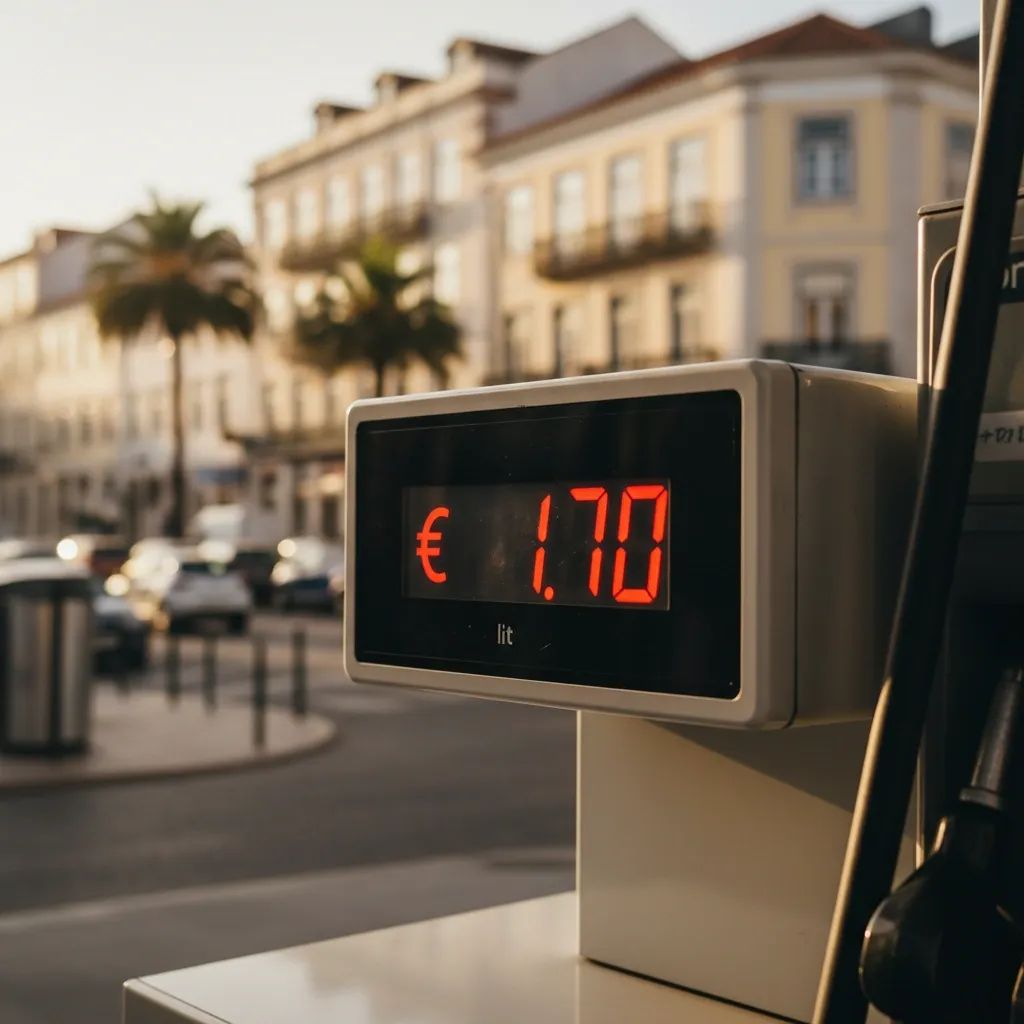
The Portugal economy faces mounting pressure as Brent crude futures for June delivery climbed above $101 per barrel on European trading floors, driven by a deepening energy crisis linked to the ongoing standoff in the Persian Gulf. The June contract closed at $101.91, marking a 3.48% jump from the prior session's close of $98.48, reflecting acute market anxiety over Middle East supply routes.
Why This Matters
• Fuel costs in Portugal: Every dollar added to Brent translates to higher gasoline and diesel prices at the pump, eroding household purchasing power and raising transport expenses.
• Inflation risk: Persistent oil price volatility threatens to reignite inflation just as the European Central Bank considers easing monetary policy.
• Supply uncertainty: The Strait of Hormuz, which channels roughly 20% of global oil trade, remains contested, with no durable ceasefire in sight.
• Business exposure: Portuguese importers and logistics firms reliant on maritime freight are facing elevated costs and scheduling chaos.
The Persian Gulf Chokepoint
The core driver of Brent's ascent is the partial closure of the Strait of Hormuz, the narrow waterway separating Iran from the Arabian Peninsula. Under normal conditions, this channel facilitates the passage of approximately 20 to 21 million barrels per day of crude and refined products destined for Asian and European markets. Since late February, Iran's Revolutionary Guard has restricted vessel transit, citing security concerns and demanding the lifting of a US naval blockade on Iranian export terminals.
Washington, under President Donald Trump, imposed the blockade following a series of strikes on energy infrastructure across the Gulf in early 2026. Despite announcing an extension to a fragile ceasefire to allow for diplomatic talks, the US has maintained its naval cordon. Teheran has conditioned any reopening of the strait on the complete removal of American restrictions, creating a circular impasse that has left global oil markets in limbo.
The result has been a supply shock of historic proportions. Kuwait, Iraq, Saudi Arabia, and the UAE collectively slashed output by an estimated 10 million barrels per day by mid-March, with projections indicating a further reduction to 9.1M barrels per day in April. Alternative pipeline routes operated by Saudi Arabia and the UAE can handle around 9M barrels per day combined, but this capacity falls well short of the 20M barrels that typically flow through Hormuz.
Market Mechanics and Price Trajectory
Brent's path since the crisis began illustrates the severity of the disruption. Trading around $70 per barrel in January, the benchmark surged past $100 in early March for the first time in four years, briefly touching $126. After a sharp correction in mid-April—when prices fell below $90 on ceasefire optimism—the market has since rebounded aggressively. On April 23, Brent traded as high as $106.22, and by April 24, June futures hovered near $105.17, reflecting a rapid reassessment of supply risk.
Fitch Ratings projected in March that if the strait remains shut for three months, Brent could average $100 per barrel for 2026, rising to $120 if the closure extends to six months, with intraday spikes potentially reaching $130 to $170. The US Energy Information Administration (EIA) forecast a peak of $115 in the second quarter before moderating to below $90 by year-end, assuming a swift resolution. Goldman Sachs has outlined a bullish scenario where persistent production losses of 2M barrels per day could push Brent to an average of $115 in Q4, or $120 if Hormuz remains largely impassable for another month.
These projections contrast sharply with the US Department of Energy's baseline estimate from January, which anticipated an average of $56 per barrel for 2026 based on ample non-OPEC+ supply growth and moderate demand. That forecast now appears obsolete in the face of geopolitical reality.
What This Means for Residents
For individuals and businesses in Portugal, the implications are both immediate and structural:
At the Pump: Retail fuel prices are poised to climb further as refiners pass through elevated crude costs. Portuguese consumers should anticipate sustained pressure on gasoline and diesel tariffs, particularly if Brent stabilizes above $100. This will directly affect household budgets and commuting expenses.
Inflation and Interest Rates: Higher energy costs feed into broader price indices, complicating the European Central Bank's mandate. If inflation proves stickier than expected, the ECB may delay or scale back rate cuts, keeping borrowing costs elevated for Portuguese mortgages and business loans.
Freight and Logistics: Portugal's import-dependent economy relies heavily on maritime shipping. Diverted cargo routes—around the Cape of Good Hope or via alternative pipelines—add time and expense. Expect delays and surcharges on goods sourced from Asia and the Middle East, including electronics, textiles, and industrial inputs.
Food and Agriculture: Fertilizer prices, sensitive to oil and natural gas costs, are rising. Portuguese farmers and agribusinesses may face margin compression, potentially feeding through to supermarket shelves in the form of higher produce and processed food prices.
Investment Climate: Portugal's attractiveness to foreign capital depends in part on macroeconomic stability. Prolonged energy market volatility introduces uncertainty that can deter investment and dampen growth prospects, particularly in energy-intensive sectors such as manufacturing and logistics.
OPEC+ and the Supply Response
In response to the crisis, OPEC+ announced in April that it would increase production by 206,000 barrels per day in both April and May. The group retains roughly 5M barrels per day of spare capacity, with Saudi Arabia accounting for 3M of that buffer. However, analysts caution that this increment is insufficient to offset the scale of the disruption. Even at maximum output, OPEC+ cannot fully replace the lost volumes from the Gulf if the strait remains closed or severely restricted.
Non-OPEC+ producers—led by Brazil, the United States, Canada, and Argentina—continue to expand output, but the pace of growth lags behind the immediate shortfall. The International Energy Agency (IEA) has warned that global supply in 2026 could fall by 1.5M barrels per day compared to 2025, while demand contracts by 80,000 barrels per day due to economic headwinds.
Diplomatic Efforts and the Fragility of Ceasefire
Diplomatic initiatives have yielded limited progress. In mid-April, Washington and Teheran agreed to a two-week ceasefire brokered by Pakistan, contingent on full reopening of the strait. Israel and Lebanon extended a separate truce by three weeks following talks in Washington. Yet these agreements have proven fragile. Reports indicate that after a brief resumption of tanker traffic through Hormuz, the channel was again disrupted following Israeli strikes in Lebanon, prompting renewed Iranian restrictions.
A 45-day ceasefire proposal advanced by mediators from Egypt, Pakistan, and Turkey awaited formal responses from both Washington and Teheran as of late April. Turkish President Recep Tayyip Erdoğan described the situation as a "geostrategic deadlock," urging the international community to intensify conflict resolution efforts.
Market participants remain skeptical. Even if a durable ceasefire takes hold, analysts agree that Brent is unlikely to return to pre-crisis levels near $65 per barrel. The precedent of weaponizing the strait has introduced a structural risk premium that will persist long after hostilities cease.
Broader Economic Repercussions
The oil shock has cascading effects beyond energy markets. The International Monetary Fund (IMF) downgraded its global growth forecast for 2026 to 3.1%, citing the Middle East conflict and resulting oil crisis as key headwinds. Oxford Economics anticipates that disruptions to maritime logistics will outlast any ceasefire, as shipping networks recalibrate and insurance premiums remain elevated.
For Portugal, the risk is compounded by its geographic position at the western edge of Europe. While the nation is less directly exposed to Middle Eastern supply routes than some continental peers, it is not insulated from global price dynamics or the knock-on effects of disrupted Asian and Gulf trade. Portuguese policymakers and the Bank of Portugal will need to monitor energy price developments closely as they assess fiscal and monetary policy settings in the months ahead.
The current episode underscores the vulnerability of oil-dependent economies to geopolitical shocks and highlights the strategic imperative of accelerating energy diversification and resilience. Until the Strait of Hormuz returns to normal operations—or alternative supply channels are decisively activated—Portugal and the broader European economy will remain hostage to developments in the Persian Gulf.