

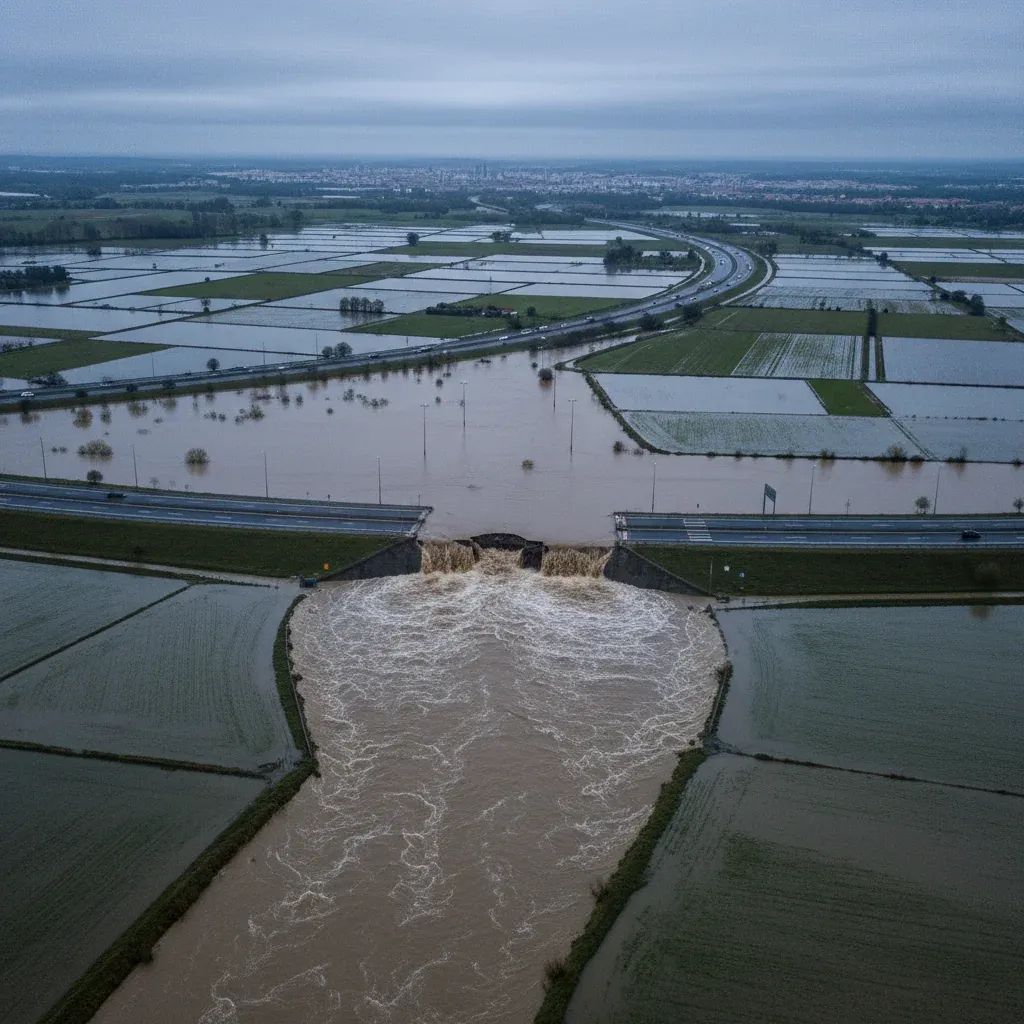
The Portugal Environment Agency (APA) has confirmed that two flood dikes on the Mondego have already failed, a development that has paralysed the country’s main north-south artery and forced thousands out of their homes.
Why This Matters
Commuting chaos
The A1 motorway around Coimbra is shut for “several weeks,” rerouting Porto-Lisboa traffic through toll-heavy alternatives.
Mandatory evacuations
About 3,000 residents in river-bank parishes have been moved, and officials warn they may be away until engineers certify the levees.
€2.5 B Government fund
Fast-track grants are promised for rebuilding homes, farms and small businesses in 68 municipalities.
Future insurance costs
With one-in-a-century floods now arriving every decade, home-cover premiums in central Portugal are likely to rise.
Where the Waters Broke
The first breach came at Casais, just north of Coimbra, during the night of 11 February. A 50-metre section of the right-bank dike gave way under a flow topping 2,100 m³/s, well above the 2,000 m³/s design limit set when the system was built in the 1970s. Water quickly undermined the concrete pillars of the A1, shearing off a lane of roadway and flooding neighbouring maize fields. Twenty-four hours later a second rupture occurred 30 km downstream in Granja do Ulmeiro (Soure). Together, the breaks have turned what locals call the Baixo Mondego into an inland lagoon and revived memories of the 2001 floods that put half of Montemor-o-Velho under water.
How Authorities Are Trying to Buy Time
Facing forecasts of rainfall equal to 20 % of a typical year in just two days, APA engineers ordered controlled releases from the Aguieira and Fronhas dams last week. The idea was to create spare storage—known as encaixe—before the worst of Depressão Nils and Depressão Kristin arrived. Even so, the river crested almost a metre above the so-called “safe threshold” at the Coimbra weir. The Portugal National Emergency and Civil Protection Authority (ANEPC) has positioned pumps and sand-filled geotextile tubes at the most fragile sections of the remaining levees. Meanwhile the Laboratory of Civil Engineering is drilling cores to see whether the clay cores of the embankments have been washed out.
What This Means for Residents
Daily life
Classes are suspended in every school on the left bank of the Mondego. Parents should watch municipal SMS alerts; reopening dates will differ by parish.
Property protection
Insurers have deployed loss-adjustment teams to Santa Clara and Taveiro. Photograph damage before removing debris—payouts hinge on dated evidence.
Travel plans
Trains on the northern line still run, but the Coimbra-B hub is operating on a reduced timetable. Expect 30–60 minute delays.
Health and safety
Stagnant floodwater brings a spike in Leptospirosis and mould-related asthma. The Coimbra health board advises boiling water for cooking until mains testing is completed.
The Bill and the Blame Game
Prime Minister Luís Montenegro has extended the state of calamity through 68 councils and earmarked up to €2.5 B in recovery grants. Opposition parties question why a 30 January inspection by the National Laboratory found “no instability” under the A1 only to see the structure collapse 12 days later. Engineers say the inspection occurred before the river’s capacity was overwhelmed. Critics counter that decades of under-investment—just €3 M a year on maintenance—left the system brittle. The resignation of the Interior Minister on 13 February underscores the political cost.
Looking Ahead
Civil engineers argue the Mondego project needs a 21st-century redesign: taller levees, a supplementary detention basin and perhaps a new flood-control dam upstream. Draft plans will be presented to Brussels next month; EU climate-adaptation funds could cover 70 % of the tab. For now, residents should brace for a slow return. River levels are falling, but hydrologists say the saturated soils will keep pressure on the dikes until at least early March. Until a full structural audit is complete, Coimbra’s lowlands—and the motorists who normally zip through them—remain at the mercy of the river.


