The United States and Israel have launched coordinated military strikes against Iranian targets across multiple cities, a massive operation that triggered immediate retaliation and ignited fears of a wider Middle Eastern war. The escalation directly affects Portugal's regional security posture, thousands of Portuguese nationals residing in the Gulf states, and could ripple through global energy markets with consequences for fuel prices and economic stability.
Why This Matters
• Portuguese nationals at risk: The Portugal Foreign Ministry has activated emergency protocols for citizens in the Middle East, urging compliance with local shelter orders and embassy contact.
• Airspace closures: Major carriers including TAP-connected partners have suspended regional flights, stranding travelers and disrupting cargo routes.
• Energy shock incoming: Iran's retaliation against Gulf infrastructure threatens global oil supply routes, with immediate implications for Portugal's import costs.
• Alliance pressure: The European Union's "grave concern" statement signals diplomatic friction as Portugal navigates its NATO commitments and economic interests in the region.
Impact on Portuguese Travelers and Nationals Abroad
Approximately 3,000 to 5,000 Portuguese nationals work across the Gulf states, concentrated in the UAE, Qatar, and Saudi Arabia, primarily in engineering, construction, hospitality, and finance sectors. The Foreign Ministry's emergency protocols signal that these residents should prepare for extended shelter-in-place periods, potential communication blackouts, and disruption to banking and supply chains.
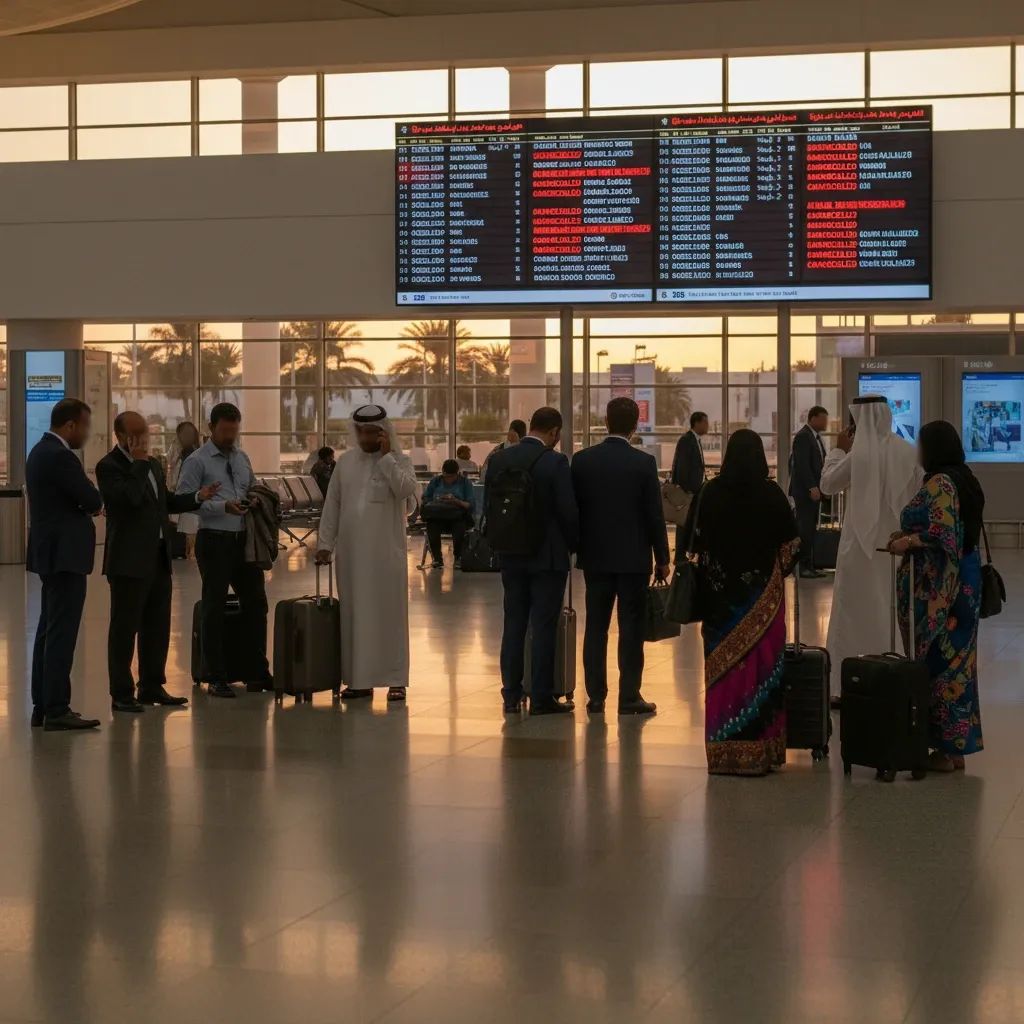
Portuguese travelers transiting through Gulf hubs—Dubai, Doha, Abu Dhabi—face immediate cancellations and rebooking challenges. TAP Air Portugal, which codeshares with multiple Gulf carriers, has suspended regional operations and is coordinating with partners to reroute affected passengers through European or North African airports.
What Portuguese nationals should do now:
• Register with the nearest Portuguese embassy or consulate immediately if not already registered
• Remain indoors and follow local authority directives
• Maintain contact with embassies or the Emergency Consular Office
• Monitor embassy communications for evacuation orders or guidance updates
• The Consular Emergency Office operates a 24-hour hotline: +351 217 929 100 (or contact the nearest Portuguese embassy directly)
The Foreign Ministry has activated contingency plans for mass notification via SMS and email to registered citizens abroad. Those requiring assistance should contact their nearest Portuguese diplomatic mission without delay. Emergency evacuation flights have not yet been chartered but are being prepared as precautionary measures.
Scope of Military Operations
Targets spanned Iranian population centers including Tehran, Isfahan, Qom, Karaj, and Kermanshah. AFP journalists in Tehran reported two massive detonations followed by thick smoke columns rising from the capital's center and eastern districts. Iranian state media confirmed strikes reached beyond Tehran to major religious and industrial hubs.
Iran's Islamic Revolutionary Guard Corps confirmed through a statement to the Tasnim news agency that its missiles and drones struck multiple installations across the Gulf region. Residents across the UAE, Qatar, Bahrain, and Kuwait reported explosions and air defense interceptions throughout the day.
Regional Impact and Casualties
In Abu Dhabi, the UAE Ministry of Defense confirmed that falling missile debris killed one Asian civilian in a residential neighborhood. In Qatar, multiple detonations were heard over central Doha and near Al-Udeid Air Base. Bahrain evacuated residents near a Fifth Fleet facility hit by a missile strike.
Italian Deputy Prime Minister and Foreign Minister Antonio Tajani reported that an Iranian missile caused significant runway damage at an air base hosting Italian Air Force personnel, though no Italian military casualties were recorded. Kuwait's air defense systems intercepted missiles over national airspace, while explosions echoed across Riyadh in Saudi Arabia.
In Iraq, bombardment targeted military bases hosting Iraqi armed factions and American forces. Syria's official news agency reported four deaths after an Iranian missile fell in the country's south.
Civilian Toll
Iranian state-run media reported that the death toll from a strike attributed to Israel on a girls' primary school in Minab, southern Iran, climbed to 53 by midday, with estimates suggesting between 40 and 60 children injured. IRNA news agency indicated that 170 students were present when the attack occurred, with victims aged 7 to 12. Footage broadcast on Iranian state television showed destruction in Tehran, including a crater, smoke plumes, and damaged buildings.
The Brazilian government issued a statement condemning the attacks and expressing "grave concern," calling for maximum civilian protection and restraint to prevent further escalation. The strikes occurred amid weeks of heightened tensions and massive anti-government protests in Iran. Human rights monitoring groups have documented thousands of deaths in the Iranian regime's crackdown on dissent.
What This Means for Residents in Portugal
The escalation carries direct economic and personal implications for people living in Portugal:
• Travel disruptions: Air France, Lufthansa, British Airways, Turkish Airlines, and multiple regional carriers suspended flights. Airspace closures affect Iran, Israel, Qatar, Iraq, Syria, Kuwait, Bahrain, and the UAE, stranding travelers and delaying cargo shipments including perishable goods.
• Energy costs: Iran holds significant sway over the Strait of Hormuz, a chokepoint for roughly one-fifth of global oil supply. Any disruption to this route or Gulf production facilities will translate rapidly into higher fuel prices at Portuguese pumps and increased costs for transportation-dependent sectors.
• Financial market volatility: Historical precedent from Middle Eastern conflicts shows immediate spikes in crude oil benchmarks, currency fluctuations, and equity market declines. Portuguese pension funds, investment portfolios, and business supply chains exposed to energy-intensive industries face near-term headwinds.
• Supply chain delays: Airspace closures and maritime rerouting disrupt cargo flows, delaying shipments of electronics, textiles, and agricultural products that transit through Gulf hubs. Portuguese retailers and manufacturers with just-in-time inventory models face immediate strain.
• Diplomatic positioning: Portugal's dual commitments as a NATO member and as a nation with economic ties across the Gulf present a delicate balancing act. Brussels has issued statements calling developments "very worrying" and reaffirming the EU's "firm commitment to safeguarding regional security and stability."
European Response and Diplomatic Pressure
A joint statement from the European Commission and the European Council characterized the situation as "very concerning," reaffirming the EU's "firm commitment to safeguarding security and regional stability." Spain and China have issued formal condemnations of the military action, while other capitals await further developments before committing to public positions.
For Portugal specifically, the government faces pressure to articulate a clear stance that balances NATO solidarity, EU coordination, and protection of national interests. Portuguese firms with contracts in Gulf states, particularly in construction, renewable energy, and logistics, require stability to operate. Any prolonged conflict threatens those investments and the jobs they support domestically.
Economic Outlook
Although immediate market data remains preliminary, historical patterns from previous Gulf conflicts suggest Portugal should brace for several economic ripples:
• Fuel prices: Crude oil benchmarks typically spike 10-30% in the opening days of major Middle Eastern military operations. Portugal's dependence on imported petroleum for transportation and industry means those increases pass directly to consumers and businesses.
• Financial contagion: European equity markets typically react negatively to geopolitical instability. Portuguese pension funds and retail investors with international exposure will see portfolio volatility.
The European Central Bank and national finance ministries across the Eurozone have yet to issue formal guidance, but internal discussions likely focus on inflation risks, potential coordinated responses, and contingency planning.
What Comes Next
Expert assessments suggest further developments will unfold based on the extent of damage inflicted by the strikes and regional actors' assessments of escalation risks. The risk of further regional tension remains. Iran possesses the Middle East's largest ballistic missile and drone arsenal, and its demonstrated willingness to strike across the Gulf demonstrates the complexity of the security landscape.
For Portuguese nationals in the region, the Foreign Ministry's guidance is unambiguous: stay indoors, monitor embassy communications, and prepare for possible evacuation orders. The government continues to coordinate with EU partners and local authorities to ensure access to safe zones and transportation corridors should the situation deteriorate.
The coming days will clarify whether this operation represents a contained, targeted strike or the opening phase of a broader confrontation. Portugal's challenge is to protect its citizens, safeguard its economic interests, and contribute constructively to diplomatic efforts aimed at de-escalation—all while navigating the complex web of alliances, commercial relationships, and humanitarian concerns that define Europe's role in the Middle East.