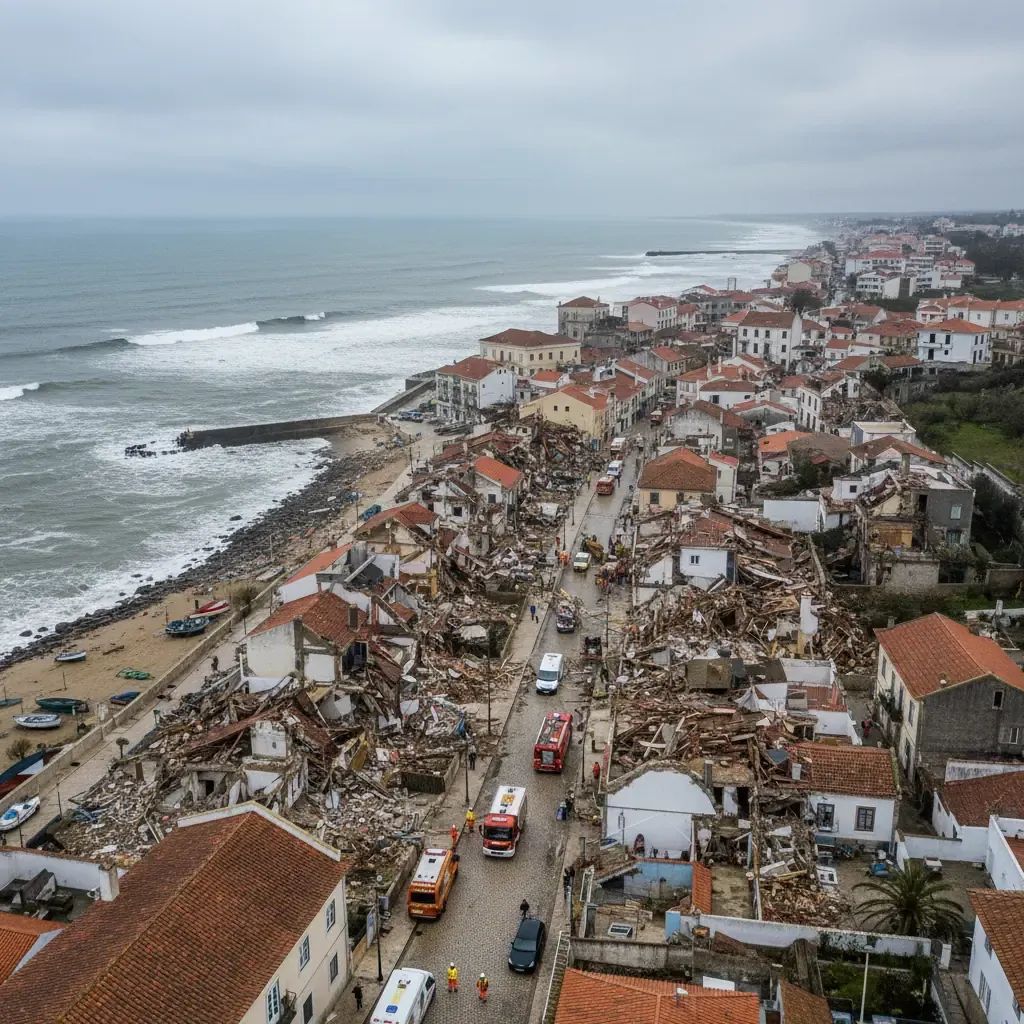
The Marinha Grande municipal government has submitted a revised damage assessment to regional authorities, now quantifying losses from January's storm system at €143 million (M), a figure that excludes private sector devastation and signals one of the costliest natural disasters in the district of Leiria's recent history.
Why This Matters:
• Municipal services face years of reconstruction: Schools, drainage systems, social housing, and cultural facilities sustained structural damage requiring multi-year repair timelines.
• National funding mechanisms available: The Portugal Cabinet has established credit lines and direct subsidies for households and businesses nationwide to support recovery efforts.
• Private sector losses uncounted: The official €143 M figure omits industrial damage, meaning the true economic toll for this manufacturing hub remains unknown.
• Recovery workers faced risks: More than half of the 19 deaths attributed to storms Kristin, Leonardo, and Marta occurred during cleanup operations, underscoring the hazards of disaster response.
The Anatomy of €143 M in Public Losses
Marinha Grande's municipal services transmitted detailed damage maps to the Regional Coordination and Development Commission (CCDR Centro) this week, itemizing destruction across public infrastructure, parish assets, and community institutions. The breakdown reveals where the storm hit hardest:
Municipal infrastructure absorbed €132 M in damage, encompassing roads, drainage networks, parks, and public buildings. Within that total, social housing sustained €30.45 M in losses—equivalent to roughly a year's municipal housing budget for many smaller councils. School facilities accounted for €28 M, forcing temporary relocations and hybrid learning arrangements that continue to disrupt families. Sports complexes required €10 M in repairs, while drainage systems—critical for preventing future flooding—need €10 M to restore functionality.
Cultural assets suffered €3 M in damage, and urban parks require €6 M for rehabilitation. Smaller but essential repairs include €500,000 for vertical signage, €350,000 for cobblestone pavements, and €200,000 for traffic signals. Pedestrian walkways and cycle paths, increasingly important for sustainable urban mobility, need €3 M to return to service.
Parish councils across the municipality reported €1.13 M in localized damage, while private social solidarity institutions, associations, community organizations, and religious entities tallied €10 M in losses. These organizations often provide critical social services—childcare, elder care, food assistance—making their rapid restoration a municipal priority.
The Corporate Impact
The €143 M assessment conspicuously omits the industrial sector, which forms the economic backbone of Marinha Grande, historically renowned for glass and mold manufacturing. Mayor Paulo Vicente acknowledged that businesses experienced "very high losses" in equipment, raw materials, machinery, warehouses, and prolonged production stoppages.
The scale of disruption was substantial: roughly 90% of local companies were affected by storm Kristin. A single glass packaging producer in the municipality—responsible for manufacturing between 8 and 10 million bottles daily—shut down for four consecutive days, halting export shipments. A molds and plastics group saw two of its five facilities "totally destroyed," with damage estimates still being calculated. Approximately 2,000 damage assessment requests flooded the municipal support desk in the storm's immediate aftermath.
Without a comprehensive private-sector inventory, the true economic impact remains unclear, complicating efforts to secure proportional state and European Union disaster relief funding.
From €118 M to €143 M: The Damage Deepens
The municipality's preliminary assessment on February 24 placed losses at €118 M, with municipal buildings alone accounting for more than €20 M. The subsequent revision to €143 M reflects deeper technical evaluations and the discovery of secondary damage—structural weaknesses, compromised foundations, and degraded electrical systems—that only became apparent as engineers conducted thorough inspections.
Vicente described the situation as "one of the greatest destructions recorded in the municipality in recent decades," emphasizing the "overwhelming" scale that affects not only infrastructure but also the institutions "that play an essential role in supporting the community."
What This Means for Residents
For households, the immediate impact manifests in disrupted public services, detoured commutes, and delayed municipal programs. Schools operating at partial capacity or in temporary facilities complicate childcare and work schedules. Damaged drainage systems elevate flood risk during spring rains, and non-functional sports and cultural venues eliminate recreational outlets.
The municipal government is coordinating with regional and national authorities to activate support mechanisms for affected residents and businesses. Mayor Vicente emphasized the municipality's commitment to ensuring "no one is left behind," with plans to accelerate procedures for restoring normal conditions to families, institutions, and public spaces.
The Broader National Picture
Marinha Grande sits within a broader disaster zone. Storms Kristin, Leonardo, and Marta battered Portugal's mainland for approximately three weeks starting January 28, with the Centro, Lisbon and Tagus Valley, and Alentejo regions bearing the brunt. Nationwide, the storms caused at least 19 deaths, hundreds of injuries, and mass displacement. Thousands of homes, businesses, and public facilities sustained total or partial destruction. Infrastructure collapsed: trees fell, power lines snapped, water supplies failed, and communications networks went dark.
National damage estimates reach into the thousands of millions of euros, though no consolidated figure has been published. The Recovery Mission Structure for the Centro Region, headquartered in Leiria, was established to coordinate reconstruction efforts among ministries, municipalities, the CCDR, social sector entities, and private companies.
The Road Ahead
Reconstruction "will be a demanding process, requiring substantial resources and coordinated work between local, regional, and national entities," according to municipal leadership. Timelines remain uncertain. School repairs could stretch into the next academic year. Housing reconstruction depends on the pace of assistance approvals and contractor availability. Industrial recovery hinges on whether businesses can access financing and support quickly enough to prevent bankruptcies or relocations.
For residents navigating this recovery phase, the key steps are:
Document all damage with photographs and receipts.
File insurance claims immediately, as state assistance is coordinated with private coverage.
Register damage with the municipality or parish council to enter official assessments.
Monitor announcements from municipal and regional authorities for application deadlines on housing and business support.
Contact municipal offices for information about available recovery assistance programs.
The storms exposed vulnerabilities in drainage, building codes, and emergency preparedness that will likely drive policy reforms. For now, Marinha Grande's focus remains on stabilization: making schools safe, restoring mobility, and preventing a second wave of economic damage as businesses decide whether to rebuild or relocate.