The Hidden Cost of Storm Kristin: Inside Marinha Grande's €118 Million Reckoning
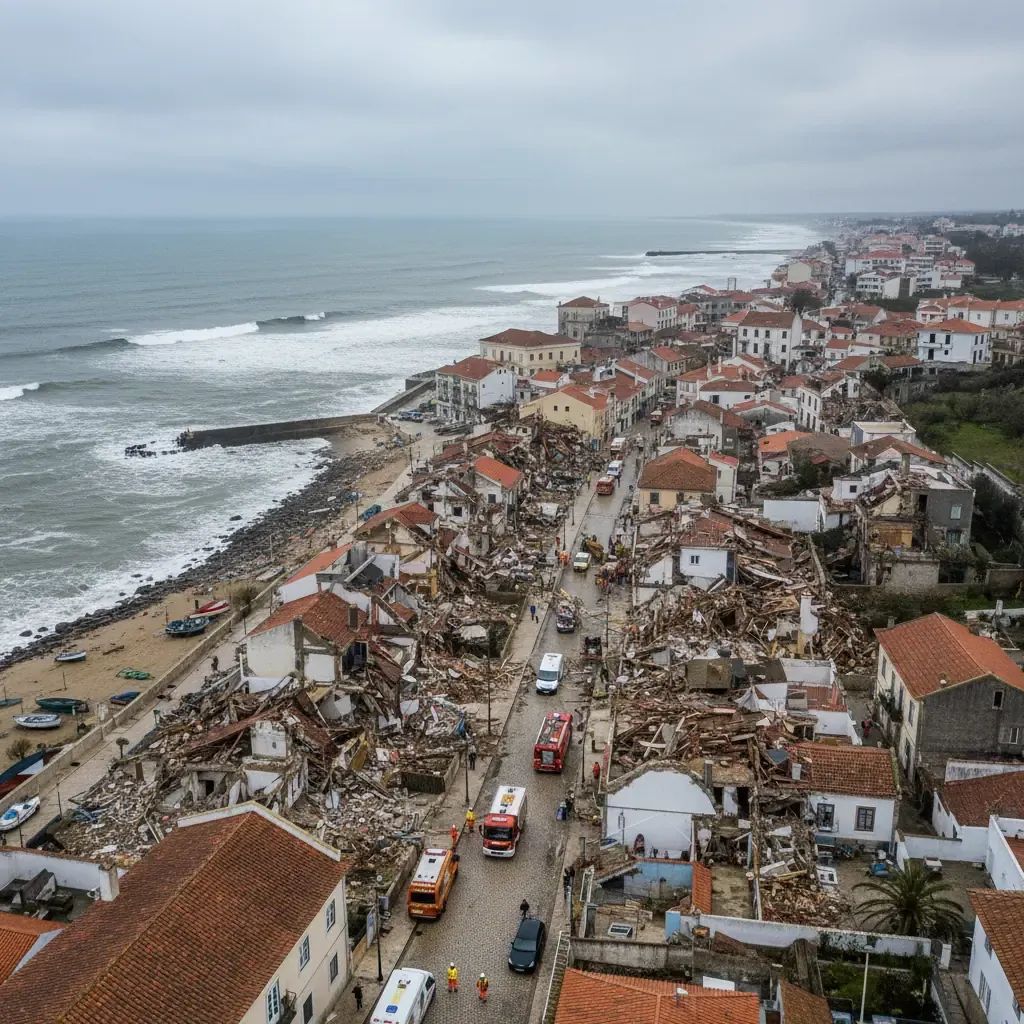
The Municipality of Marinha Grande is facing a financial and infrastructure crisis that has no parallel in recent regional memory. Preliminary damage surveys conducted by municipal teams confirm losses exceeding €118 million following the violent atmospheric depression that swept through on 28 January, a figure that excludes significant portions of the private sector and several heritage properties still undergoing technical assessment. For residents and business operators in this glass-manufacturing hub on Portugal's central coast, the recovery will reshape daily life, employment prospects, and municipal finances for years to come.
What Happened and Why Scale Matters
Storm Kristin arrived as an explosive cyclogenesis—meteorologists describe it as a "bomb cyclone"—that intensified with brutal speed over the Atlantic before making landfall near Marinha Grande in the pre-dawn hours. The depression severed electrical power, water supply, and mobile communications across the entire jurisdiction simultaneously, forcing immediate activation of the Municipal Emergency Plan and mobilizing every available municipal resource plus civil protection agents from across the region.
The immediate aftermath was near-total paralysis. Within hours, authorities had activated two emergency concentration zones to shelter and feed displaced persons. The municipality's preliminary accounting now breaks down the damage across dozens of asset categories, revealing an economic disaster far wider than the headline figure suggests.
The Anatomy of Destruction: Where €118 Million Went
Public buildings and facilities absorbed the largest single impact. Municipal structures themselves suffered over €20 million in damage, while the school system—traditionally fragile infrastructure in any storm—took €28 million in destruction. Social housing estates, populated largely by lower-income families with few liquid reserves, recorded €30.45 million in necessary repairs, making this category the single costliest item on the damage ledger.
Recreational and cultural infrastructure sustained €13 million combined: sports facilities (€10 million), parks and green spaces (€6 million), and cultural equipment (€3 million). The numbers may seem discrete, but they represent closed swimming pools, unusable playing fields, and shuttered exhibition halls that anchor community life for residents.
Underground and often-invisible systems absorbed substantial harm. Stormwater and wastewater networks require €10 million in reconstruction, indicating that subsurface piping and drainage channels—typically out of sight and therefore overlooked in disaster planning—collapsed or filled with sediment. Urban boardwalks and bicycle paths favored by residents need €3 million to restore. Even modest infrastructure items added up: vertical signage (€500,000), paved sidewalks and calçada patterns (€350,000), traffic lights (€200,000).
A portion of damage remains unquantified. The Casa-Museu Afonso Lopes Vieira and the heritage complex known as FEIS (Fábrica Escola dos Irmãos Stephens)—both sites of historical and cultural significance—are undergoing detailed technical evaluation. Preliminary assessments suggest substantial conservation costs ahead, though final tallies have not been released.
One critical detail often buried in recovery narratives: the Mata Nacional de Leiria, a vast planted pine forest occupying roughly two-thirds of Marinha Grande's territory, suffered catastrophic damage. Approximately 1,200 hectares of mature pine forest that had survived the 2017 wildfires were "snapped or uprooted almost entirely." That debris now poses an extraordinary wildfire hazard heading into the 2026 fire season, a secondary disaster risk that municipal fire brigades are already flagging as urgent.
A City's Economic Spine Fractured: 90% of Businesses Damaged
The true gauge of Kristin's impact emerges in the business community's wounds. Municipal authorities documented that an estimated 90% of enterprises operating in Marinha Grande sustained some degree of damage, a figure that reflects both the storm's violence and the city's concentration in sectors—glass manufacturing, precision moulding, plastics—that operate from facilities vulnerable to wind and water incursion.
The municipal support desk created to intake damage claims processed approximately 2,000 requests in the immediate aftermath, predominantly from small and medium-sized firms lacking capital reserves or comprehensive insurance. Many operate with policies that exclude wind damage entirely or cap payouts far below replacement cost. For workshops and fabrication plants, downtime translates instantly into missed contracts, broken supply commitments, and erosion of client confidence.
The Banco Português de Fomento (Portuguese Development Bank) has mobilized two distinct credit lines to bridge the insurance and equity gap. A €1 billion reconstruction facility covers up to 100% of validated losses, with a 10-year payback window and a 36-month grace period before repayment obligations commence. A parallel €500 million liquidity line addresses immediate cash-flow crises—payroll, material costs, utilities—while physical reconstruction unfolds.
Yet bureaucratic friction remains substantial. Applications require detailed documentation: invoices, photographs, structural reports, insurance claims correspondence. Small operators without formal accounting infrastructure or current tax filings face material barriers to access. Early reports from the municipal desk suggest average processing time is running 4 to 6 weeks, far longer than many businesses can sustain without bridge financing.
1,150 Households in Recovery Mode: The Human Tally
When the emergency sweep concluded, municipal social services had identified 1,150 households requiring structured follow-up—a cohort representing roughly 5,000 to 6,000 individuals depending on average household size in the region. Critically, half of these families were newly identified as a direct result of the storm, suggesting that Kristin exposed vulnerabilities in the social fabric that had previously gone undetected.
The Segurança Social (Portugal's social security agency) has mobilized an emergency apparatus. A dedicated hotline (300 51 31 31, weekdays 09h00–17h00) fields inquiries about extraordinary assistance programs. The agency deployed roving social workers and opened Espaços Cidadão drop-in offices equipped with internet terminals in the 68 (later expanded to 90) municipalities declared under calamity status.
At the municipal level, the distribution of aid has been methodical and substantial. The municipality has handed out 18,183 emergency baskets containing essentials—canned food, bottled water, hygiene products, blankets, temporary shelter materials. An additional 7,680 vouchers were issued for the collection of building materials—lumber, corrugated metal, plastic sheeting—needed for emergency repairs. Daily meal services operated at scale during peak relief: roughly 150 lunches and 200 dinners per day were prepared and distributed to affected families.
Two emergency sheltering zones operated during the critical phase but have since been deactivated, meaning families have either returned to repaired homes or sought temporary private accommodation. For those whose primary residences remain uninhabitable, the government's "O Turismo Acolhe" programme—which mobilizes hospitality operators to provide temporary lodging—has become a critical safety net.
If You Live Here: The Practical Roadmap for Recovery
For business operators: Contact the municipal damage-assessment office to file your claim, then immediately apply to the BPF reconstruction facility. Gather invoices, photographs (dated immediately after the storm), contractor quotes, and any insurance documentation. If you need to temporarily reduce your workforce while awaiting reconstruction financing, the simplified lay-off regime (layoff simplificado) allows you to furlough employees while the state covers a portion of wages, preserving jobs until revenue recovers. Tax filing deadlines have been extended to 30 April 2026 for all entities based in declared-calamity zones.
For residents with primary homes damaged: File an application with Segurança Social (online, by phone, or at your local Espaço Cidadão) requesting emergency subsidies and construction-material vouchers. Document everything: photographs, contractor estimates, municipal inspection reports. If your home qualifies as your legal habitação própria e permanente (permanent primary residence) and you have documented income loss, you may receive direct repair grants even without insurance coverage. Mortgage institutions have been instructed to grant payment moratoria to homeowners whose repair bills have left them underwater on existing loans.
For residents of social housing: Monitor communications from the municipal housing office. The €30.45 million earmarked for repairs will unfold over many months due to procurement complexity. Units requiring extensive structural work may face prolonged closure. The municipality is assisting displaced residents in accessing temporary accommodation while repairs proceed.
For parents and schoolchildren: As of mid-February, 29 schools had completed safety inspections and reopened, some operating in temporary formats (modular classrooms, borrowed parish halls, relocated libraries). The Ministry of Education is conducting a full review of the school network to accelerate structural interventions and impose new resilience standards. No school will reopen without a comprehensive safety vetting signed by municipal engineers. Some facilities will likely remain closed into the spring term.
For cultural visitors: The Museu do Vidro (Glass Museum), Casa-Museu Afonso Lopes Vieira, and Museu Joaquim Correia remain closed pending structural assessment and conservation triage. No reopening dates have been announced. Some artifacts, particularly at the Afonso Lopes Vieira residence, face prioritization decisions as conservation teams assess survival and restoration cost-benefit.
The Broader Context: Kristin as Part of a Sequence
Kristin was the leading edge of a three-storm sequence that battered Portugal's Centre region and Atlantic coast throughout late January and early February. The depression's successors—Leonardo and Marta—added cumulative damage, though Kristin bore the primary destructive burden. Collectively, the three systems claimed 18 lives nationwide, caused over €5 billion to €6 billion in total estimated damage, and affected nearly every municipality in the Centre, Lisbon Valley, and Alentejo regions.
Within the Diocese of Leiria-Fátima—which encompasses Marinha Grande, Leiria, Batalha, Porto de Mós, Ourém, Pombal, Alcobaça, and neighboring jurisdictions—approximately half of all churches sustained wind or water damage. Diocese officials estimate €12 million in heritage-restoration needs, a figure that speaks to the intensity and geographic sweep of the meteorological event.
The government initially declared 68 municipalities under calamity status in late January, a designation that triggered emergency economic measures and simplified bureaucratic procedures. On 25 February, the Cabinet expanded the calamity zone to 90 municipalities, acknowledging that damage assessments in rural and interior areas were still underway and that secondary impacts—agricultural losses, forestry damage, rural infrastructure deterioration—required inclusion.
National Response and Political Reckoning
Peak emergency response mobilized an estimated 40,000 operatives daily—firefighters, civil protection personnel, military engineers, health teams, and municipal staff. Teams cleared over 5,000 kilometers of roads, stabilized reservoirs and river systems, and worked to restore electrical, water, and telecommunications infrastructure.
The electrical restoration achieved visible speed: more than 1 million users were reconnected within days. However, as of 20 February, approximately 4,500 customers of E-Redes (the distribution operator) in the hardest-hit zones around Leiria, Santarém, and Coimbra remained without power due to destroyed transmission lines and tower collapses.
The government's crisis response has attracted public scrutiny. An opinion poll conducted 4 February revealed 43% of Portuguese expressing criticism of official response, versus 23% offering approval. The verdict reflected both communication shortcomings and uneven municipal readiness, factors that complicated relief delivery even as the state mobilized substantial human and financial resources.
Recovery, Not Restoration: What Comes Next
The Municipality of Marinha Grande has formally pivoted from emergency operations to structural recovery, with explicit focus on economic restart, infrastructure rehabilitation, and the framing of losses for qualification under state support mechanisms. The decision to cancel the 2026 Festas da Cidade (City Festival)—a major annual celebration and revenue driver—signals the fiscal strain and redirected priorities. All municipal funds and personnel capacity are being concentrated on recovery work.
Residents should expect rolling construction tenders, street-level disruptions, and incremental service restoration through at least the second quarter of 2026. Heritage assessments at Afonso Lopes Vieira and the FEIS site will continue, with both sites eligible for national heritage-restoration grants given their architectural and historical significance.
The €118 million figure is not an anomaly or a worst-case outlier. It is a harbinger. As Atlantic cyclogenesis intensifies—a trend tied to ocean warming and shifting atmospheric pressure patterns—coastal and forested municipalities in Portugal face a new fiscal baseline characterized by destructive events occurring at shorter intervals than traditional infrastructure planning cycles can accommodate. Marinha Grande's recovery will test whether Portugal's state support mechanisms are adequate, whether insurance coverage truly protects households and businesses, and whether the nation will invest in climate-hardened infrastructure or accept repeat disasters as a normal operating cost of residence in this region.