

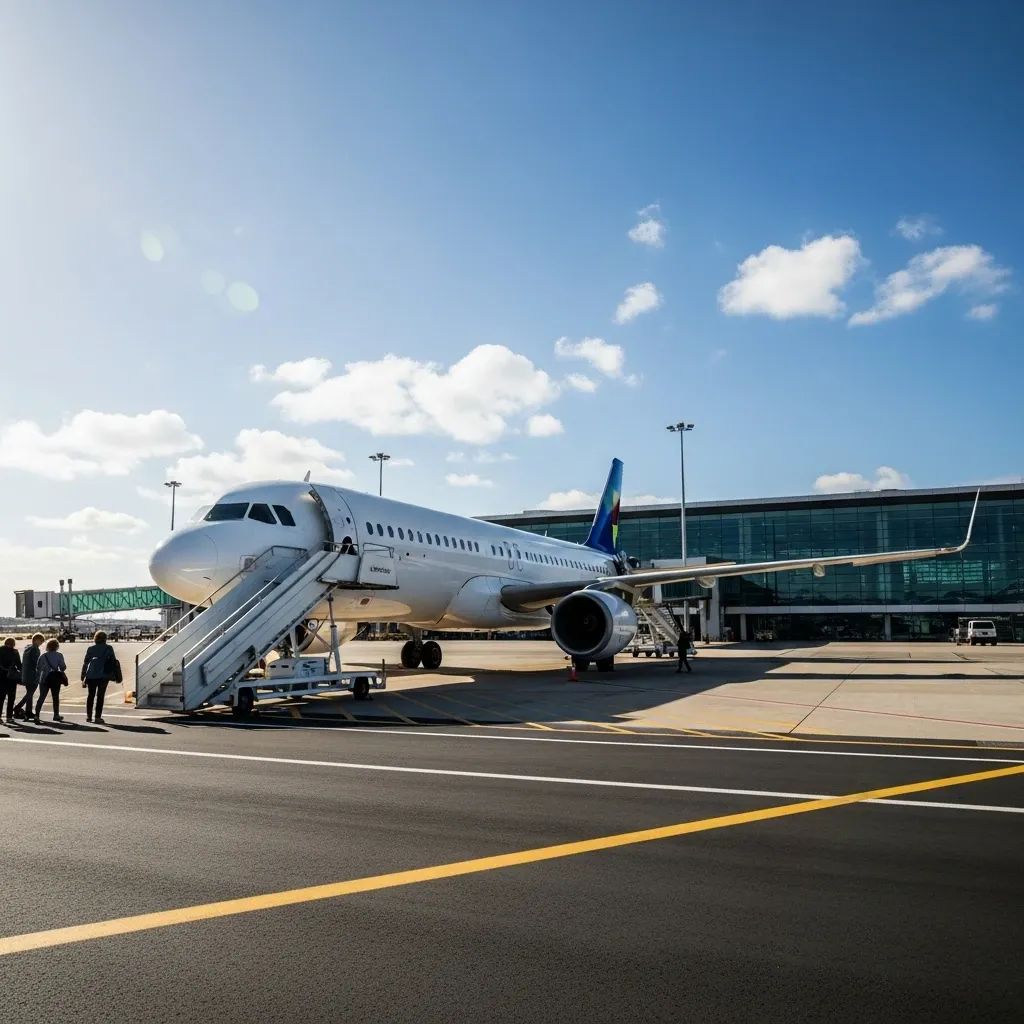
Demand for low-cost flights across Europe is still growing, yet Ryanair’s latest results show that even the continent’s largest budget carrier is not immune to legal and cost pressures. The airline ended the October-to-December quarter with just €30 million in net profit—far below what shareholders have become accustomed to—after setting aside cash for a disputed Italian antitrust penalty. Still, the carrier moved a record 47.5 million passengers, lifted ticket prices, and reaffirmed a full-year outlook that would leave most rivals envious.
Quick take
• Profit collapses to €30 million because of an €85 million provision linked to an Italian fine.
• Underlying earnings would have reached €115 million, still 22 % lower than last year.
• Revenue climbs 9 % to €3.21 billion on the back of a 6 % jump in passengers and 4 % higher fares.
• Management keeps full-year profit guidance at €2.13–2.23 billion before exceptional items.
• Portuguese travellers can expect more routes, but likely not cheaper seats, this summer.
Why this matters for Portugal
For residents on the western edge of Europe, Ryanair’s network is often the cheapest bridge to family, business and leisure destinations. The Irish carrier now offers more than 140 routes from Lisbon, Porto, Faro and Ponta Delgada, giving it an out-sized role in setting airfare trends at Portuguese airports. A weaker balance sheet could, in theory, chill expansion. Instead, the company is doubling down on the Iberian market, encouraged by Portugal’s strong inbound tourism and its own cost advantage over TAP and other competitors. Ryanair’s traffic through Portuguese airports has risen 18 % year-on-year, according to ANA Aeroportos data, and the airline expects that momentum to continue as new Boeing 737-8200 “Gamechangers” arrive.
Fine print: the Italian penalty that stung
The headline plunge in profit traces almost entirely to an €85 million exceptional charge—roughly one-third of a €256 million fine slapped on the carrier by the Autorità Garante della Concorrenza e del Mercato for alleged abuse of market power in ancillary services. Ryanair calls the accusation “baseless”, has lodged an appeal and says its lawyers are confident of overturning the ruling. Without that hit, after-tax earnings would still have fallen to €115 million, squeezed by the absence of last year’s Boeing delivery compensation and higher operating bills. Even so, CFO Neil Sorahan told analysts that the company’s BBB+ credit rating and unencumbered fleet make the provision manageable.
Planes full, coffers fuller: traffic and pricing trends
Passenger numbers rose to 47.5 million with load factors steady at 92 %. Crucially, the average fare crept up to €44, reflecting robust demand in the mid-term school break and late Christmas bookings. Ancillary income—everything from bag fees to priority boarding—grew 7 % to €1.11 billion, now accounting for one-third of total revenue. For travellers in Portugal, that usually translates into cheap base fares supplemented by extras such as the popular “Family Plus” bundle. Ryanair opened three new seasonal bases and 106 fresh routes for the coming summer, many funnelling sun-seekers through Lisbon, Porto and Faro to secondary cities across Europe.
Keeping costs on a short leash
Operating expenses before the special charge rose 6 % to €3.11 billion, broadly in line with the expansion in traffic. Unit costs therefore stayed flat—an achievement at a time of volatile fuel prices. Hedge contracts have locked in 84 % of Q4 jet fuel at $77 per barrel and 80 % of FY 2027 needs at $67, providing visibility that legacy carriers often lack. The ongoing delivery of high-density 737-8200 jets, able to carry 4 % more passengers on 16 % less fuel, will further suppress per-seat costs. Ryanair also plans to retire its last €1.2 billion bond in May using internal cash, leaving the balance sheet effectively debt-free.
Looking ahead: guidance and storm clouds
Chief executive Michael O’Leary maintained guidance for €2.13–2.23 billion in pre-exceptional profit for the fiscal year ending 31 March. That would represent growth of up to 38 % versus FY 2025, helped by an expected 4 % rise in passenger numbers to 208 million. Yet management warns that the final quarter could still be rattled by geopolitical shocks, air-traffic-control strikes and wider macro headwinds. The muted capacity growth caused by Boeing delivery delays has paradoxically supported pricing: with supply tight, Ryanair expects average fares for the full year to run 1–2 percentage points above its earlier forecast of 7 % growth.
What Portuguese flyers should watch
For consumers here, the big takeaway is that Ryanair remains in aggressive expansion mode despite the legal hiccup. Expect:
More point-to-point services from Porto and Faro, especially to Mediterranean leisure spots.
Continued use of ancillaries to drive profitability—bags and seat selection are unlikely to get cheaper.
A summer schedule that prioritises high-yield routes where airport charges are low; municipalities that cut fees, as Madeira did last year, may gain new connections.
Relatively stable ticket prices in the shoulder months, given the airline’s capacity discipline.
In short, while the Italian fine bruised the quarter’s bottom line, Ryanair’s underlying engine of cheap seats and disciplined costs remains intact—good news for Portuguese travellers hunting value, but a reminder that the real price of a flight often reveals itself only after the extras are tallied.


